



New Delhi: At the ongoing World Book Fair 2026 in New Delhi, the Abu Dhabi-based Muslim Elders Council organised a thought-provoking panel discussion on “AI for Humanity: Religious Perspective on Ethical AI”.
The session was chaired by former diplomat Dr Zikrur Rehman, who earlier served as India’s Ambassador to the erstwhile Palestinian Authority and as Consul General in Riyadh.
Journalism Must Retain Its Human Core
Renowned journalist and President of the Editors Guild of India, Sanjay Kapoor, asserted that reporting remains one of the most powerful human occupations, even in the age of Artificial Intelligence (AI).
However, he cautioned that many news organisations are cutting back on field reporting and becoming increasingly dependent on internet-based content.
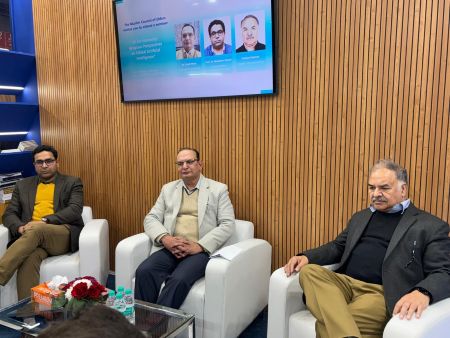
Experts discuss AI, ethics and the future of media at World Book Fair
Referring to tech entrepreneur Elon Musk, Kapoor noted that while Musk once suggested that plumbers may outlast journalists in the AI era, the real threat emerges when journalists limit themselves to merely asking questions. “In doing so, reporters themselves are strengthening AI,” he said.
Kapoor warned that the Indian media community is still not fully aware of AI’s disruptive potential. Tools like ChatGPT, he pointed out, are already capable of producing better-structured content than an average journalist.
“If journalism loses emotional depth, ground reporting and lived human experience, AI will replace journalists—and people may not even realise when it happens,” he cautioned.
He strongly emphasised the need for regulation, ethical oversight and institutional accountability to curb misinformation.
Academia, Ethics and the Balance with Technology
Dr Mudassar Qamar, Assistant Professor at Jawaharlal Nehru University, described the evolution of AI in academics as both a significant achievement and a cause for concern.

AI’s promise and peril across societies
He noted that AI tools now assist with everything from literature reviews and reference lists to grammar checks.
While acknowledging that over-dependence on AI risks making research mechanical and uncreative, Dr Qamar also highlighted its benefits, particularly for students facing language barriers.
He stressed that educators and students must strike a careful balance between caution and constructive use of AI.
AI Can Assist Journalism, Not Replace It
Senior analyst and columnist Asad Mirza underlined that AI should be viewed as a tool for journalism, not a substitute. He cited an experiment by the Italian newspaper Il Foglio, which last year published a four-page supplement created entirely by AI—from news selection to layout.
According to Mirza, when the British daily The Guardian analysed the AI-generated supplement, it found the technical aspects impressive but concluded that the human element was missing. “The content had accuracy and structure, but lacked emotion and connection with readers,” he said.

AI as an assistant, not a replacement, in journalism
Mirza argued that while AI can enhance efficiency and content creation, human supervision remains indispensable. “Without a human touch, news cannot truly connect with readers or meet their expectations,” he said.
Addressing the religious dimension, Mirza cited Quranic references to explain that Islam does not prohibit the use of AI.
On the contrary, he said, the faith encourages the use of new resources to improve human life, as long as they do not violate ethical or moral boundaries.
Also Read: The AI Hype: Separating Fact from Fiction
“Artificial intelligence is permissible in Islam, except in matters of worship, provided it does not fall under prohibition,” he concluded. 
_________
Also Read:
Subtle Prejudices: Sexism in Boardrooms, Bureaucracy and Public Spaces
Young, Unskilled, Unemployed: How India’s Demographic Advantage Is Slipping Away

Team PT
punjabtodaynews@gmail.com
Disclaimer : PunjabTodayNews.com and other platforms of the Punjab Today group strive to include views and opinions from across the entire spectrum, but by no means do we agree with everything we publish. Our efforts and editorial choices consistently underscore our authors’ right to the freedom of speech. However, it should be clear to all readers that individual authors are responsible for the information, ideas or opinions in their articles, and very often, these do not reflect the views of PunjabTodayNews.com or other platforms of the group. Punjab Today does not assume any responsibility or liability for the views of authors whose work appears here.
Punjab Today believes in serious, engaging, narrative journalism at a time when mainstream media houses seem to have given up on long-form writing and news television has blurred or altogether erased the lines between news and slapstick entertainment. We at Punjab Today believe that readers such as yourself appreciate cerebral journalism, and would like you to hold us against the best international industry standards. Brickbats are welcome even more than bouquets, though an occasional pat on the back is always encouraging. Good journalism can be a lifeline in these uncertain times worldwide. You can support us in myriad ways. To begin with, by spreading word about us and forwarding this reportage. Stay engaged.
— Team PT