


From Venezuela to the Arctic, Trump’s foreign policy is driven by intimidation, not diplomacy
America’s recent actions in Venezuela do not simply appear to be those of a rogue state, but something far worse: those of a rogue superpower. The global comity needs to take immediate and strong action against this American swashbuckling politics.
DURING THE PAST year, perhaps no other man has garnered as many headlines and as much media space as American President Donald Trump.
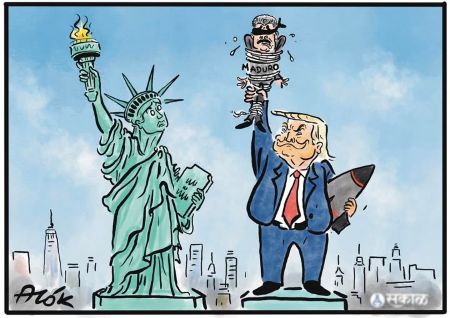
This has not been due to any humane policies or pro-people announcements, but solely because of his quirky and unpredictable executive orders, which undermine global political, diplomatic, and economic rules-based governance — or reveal a lack of comprehension of how to run a superpower.
After a hiatus of four years, Trump returned as the 47th American president, promising to end the 14-year-old Russia–Ukraine war within 24 hours of assuming office. Nothing of that sort has happened in the past year.
Immediately after assuming office, he launched a whimsical tariff war against almost every nation and even vowed to colonise Greenland and run over Mexico. The latest folly committed by this foaming-at-the-mouth American president represents a flagrant violation of international norms and respect for sovereign nations.
Trump’s Second Term and the Militarisation of US Foreign Policy
Trump’s second term has been marked by aggressive foreign actions, including the military capture of Venezuela’s President Nicolás Maduro and threats toward Colombia, Cuba, Mexico, along with renewed interest in Greenland — sparking global backlash and serious concerns over US power projection.

Trump’s second term rhetoric contrasts sharply with his foreign policy actions
At his inauguration in January 2025, Donald Trump pledged to be a “peacemaker and unifier.”
Although he has claimed to have brokered several — and in some cases short-lived — peace deals, including a self-proclaimed one between India and Pakistan, he has simultaneously carried out military interventions with relish, bombing seven countries during the first year of his second term.
During his first stint as US president, Trump dramatically ramped up strikes against jihadists in Somalia.
He has intensified this campaign since returning to the White House, with 118 strikes conducted in 2025 — more than the Bush, Obama, and Biden administrations combined.
Trump also launched a wave of air and naval strikes against Houthi-controlled Yemen in early 2025, pledging to “annihilate” the Iran-backed militia group after it targeted Israel and Red Sea shipping.
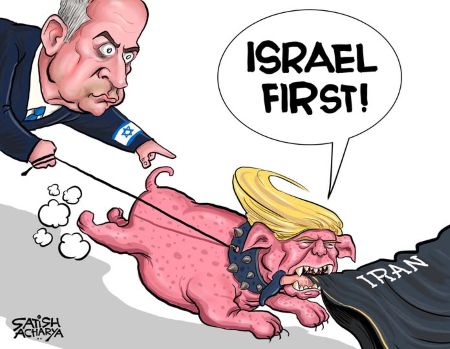 In March last year, a US airstrike killed a senior Islamic State (IS) leader in Iraq. Trump hailed it on social media as an example of “peace through strength.”
During Israel’s short war with Iran in June, the US struck three Iranian nuclear facilities. B-2 stealth bombers dropped bunker-buster bombs, while cruise missiles were launched from a submarine.
Trump claimed Iran’s nuclear programme had been “completely and totally obliterated,” though the extent of damage remains unclear.
After IS killed two US soldiers and a US civilian interpreter in Syria on December 13, 2025, Trump authorised more than 70 strikes. His rebranded “war secretary,” Pete Hegseth, described them as a “declaration of vengeance.”
Venezuela, Colombia and the New American Doctrine of Coercion
In Nigeria, a US ship stationed in the Gulf of Guinea launched more than a dozen cruise missiles at two IS training camps on Christmas Day.
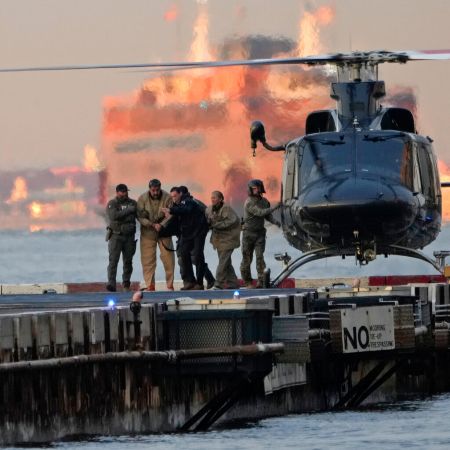
Nicolás Maduro taken by helicopter to a Manhattan courthouse (Courtesy: Vincent Alban/The New York Times)
Trump claimed the strikes were aimed at protecting Christians allegedly targeted for their faith. Nigeria’s government denies the claim but acquiesced to the strikes.
The US also began attacking alleged drug boats off Venezuela’s Caribbean coast in September, carrying out 33 known strikes and killing at least 112 people.
US forces docked two sanctioned oil tankers, pursued a third, and struck a Venezuelan port facility with a drone prior to the Maduro operation.
Donald Trump’s second term is increasingly defined by an aggressive projection of power far beyond America’s borders.
Also Read: VISION OR EXPLOITATION?
Following the dramatic military operation in Venezuela and the capture of President Maduro, Trump has signalled that his ambitions extend across the Western Hemisphere and into the Arctic — alarming nations from Latin America to Europe.
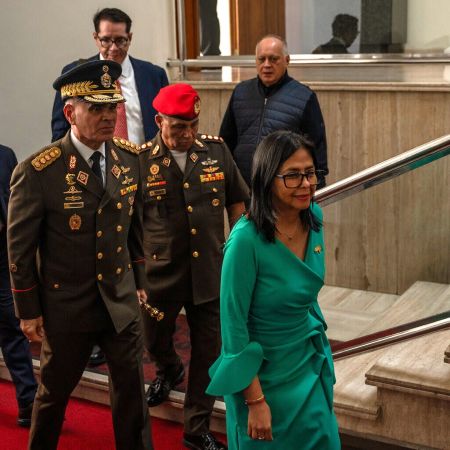
Delcy Rodríguez assumes interim leadership in Venezuela (Courtesy: Alejandro Cegarra/The New York Times)
He has even mused about kidnapping Colombia’s President Gustavo Petro and warned Venezuela’s Vice-President Delcy Rodríguez that she would face “a fate worse than Maduro” if she failed to fall in line.
As US forces were bringing Maduro to New York, Trump publicly warned Petro to “watch his ass.”
Maduro’s ouster has been justified in the name of combating “narco-terrorism.” While Maduro’s government was indeed deeply involved in drug smuggling, the emphasis reflects a persistent failing in US policy toward Latin America — remaining largely indifferent except when narcotics are involved.
Rare Earth Minerals, China, and the Real Motive Behind US Aggression
Trump’s hostility toward Latin America began with Mexico and the Panama Canal, but the deeper reason lies in economics and his MAGA worldview.
Over the past 25 years, China has made deep inroads into almost every Latin American country, much as it has in Asia and Africa.
 Chinese companies, infrastructure projects, and strategic investments span the region. Trump’s objective is therefore not merely Venezuela’s oil, but to re-establish American dominance across Latin America.
These countries form the backbone of China’s access to rare-earth and strategic minerals. Mexico is the world’s largest silver producer, exporting much of it to China. Bolivia holds vast lithium reserves, while Chile and Peru dominate copper production.
Also Read: Trump’s Plan to Reshape Global Power Dynamics
Trump understands that maintaining American supremacy in artificial intelligence, supercomputing, and advanced technology depends on controlling global mineral supply chains.
In essence, what Trump has unleashed against Latin America is not a geopolitical blitzkrieg driven by strategy or ideology. It is a bombastic display of power aimed at securing control over the world’s rare-earth resources. 
_________
Also Read:
Punjab’s ₹10-Lakh Health Insurance Scheme: Big on Assurance, Still Short on Answers
Asad Mirza
The author is a New Delhi-based senior commentator on national and international affairs, defence and strategic issues, and environmental concerns. He is also an interfaith practitioner and a media consultant. Previously, he was associated with the BBC Urdu Service and the Khaleej Times in Dubai.
Disclaimer : PunjabTodayNews.com and other platforms of the Punjab Today group strive to include views and opinions from across the entire spectrum, but by no means do we agree with everything we publish. Our efforts and editorial choices consistently underscore our authors’ right to the freedom of speech. However, it should be clear to all readers that individual authors are responsible for the information, ideas or opinions in their articles, and very often, these do not reflect the views of PunjabTodayNews.com or other platforms of the group. Punjab Today does not assume any responsibility or liability for the views of authors whose work appears here.
Punjab Today believes in serious, engaging, narrative journalism at a time when mainstream media houses seem to have given up on long-form writing and news television has blurred or altogether erased the lines between news and slapstick entertainment. We at Punjab Today believe that readers such as yourself appreciate cerebral journalism, and would like you to hold us against the best international industry standards. Brickbats are welcome even more than bouquets, though an occasional pat on the back is always encouraging. Good journalism can be a lifeline in these uncertain times worldwide. You can support us in myriad ways. To begin with, by spreading word about us and forwarding this reportage. Stay engaged.
— Team PT