


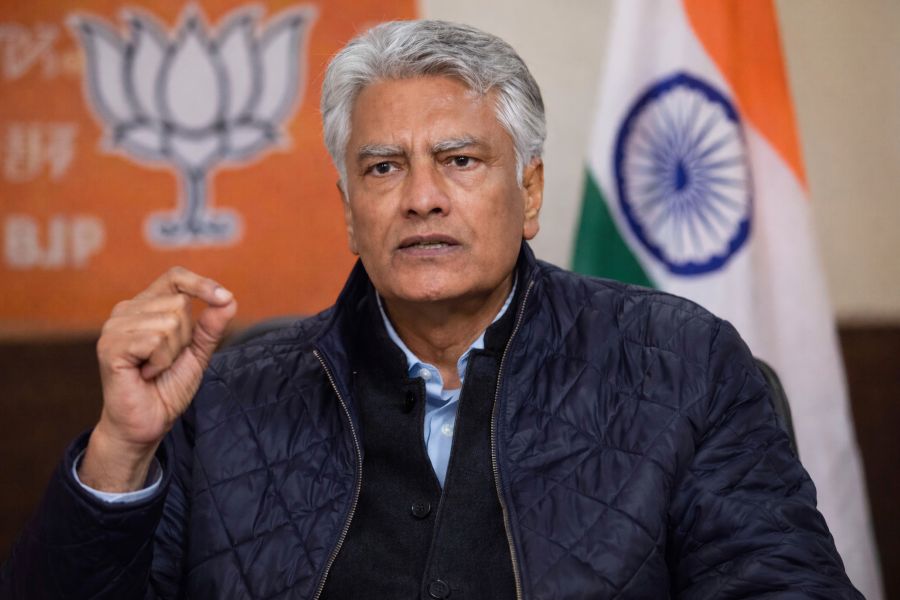
THE UNION BUDGET, inspired by the timeless vision of equality and dignity articulated by Guru Ravidas Ji Maharaj, lays a strong foundation for India’s long-term development, said Sunil Jakhar, President of the Bharatiya Janata Party, Punjab, in an exclusive interview with Punjab Today.
Referring to the revered saint’s ideal of a society free from hunger and hierarchy, Jakhar said the spirit of the Budget finds resonance in Guru Ravidas Ji’s celebrated couplet:
“ऐसा चाहूँ राज मैं, जहां मिले सबन को अन्न
छोट-बड़ों सब सम बसै, रैदास रहे प्रसन्न”
(Aisa chāhū̃ rāj main, jahān mile saban ko ann;
chhoṭ-baṛon sab sam basai, Raidās rahe prasann.)
“This vision of equality and shared prosperity is reflected in a Budget that prioritises inclusive growth, fiscal responsibility and long-term nation-building,” Jakhar said, adding that political criticism divorced from economic understanding ultimately does a disservice to Punjab.
‘Equality as policy, not slogan’
Jakhar said the defining feature of the Budget lies in its sector-driven approach rather than region-specific announcements. Under the leadership of Prime Minister Narendra Modi, he said, development policy has shifted towards building ecosystems around infrastructure, manufacturing, agriculture, MSMEs and skilling.
He pointed out that cities such as Jalandhar, Amritsar, Ludhiana, Hoshiarpur, Moga and Ferozepur stand to gain through improved connectivity and industrial expansion. “These are Punjab’s economic engines. When they grow, the benefits flow naturally to surrounding regions,” he said.
Punjab’s challenge: planning, not provision
Responding to criticism that Punjab had been ignored in the Budget, Jakhar said the issue was not a lack of Central support but the absence of a coherent development roadmap from the state government.
He noted that before the Budget was finalised, the Union Finance Minister had convened a meeting to seek inputs from states. “Punjab’s Finance Minister did not present any concrete development proposals—no infrastructure plan, no employment strategy. The only request was to raise the borrowing limit,” Jakhar said.
“Borrowing cannot replace vision. Debt cannot substitute governance,” he added.
Sunil Jakhar during an exclusive interview.
Jakhar pointed out that Central financial support to Punjab has steadily increased. For FY 2026–27, ₹30,464 crore has been budgeted as tax devolution for Punjab, along with ₹10,576 crore as grants-in-aid. Between 2014 and 2026, Punjab has received ₹1.66 lakh crore in tax devolution and ₹1.32 lakh crore in grants-in-aid, he said.
“These are substantial resources. The responsibility now lies with the state government to plan effectively and deliver outcomes,” he added.
Jakhar also criticised Chief Minister Bhagwant Mann for not meeting the Prime Minister during his recent visit to Punjab. “Centre–state dialogue is not a political courtesy; it is a constitutional obligation. Avoiding engagement weakens Punjab’s case,” he said.
Rural Punjab, infrastructure and employment
Jakhar said rural Punjab stood to benefit significantly from the Budget if funds were utilised properly. He cited Finance Commission grants of ₹1.4 lakh crore to states in 2026–27 under the 41 per cent tax devolution formula, part of which is earmarked for rural local bodies.
He also highlighted allocations of over ₹1.25 lakh crore for rural employment and livelihood schemes, saying these could help address unemployment pressures among Punjab’s youth through asset creation and local economic activity.
In addition, Punjab has received ₹6,157 crore since 2020–21 under the Centre’s Special Assistance to States for Capital Expenditure, which provides 50-year interest-free loans for infrastructure creation.
On infrastructure, Jakhar said over 4,264 km of National Highways have been constructed in Punjab, while five greenfield and economic corridors worth nearly ₹29,000 crore are under development. Projects such as the Delhi–Amritsar–Katra Expressway and the Amritsar–Bathinda–Jamnagar Corridor would reshape Punjab’s economic geography, he said.
Punjab is now 100 per cent electrified on the railway network, with Vande Bharat services, redevelopment of 30 railway stations as Amrit Stations, completion of the Eastern Dedicated Freight Corridor link from Ludhiana, and expansion of UDAN air connectivity strengthening integration with national markets.
Industry, welfare and the road ahead
Jakhar said Punjab’s strengths in MSMEs, textiles and sports goods manufacturing would benefit from increased national investment and international trade engagement, particularly with the European Union.
He also cited welfare and human development initiatives, including AIIMS Bathinda, PGI satellite centres, expanded healthcare infrastructure, and over 34 lakh rural households receiving tap water connections under the Jal Jeevan Mission.
Schemes such as Mudra, Jan Dhan and SVANidhi, he said, had expanded entrepreneurship and financial inclusion across the state.
“Punjab today stands at a crossroads,” Jakhar said. “One path leads to confrontation and stagnation; the other to cooperation and renewal. What Punjab needs is planning, engagement and responsible governance.” 
(Views expressed are those of the interviewee.)
__________
Also Read:
Capex Resolve, Rural Reset and India’s Quiet Preparation for a Tariff-Torn World
Punjab Congress Infighting: When a Party Chooses Self-Destruction Over Revival

Ekjot Singh
Special Correspondent covering governance, public policy, and development for Punjab Today.
Disclaimer : PunjabTodayNews.com and other platforms of the Punjab Today group strive to include views and opinions from across the entire spectrum, but by no means do we agree with everything we publish. Our efforts and editorial choices consistently underscore our authors’ right to the freedom of speech. However, it should be clear to all readers that individual authors are responsible for the information, ideas or opinions in their articles, and very often, these do not reflect the views of PunjabTodayNews.com or other platforms of the group. Punjab Today does not assume any responsibility or liability for the views of authors whose work appears here.
Punjab Today believes in serious, engaging, narrative journalism at a time when mainstream media houses seem to have given up on long-form writing and news television has blurred or altogether erased the lines between news and slapstick entertainment. We at Punjab Today believe that readers such as yourself appreciate cerebral journalism, and would like you to hold us against the best international industry standards. Brickbats are welcome even more than bouquets, though an occasional pat on the back is always encouraging. Good journalism can be a lifeline in these uncertain times worldwide. You can support us in myriad ways. To begin with, by spreading word about us and forwarding this reportage. Stay engaged.
— Team PT