


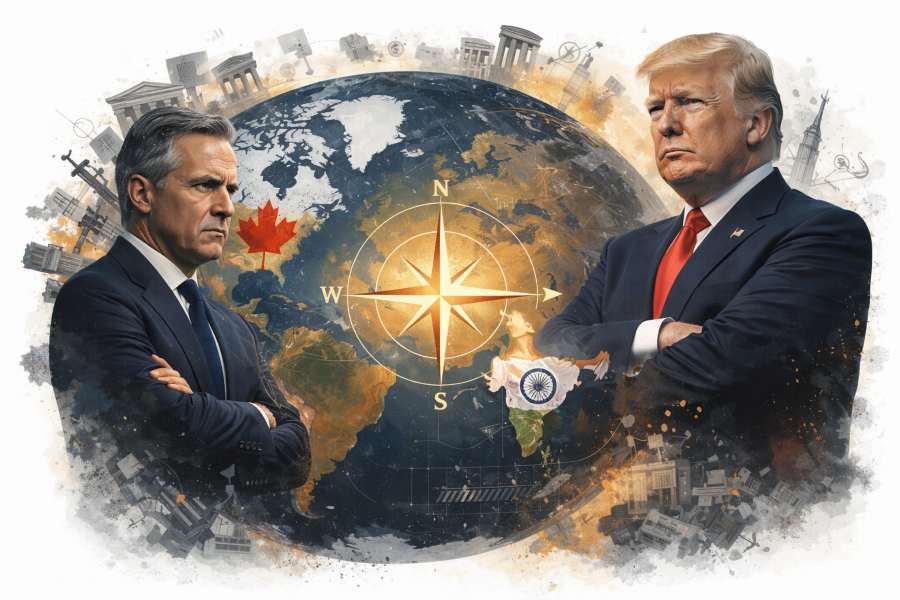
Canada’s strategic recalibration under Mark Carney exposes the breakdown of old global assumptions — and explains why India, too, is quietly preparing for a more uncertain world
GLOBAL ORDERS RARELY collapse in a single dramatic moment. More often, they erode slowly — through repeated shocks, broken assumptions and the steady realisation that yesterday’s guarantees no longer hold. Over the past week, that erosion became unmistakable.
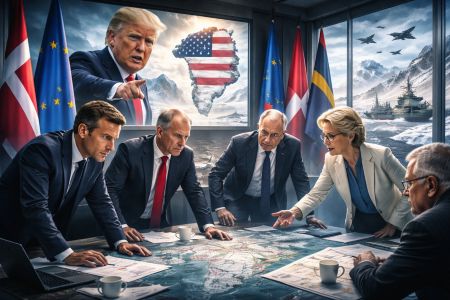
European leaders react to growing uncertainty in transatlantic relations following U.S. pressure on allies.
When U.S. President Donald Trump issued public threats touching Greenland — implicitly questioning long-standing NATO understandings — it was not merely rhetorical excess. For many governments, it reinforced a conclusion already forming across capitals: the rules-based international order anchored in predictable American leadership can no longer be assumed to function as before.
That reality was articulated most clearly at the World Economic Forum in Davos by Canada’s Prime Minister Mark Carney. “The old order is not coming back,” Carney said. “Nostalgia is not a strategy.” The line resonated not because it was dramatic, but because it reflected a growing consensus among U.S. allies that structural conditions have changed.
Why Canada’s Assessment Carries Weight
Canada’s voice matters because no major economy is more deeply integrated with the United States. Nearly 70 per cent of Canadian exports go to the U.S. Supply chains in automobiles, energy, aerospace and manufacturing are tightly interwoven. Millions of Canadian jobs depend directly on American demand. Geography alone ensures that the U.S. will remain Canada’s dominant trading partner.
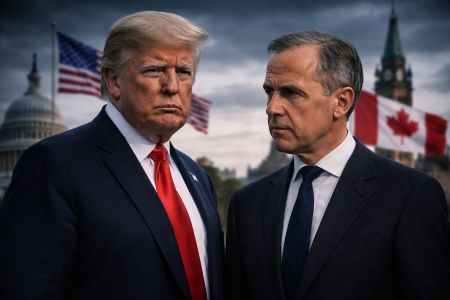
A strained U.S.–Canada relationship underlines the limits of traditional alliances.
Yet this very integration has become a source of vulnerability under an administration that increasingly uses tariffs, certification regimes and regulatory pressure as instruments of leverage.
That vulnerability was underlined in recent days when President Trump threatened steep tariffs on Canadian-made aircraft and raised the possibility of decertifying Canadian planes operating in the U.S. market — a move that immediately unsettled investors and sent shares of Canada’s flagship aerospace manufacturer sharply lower.
These actions are not isolated trade disputes. They illustrate how deeply economic interdependence can be weaponised when multilateral norms weaken and power asymmetries dominate.
Carney’s Response: Adaptation, Not Confrontation
Carney’s Davos speech did not advocate decoupling from the United States, nor did it frame Canada’s strategy as defiance. Instead, it posed a harder, more pragmatic question: how should countries whose prosperity and security have long depended on the U.S. respond when that dependence itself becomes a strategic risk?
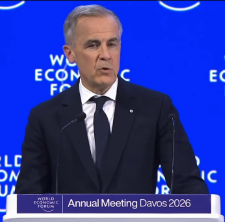
Mark Carney speaks in Davos
His answer was explicit. Countries must reduce “the leverage that enables coercion” by diversifying trade relationships, lowering strategic dependencies and coordinating more closely with one another.
For Canada, this is neither simple nor symbolic. Two out of three Canadian exporters sell exclusively to the U.S. Nearly one in ten Canadians works in industries directly tied to American customers. Ottawa does not pretend geography can be overcome.
What it is attempting instead is insurance.
Diversification as Strategic Insurance
Canada’s diversification efforts are gradual but measurable. Trade with non-U.S. markets has risen even as exports to the United States have dipped modestly.
For the first time, Canada has begun exporting natural gas to Asia. A growing share of Canadian oil is now being sold outside the U.S., including to China.
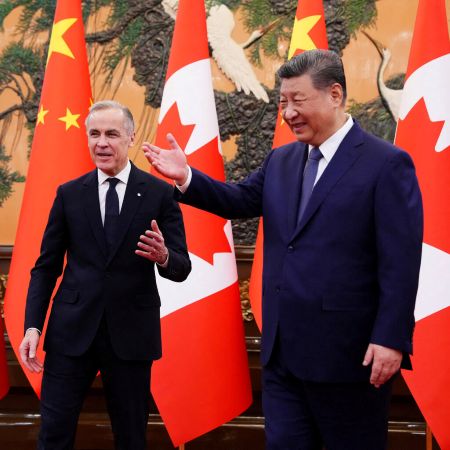
Carney met with President Xi Jinping of China last month. Courtesy: Sean Kilpatrick
Canada is also expanding energy and trade engagement beyond North America, including with India, covering crude oil, LNG and uranium — part of a broader effort to reduce over-concentration in any single market.
Perhaps most symbolically, Canada has shown willingness to recalibrate its rigid alignment with Washington on China. A limited “strategic partnership” involving modest tariff reductions on select goods — including electric vehicles and agricultural exports such as canola — would have been politically unthinkable in an earlier era.
The scale of change remains small; its significance lies in what it signals.
Washington’s response has been swift, with renewed tariff threats following even limited diversification moves — reinforcing the logic behind Canada’s strategy.
Middle Powers and a World That Will Not Revert
The most consequential element of Carney’s intervention was his appeal to “middle powers” — countries influential but not dominant enough to shape global rules alone.
The argument is structural rather than ideological. Left alone to deal with an increasingly transactional United States, no single middle power can sustain prolonged pressure. Acting collectively, however, they can reshape incentives and restore bargaining balance.
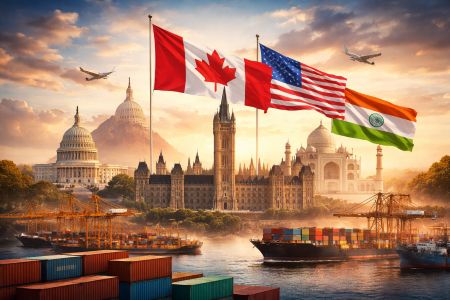
Trade, energy and geopolitics link Canada, the U.S. and India in an increasingly multipolar world.
This view is gaining traction. Across Europe and parts of Asia, U.S. allies are reassessing trade and diplomatic alignments, including their engagement with China, as they adapt to American unpredictability.
Analysts argue that the failure of coordinated resistance to unilateral U.S. tariffs in recent years allowed coercive trade practices to become normalised. Countries that sought individual exemptions weakened collective leverage.
Canada’s experience gives this argument credibility. If the country most economically intertwined with the United States is openly acknowledging the limits of dependence, others can no longer rely on assumptions formed in a different era.
Why This Matters for India
For India, Canada’s recalibration is not a distant Western episode; it mirrors choices New Delhi is already navigating. India, too, operates in a world where American power remains indispensable but increasingly unpredictable — and where over-dependence on any single partner carries growing risk.
This reality was underscored on 27 January 2026, when India and the European Union concluded a long-pending India-EU Free Trade Agreement, widely described as one of the most consequential trade deals of the decade. Finalised after nearly twenty years of negotiations, the pact will eliminate or sharply reduce tariffs on the vast majority of goods, deepen services cooperation and open investment pathways across sectors.

The deal reflects a recognition central to Carney’s argument: reliance on a single dominant market — however powerful — is no longer safe. For India, expanded access to the EU’s vast consumer base offers diversification, leverage and insulation against geopolitical shocks.
It also reinforces India’s broader strategic pattern. New Delhi has pursued parallel engagement — with the U.S., Europe, Russia, the Gulf, ASEAN and now deeper EU integration — without binding itself permanently to any single axis. Canada’s experience serves as a cautionary tale: integration without options eventually becomes exposure.
Also Read: India–EU Partnership Enters New Phase as Global Trade Order Fractures
Perhaps most importantly, both cases illustrate a shift in how sovereignty is exercised in the twenty-first century. Economic architecture, supply chains and trade agreements now matter as much as military capability. Resilience lies not in assurances, but in alternatives.
In that sense, Canada’s pivot is not anti-American. It is post-illusion realism. And for India, it confirms a lesson already learned quietly: in a world of fading certainties, strength lies in strategic choice, not dependence. 
_________
Also Read:
Davos Diversion: How Public Money Is Burnt for Promises That Never Deliver
Basant in Pakistan, my friend Gobind Thukral, & Malkoo’s ‘Nak Da Koka’

Punjab Today
punjabtodaynews@gmail.com
Disclaimer : PunjabTodayNews.com and other platforms of the Punjab Today group strive to include views and opinions from across the entire spectrum, but by no means do we agree with everything we publish. Our efforts and editorial choices consistently underscore our authors’ right to the freedom of speech. However, it should be clear to all readers that individual authors are responsible for the information, ideas or opinions in their articles, and very often, these do not reflect the views of PunjabTodayNews.com or other platforms of the group. Punjab Today does not assume any responsibility or liability for the views of authors whose work appears here.
Punjab Today believes in serious, engaging, narrative journalism at a time when mainstream media houses seem to have given up on long-form writing and news television has blurred or altogether erased the lines between news and slapstick entertainment. We at Punjab Today believe that readers such as yourself appreciate cerebral journalism, and would like you to hold us against the best international industry standards. Brickbats are welcome even more than bouquets, though an occasional pat on the back is always encouraging. Good journalism can be a lifeline in these uncertain times worldwide. You can support us in myriad ways. To begin with, by spreading word about us and forwarding this reportage. Stay engaged.
— Team PT