


RTI filed after appointment order names him Chief Justice of India but oath uses a different constitutional designation
A SUBTLE BUT constitutionally significant question has emerged following the appointment and oath of office of Justice Surya Kant. Although the Government of India officially appointed him as the Chief Justice of India (CJI) with effect from 24 November 2025, the President of India administered the oath using a different title: Chief Justice of the Supreme Court of India.
This unexpected inconsistency has now prompted a formal query through the Right to Information (RTI) Act.
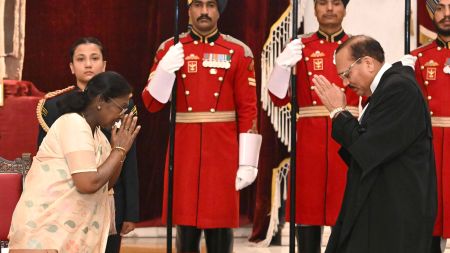
Justice Surya Kant greets President Droupadi Murmu during his oath ceremony.
Hemant Kumar, an advocate practising at the Punjab & Haryana High Court, has filed online RTI applications with the President’s Secretariat, the Department of Justice, and the Supreme Court of India, seeking clarification on the correct constitutional designation of Justice Surya Kant.
He argues that while the appointment notification uses the term CJI, the oath administered by the President uses terminology drawn from the Third Schedule of the Constitution, which refers to the office as “Chief Justice of the Supreme Court of India.”
A Constitutional Puzzle: Two Terminologies, One Office
The advocate’s application highlights a distinctive constitutional nuance. Several key provisions of the Indian Constitution—such as Articles 60, 124, 126, 127, 130, 146, 217, 257, 258 and 290—explicitly use the term Chief Justice of India. This terminology is the one commonly recognised in judicial, governmental, and public discourse.
However, the Third Schedule, which specifies the oath or affirmation for Supreme Court judges, uses a different formulation, requiring a judge to swear as “Chief Justice (or a Judge) of the Supreme Court of India.”
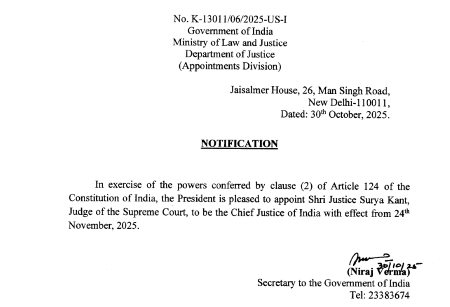
DOJ notification appointing Justice Surya Kant CJI.
This duality is not new, but it has rarely been tested or questioned formally. The present instance is unusual because the appointment notification issued by the Department of Justice on 30 October 2025 clearly names Justice Surya Kant as the Chief Justice of India, while the oath ceremony adhered strictly to the wording of the Third Schedule.
The RTI application seeks to determine whether these two expressions carry identical constitutional weight, and more importantly, which title is officially recognised in government records after the oath.
What the RTI Seeks and Why It Matters
Hemant Kumar’s RTI requests clarification on the official designation recorded in the files of the Government of India and the Supreme Court. He also asks whether the wording used in the oath of office has any bearing on the formal title of the Chief Justice, and whether both terms are interchangeable or if one holds definitive constitutional status.
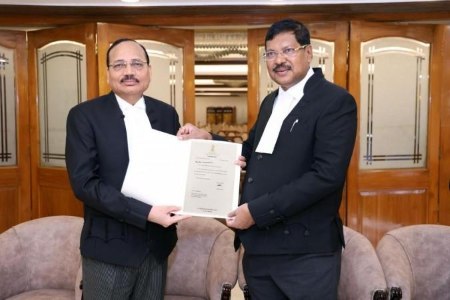
Chief Justice Surya Kant with former Chief Justice B. R. Gavai during the handover of the appointment order.
While the difference may appear semantic, the advocate argues that the question touches upon the core of constitutional interpretation, the doctrine of form and substance, and the precision required in the titles of constitutional authorities.
The responses to the RTI may also influence how future appointments, oath ceremonies, and official communications refer to India’s top judicial office.
This is perhaps the first time that an RTI has been used to seek clarity on this long-standing but largely unnoticed linguistic divergence within the Constitution.
 Depending on the replies from the President’s Secretariat, the Department of Justice and the Supreme Court, the matter may establish a precedent for standardising the designation of the Chief Justice across official documents and constitutional processes.
The episode underscores an important truth: even in a well-established constitutional democracy, nuances in language can raise fundamental questions about institutional identity, symbolism and procedure.
Justice Surya Kant has assumed charge of the nation’s highest judicial office. What remains to be clarified is how that office is formally named. 
________
Also Read:
Punjab Police Acting as AAP’s Enforcement Wing, Alleges Akali Dal; Shares ‘Audio Clip’
Are Bombay High Court Officials Unaware of Amended Court-Fee Law?
Complaint Against Lawyers? Pay ₹6,500 First, Says Bar Council of Punjab & Haryana

Ekjot Singh
Special Correspondent covering governance, public policy, and development for Punjab Today.
Disclaimer : PunjabTodayNews.com and other platforms of the Punjab Today group strive to include views and opinions from across the entire spectrum, but by no means do we agree with everything we publish. Our efforts and editorial choices consistently underscore our authors’ right to the freedom of speech. However, it should be clear to all readers that individual authors are responsible for the information, ideas or opinions in their articles, and very often, these do not reflect the views of PunjabTodayNews.com or other platforms of the group. Punjab Today does not assume any responsibility or liability for the views of authors whose work appears here.
Punjab Today believes in serious, engaging, narrative journalism at a time when mainstream media houses seem to have given up on long-form writing and news television has blurred or altogether erased the lines between news and slapstick entertainment. We at Punjab Today believe that readers such as yourself appreciate cerebral journalism, and would like you to hold us against the best international industry standards. Brickbats are welcome even more than bouquets, though an occasional pat on the back is always encouraging. Good journalism can be a lifeline in these uncertain times worldwide. You can support us in myriad ways. To begin with, by spreading word about us and forwarding this reportage. Stay engaged.
— Team PT