


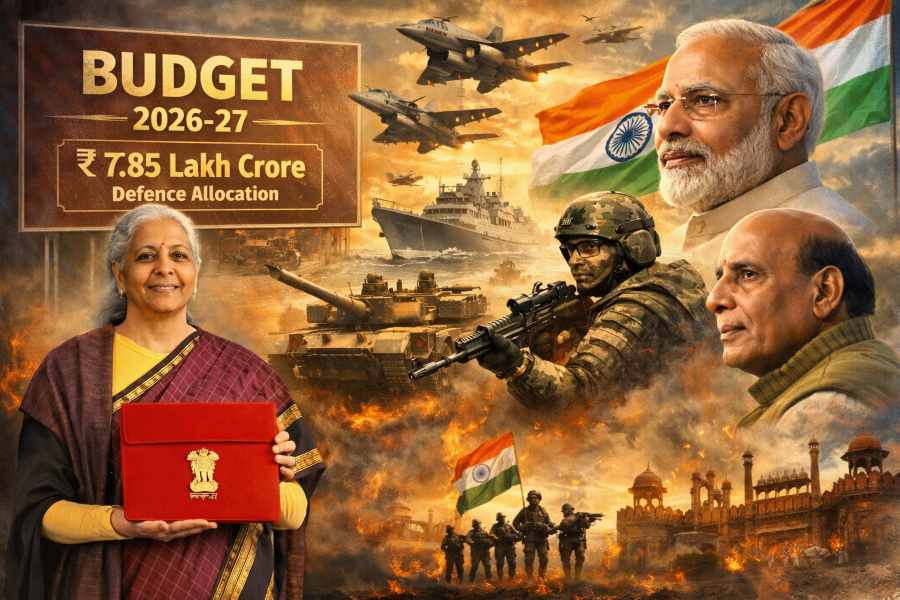
While presenting the budget for FY 2026-27, Finance Minister Nirmala Sitharaman earmarked a record ₹7.85 lakh crore allocation for the country’s defence sector, post-Operation Sindoor. The increase in the defence outlay in the recent budget was in the backdrop of the “historic success of Operation Sindoor” which has further strengthened our resolve to make India’s defence system even more robust, Defence Minister Rajnath Singh said.
IN A DECISIVE push to strengthen national security in the aftermath of Operation Sindoor and focus on indigenous defence production, the Union Budget allocated a record ₹7.85 lakh crore to defence services, marking the highest-ever outlay for the sector for FY 2026-27.
The allocation accounts for 2% of the estimated GDP for the next financial year 2026-27, and reflects a 15.19% increase over the budget estimates for the current year. Defence spending now constitutes 14.67% of the Union government’s total expenditure, the highest among all Ministries.
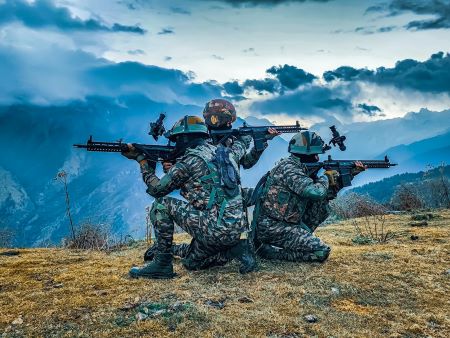
Indian Army soldiers in combat gear during a mountain exercise
According to the Defence Ministry, the enhanced allocation is aimed not only at accelerating the modernisation of the armed forces and meeting routine operational requirements, but also at addressing additional financial needs arising from emergency procurement of arms and ammunition undertaken after Operation Sindoor, under both capital and revenue heads.
Capital expenditure has been raised sharply to ₹2.19 lakh crore, compared to ₹1.8 lakh crore in 2025-26, underlining the government’s resolve to upgrade military capabilities to global standards, with a strategic emphasis on self-reliance.
Record Defence Allocation Focuses on Modernisation and Preparedness

Venkatesh Sai
Expressing the defence sector’s expectations in a pre-budget statement, Venkatesh Sai, Founder & Technical Director, Zuppa, had said, “From a technology standpoint, the Union Budget 2026 can be transformative for India’s cyber-physical and drone ecosystem by recognising secure computing, real-time AI, and indigenous hardware as national priorities.
As drones increasingly operate in sensitive, mission-critical environments, policy support must extend beyond assembly to deep-tech innovation—covering secure motherboards, real-time control computing, AI-driven autonomy, and cyber-resilient architectures. Incentives for design-first engineering, aerospace-grade manufacturing standards, and indigenous IP creation will allow Indian companies to build globally competitive systems from the ground up.”

Sai Pattabiram
Sai Pattabiram, Founder & MD, Zuppa focussing on the expectations of the drone industry and cybersecurity platforms had said, “The Indian drone industry is emerging from a critical phase of disruption—one that has fundamentally reshaped its dominant business model. With a sharper focus on indigenous component manufacturing, cybersecurity, and a growing recognition of drones as dual-use strategic assets, the sector is now at an inflection point. As we approach the Union Budget, we are hopeful of decisive policy support through Design-Linked Incentives, targeted PLI schemes, and export-focused incentives coupled with the lowering of barriers to export within the SCOMET regulations that can help Indian drone manufacturers scale with confidence.”
In real terms, most of these expectations related to the UAVs or the drone industry and smart weapons have been met by the budget.

Raj Kumar Pandey
Raj Kumar Pandey, CEO & Executive Director, ADSL, JCBL commenting on the budget said, “The Union Budget 2026 marks a decisive step towards strengthening India’s defence and aerospace ecosystem, with a record allocation of ₹7.84 lakh crore, reflecting a 15% increase. This enhanced outlay accelerates modernisation across land, air, and naval forces while reinforcing the government’s focus on advanced technologies and indigenous manufacturing. Policy support through duty exemptions and targeted investments positions India to scale capabilities, attract global partnerships, and emerge as a competitive force in the global defence and aerospace landscape.”
The Defence Ministry has already concluded contracts worth ₹2.1 lakh crore during the current year up to December, with Acceptance of Necessity (AoN) approvals exceeding ₹3.5 lakh crore. Upcoming projects include next-generation fighter aircraft, ships and submarines, UAVs, drones, smart weapons, and specialist vehicles.
A major thrust has been placed on indigenisation, with ₹1.39 lakh crore, or 75% of the capital acquisition budget, earmarked for procurement from domestic industries, boosting self-reliance, investment and job creation, the Ministry added.
Of the Ministry’s total allocation, 27.95% has been earmarked for capital expenditure, 20.17% for operational sustenance and preparedness, 26.40% for pay and allowances, 21.84% for defence pensions, and 3.64% for civil organisations.

Ankit Mehta
Ankit Mehta – CEO of ideaForge Technology Pvt Ltd commenting on the outlay for the defence and technology segment, in the budget said, “We congratulate the finance minister for presenting a pragmatic budget that continues to prioritise defence capital outlay, while strengthening India’s domestic manufacturing ecosystem, electronics base, and semiconductor capabilities. Proposed measures such as the India Semiconductor Mission 2.0, the expanded Electronics Components Manufacturing Scheme, and support for advanced technology R&D signal a strong focus on building strategic supply chains and indigenous high-tech capability.”
Defence Minister Rajnath Singh thanked Prime Minister Narendra Modi for the historic allocation, saying that the budget strengthens the balance between security, development, and self-reliance. He said the post-Operation Sindoor budget reinforces the government’s resolve to bolster national security, enhance military capabilities and ensure the welfare of ex-servicemen, while advancing the vision of an Aatmanirbhar and Viksit Bharat.
Defence Budget 2026-27: Key Announcements
Key measures announced include exemption of basic customs duty on components and engines required for civilian and training aircraft, along with duty exemption on raw materials imported for manufacturing aircraft parts meant for Maintenance, Repair and Overhaul (MRO) requirements by Defence Public Sector Units. A new scheme for the Enhancement of Construction and Infrastructure Equipment (CIE) has also been introduced, including support for tunnel-boring equipment essential for high-altitude strategic infrastructure.
On strategic technology, customs duty exemptions for imports required for Nuclear Power Projects have been extended until 2035 and expanded to cover all nuclear plants. Duty exemptions have also been introduced for capital goods needed for processing critical minerals in India. Dedicated Rare Earth Corridors will be established in Odisha, Kerala, Andhra Pradesh and Tamil Nadu to promote mining and processing vital for advanced defence electronics.
The budget also provides a specific tax exemption for disability pensions granted to Armed Forces and paramilitary personnel, covering both the service element and disability element for those invalided out due to disability attributable to or aggravated by military service.
In his post-budget statement Sai Pattabiram, Founder & MD, Zuppa, a defence drone tech company said, “The increased defence allocation in Union Budget 2026 is an important and timely step for India’s indigenous drone industry. After Operation Sindoor, it has become clear that drones are no longer optional equipment but essential tools for surveillance, border security, and precision operations. This budget gives local manufacturers the confidence to invest in new technology, local production, and skilled employment. The focus on domestic procurement and localisation will strengthen the entire ecosystem from electronics and propulsion to AI-based payloads and components supplied by MSMEs.”
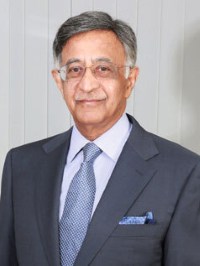
Baba Kalyani
Baba Kalyani, CMD, Bharat Forge Ltd expressing his and the industry’s euphoria on the budget said, “The Union Budget 2026 reflects the hallmark of Prime Minister Modi’s stable, strong and visionary leadership, anchored in policy continuity, fiscal discipline and a clear focus on building long-term national capabilities. I congratulate the Hon’ble Finance Minister on her ninth successive Budget, which strikes a careful balance between macroeconomic stability and sustained investment-led growth. The articulation of a multi-pronged growth framework and the three kartavyas reinforces the commitment to building a competitive, inclusive, and future-ready economy.”
“At a time of heightened geopolitical and supply-chain uncertainty, these measures are bound to strengthen India’s economic resilience and global positioning, sending a strong signal to both Global and Indian investors.” Kalyani further said.
Commenting on the government’s focus on modernising and strengthening the armed forces Ankur Kanaglekar, Vice-President – India, Thales said, “The latest budget seeks to reinforce the nation’s commitment to modernising and strengthening the armed forces. The announcements around exemption of basic customs duty on component and parts for manufacture of civilian, training, and other aircraft and on the raw materials imported for manufacture of parts to be used in maintenance, repair, and overhaul by defence sector units, further signal India’s long-term strategic intent for strengthening civil aerospace and defence industrial capabilities.”
Industry Response and Defence Spending Trends
Meanwhile, in a pre-budget interaction, the two bodies representing private space companies had urged the government to undertake fiscal, regulatory, and structural reforms aligned with the Space Policy 2023 and IN-SPACe’s decadal vision.

Anil Prakash
In his post-budget statement, Anil Prakash, Director General, SIA-India said, “Industry expectations going into this Budget included targeted incentives for space manufacturing, GST rationalisation for space-grade inputs, clearer HSN classifications for space components, and a more predictable scaling of the space budget in line with India’s ambitions. These did not find a place this year, so there is no direct fiscal boost for the space sector.”
“The union Budget reflects a strong push toward technology-led growth, manufacturing scale-up, and supply-chain resilience — all important for India’s emerging space economy. While there is no direct space-specific fiscal boost, several horizontal measures in electronics, semiconductors, MSME financing, customs modernisation, AI, and R&D act as meaningful enablers for the sector,” said Dr Subba Rao Pavuluri, President, SIA-India.
In fact, the budget never satisfies one and all, juggling expectations with real deliverables is a daunting task. However, this time the finance minister might have been guided by Operation Sindoor and its aftermath, and technological edge achieved by adversaries like China on the military front and India’s Aatmanirbharta mission on one hand and the imperative need for increasing the number of cutting-edge military platforms on an urgent basis. In addition to fulfilling the long pending demands of services like the air force, might have been weighed-in by her to prepare such a forward looking and aspirational budget.
As a result, the defence ministry leads with the highest of allocations among the ministries with a 14.68 per cent share of the total budget—much more than the 13.45 per cent share of the total budget last year.

Indian Army armoured vehicle with the national flag during a field deployment
To note is the capital expenditure aspect, which increased big-ticket acquisitions in current and subsequent years. It means more buys of advanced and sophisticated fighter aircraft, more naval warships and submarines, and the critically important drones, among others.
The 2026-27 allocation is 15.27 per cent more than last year’s total defence budget allocation of Rs 6.81 lakh crore. This year-on-year rate of increase is more than the 9.53 per cent year-on-year hike in last year’s budget.
It also signifies that the defence spending will maintain its increasing trend over the coming years, too. This in turn will speed up the drive and ensure greater military preparedness and modernisation.
In this aspect the government seems to have well understood the fact that capital-heavy defence expenditure ultimately supports and invigorates the domestic manufacturing ecosystem, which in turn fulfills its technological sovereignty aspirations leading to strategic autonomy, as per the government’s various missions and initiatives. 
__________
Also Read:
Canada’s Pivot Away from the U.S. and the End of Comfortable Certainties

Asad Mirza
The author is a New Delhi-based senior commentator on national and international affairs, defence and strategic issues, and environmental concerns. He is also an interfaith practitioner and a media consultant. Previously, he was associated with the BBC Urdu Service and the Khaleej Times in Dubai.
Disclaimer : PunjabTodayNews.com and other platforms of the Punjab Today group strive to include views and opinions from across the entire spectrum, but by no means do we agree with everything we publish. Our efforts and editorial choices consistently underscore our authors’ right to the freedom of speech. However, it should be clear to all readers that individual authors are responsible for the information, ideas or opinions in their articles, and very often, these do not reflect the views of PunjabTodayNews.com or other platforms of the group. Punjab Today does not assume any responsibility or liability for the views of authors whose work appears here.
Punjab Today believes in serious, engaging, narrative journalism at a time when mainstream media houses seem to have given up on long-form writing and news television has blurred or altogether erased the lines between news and slapstick entertainment. We at Punjab Today believe that readers such as yourself appreciate cerebral journalism, and would like you to hold us against the best international industry standards. Brickbats are welcome even more than bouquets, though an occasional pat on the back is always encouraging. Good journalism can be a lifeline in these uncertain times worldwide. You can support us in myriad ways. To begin with, by spreading word about us and forwarding this reportage. Stay engaged.
— Team PT