


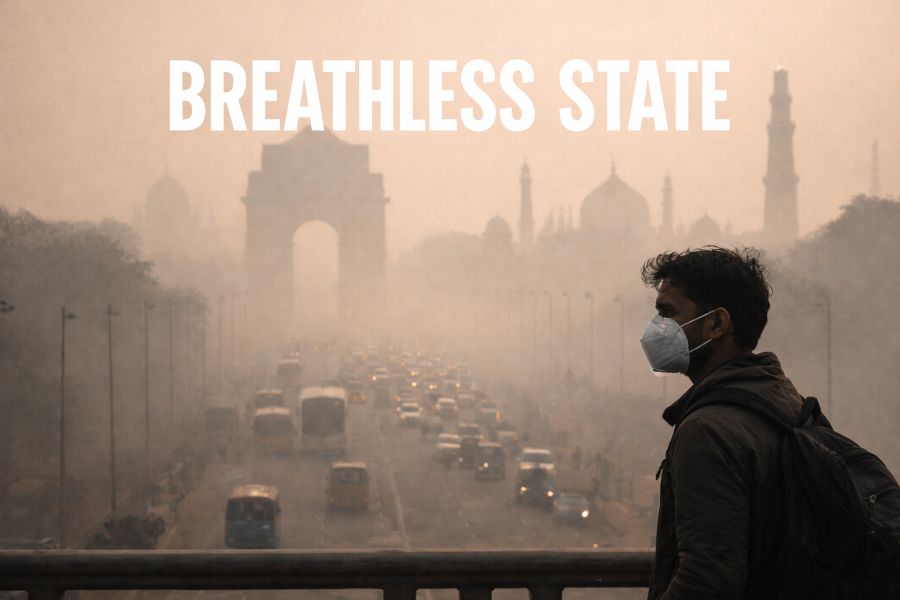
Courts and governments rely on seasonal fixes while toxic air continues to threaten public health
IT IS THAT time of the year when pollution levels are at their peak, particularly in the Delhi-NCR region, though not confined to it alone. The situation is almost equally bad across the entire northern region.

Air Pollution in Delhi
It is also the time when the Delhi government scrambles to deal with the situation by taking short-term measures like imposing restrictions on construction activities, introducing the odd-even traffic system, closing educational institutions, and imposing heavy fines on vehicles emitting pollution.
These measures are forgotten almost immediately after the first showers, which reduce pollution levels dramatically. It takes almost a year — till early November — before the government wakes up from its slumber when pollution levels start rising again.
Short-Term Fixes, No Long-Term Plan
This year was no different, except that the highest court added its bit by allowing the bursting of “green crackers” for “two hours” on Diwali.
The order pandered to those who argued that Diwali celebrations were incomplete without crackers, forgetting that this notion is of recent origin and that Diwali or Deepawali was traditionally celebrated by lighting lamps to welcome the return of Bhagwan Ram to Ayodhya.
Also Read: Air pollution is cutting short the lives of Indians by up to six years
The Supreme Court order proved to be self-defeating. It made enforcement of its own order impossible. Revellers burst all kinds of firecrackers with impunity, and the two-hour restriction, of course, went up in flames.
Although pollution caused by crackers may be just one of the reasons behind high pollution levels, the casual approach of the highest court and the Delhi government reflects a lack of seriousness in dealing with the issue.

Delhi’s Short-Term Pollution Fixes
Last week, another bench of the Supreme Court orally observed that the measures taken by authorities so far have been a “total failure” in effectively curbing rising air pollution levels in the Delhi-NCR region.
It remarked that any meaningful reduction in pollution would require broader and long-term planning rather than ad hoc responses.
It said that a long-term plan needs to be evolved and implemented in a phased manner.
The court asked the Commission for Air Quality Management (CAQM) to take long-term measures, including improving urban mobility, promoting cleaner industry and green energy, regulating construction activities, checking stubble burning and household emissions, strengthening public transport systems, and intensifying citizen awareness programmes.
Courts Speak, But Enforcement Fails
The apex court’s directives were both overdue and necessary. The high levels of pollution should have prompted structural interventions years ago. However, the tendency has been to bury this serious issue under the carpet once AQI levels come down after rains.

Courts Speak, Enforcement Lags
It is common knowledge that residents of these areas face serious health issues. There is enough medical evidence to prove how pollution adversely impacts the growth of children and leads to more cases of asthma and other lung diseases.
Some reports also point out that the longevity of adults residing in these areas reduces by several years due to prolonged exposure to high pollution levels.
Lessons From Beijing — And The Road Ahead
It is important to draw lessons from other countries which have successfully tackled pollution. Closer home, Beijing — once the most polluted city in the world — successfully cut its annual pollution levels by more than 50 per cent between 2013 and 2021.

Lessons From Beijing
Its transformation stemmed from strong, top-down interventions across energy, transport, and industry.
It vastly expanded electric mobility, shut down or relocated hundreds of polluting industries, replaced thousands of coal-fired boilers with natural gas, imposed stringent vehicular emission standards, and enforced substantial penalties for non-compliance.
It may not be possible to take such harsh steps — like moving out 30,000 polluting small and medium units from a city — in a democratic country like ours, but we can certainly draw on the principles that made China’s progress possible.
Also Read: Industrialization versus Environmental Degradation
Among the key lessons is the need to shift from ad hoc responses to a long-term, sustained, mission-oriented strategy.

Beijing vs Delhi Pollution Reality
India should treat air pollution as a national public health emergency and must accelerate its transition to clean energy. This includes reforms in vehicular emission norms.
It is well known how easy it is to obtain “pollution-free” certificates for vehicles in India without even getting them tested. Strengthening the public transport system and offering attractive relocation alternatives to polluting industrial units could be among the measures required to tackle this serious situation.
Also Read: How Clean is the River ‘Ganges’ or ‘Ganga’?
We also need stringent measures like a complete ban on the production and import of firecrackers, which would address the problem of their easy availability. The government must take both long-term and short-term measures to tackle this menace. 
__________
Also Read:
India’s Silent Pandemic: How Mobile Addiction Is Harming Our Children
SAHITYA AKADEMI AWARDS ROW: Power Comes A-Knocking, or Writers Go Knocking at Power’s Door?

Vipin Pubby
The author, a freelance journalist, is a former Resident Editor of Indian Express, Chandigarh, and reported on the political developments in Jammu and Kashmir, North-Eastern India, Gujarat, Himachal Pradesh, Haryana and Punjab in his long, illustrious career.
Disclaimer : PunjabTodayNews.com and other platforms of the Punjab Today group strive to include views and opinions from across the entire spectrum, but by no means do we agree with everything we publish. Our efforts and editorial choices consistently underscore our authors’ right to the freedom of speech. However, it should be clear to all readers that individual authors are responsible for the information, ideas or opinions in their articles, and very often, these do not reflect the views of PunjabTodayNews.com or other platforms of the group. Punjab Today does not assume any responsibility or liability for the views of authors whose work appears here.
Punjab Today believes in serious, engaging, narrative journalism at a time when mainstream media houses seem to have given up on long-form writing and news television has blurred or altogether erased the lines between news and slapstick entertainment. We at Punjab Today believe that readers such as yourself appreciate cerebral journalism, and would like you to hold us against the best international industry standards. Brickbats are welcome even more than bouquets, though an occasional pat on the back is always encouraging. Good journalism can be a lifeline in these uncertain times worldwide. You can support us in myriad ways. To begin with, by spreading word about us and forwarding this reportage. Stay engaged.
— Team PT