


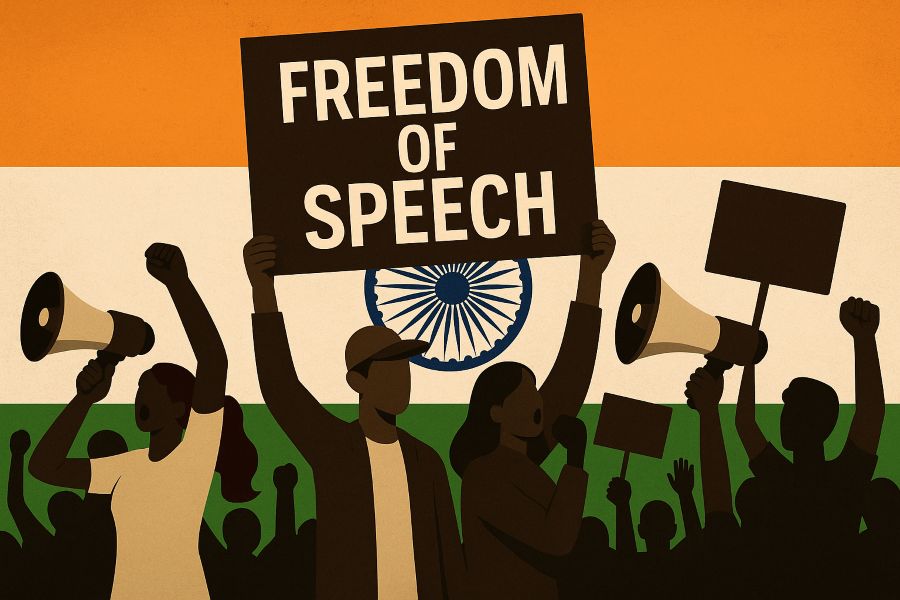
The Neha Singh Rathore case tests India’s constitutional promise of free expression and raises critical questions about sedition, democratic rights, and judicial oversight.
THE ALLAHABAD High Court has recently rejected the bail application of Bhojpuri folk singer Neha Singh Rathore. The case against her arose after she posted several tweets in April 2025 criticizing the Prime Minister and the ruling party for allegedly exploiting a terrorist attack in Kashmir for political gain.

Neha Singh Rathore
Following the viral posts, the police registered an FIR under the Bharatiya Nyaya Sanhita, 2023, and the Information Technology Act, 2008, alleging that her statements endangered India’s sovereignty.
I am not going into the merits of the case, as the matter may be sub judice in a possible appeal before the Supreme Court of India. However, I would like to make some general observations.
In the Indian Constitution, promulgated on January 26, 1950, a set of fundamental rights was guaranteed to the people, including the freedom of speech and expression, modelled on the Bill of Rights in the U.S. Constitution. The judiciary was made the protector and guardian of these rights; otherwise, they would remain only on paper.
Also Read: A BLOW TO FREE DISCOURSE
A few months after the Constitution came into force, a Constitution Bench of the Supreme Court held in **Romesh Thapar vs State of Madras** (1950) that in a democracy people have the right to criticise the government. The Court observed:
“Criticism of government exciting disaffection or bad feelings towards it is not to be regarded as a justifying ground for restricting the freedom of expression or of the press.”
Courts Have Consistently Affirmed That Criticism Is Not Sedition
This view, expressed differently, was reiterated by Justice Abdul Quddhose of the Madras High Court in his historic verdict in Thiru N. Ram vs Union of India & Anr. The learned judge observed:
“A very important aspect of democracy is that citizens should have no fear of the government. They should not be scared of expressing views which may not be liked by those in power.”
He further stated:
“Criticism of the government is not sedition unless there is a call for public disorder or incitement to violence.”
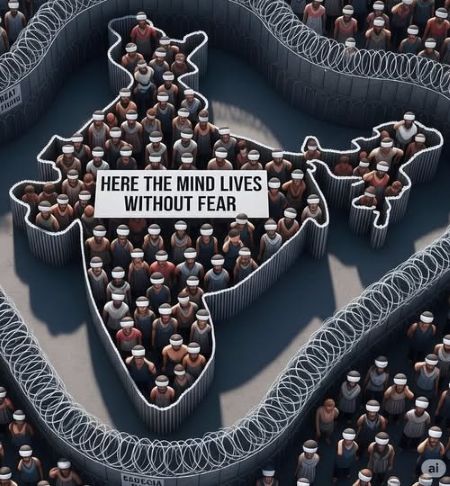 Justice Quddhose also observed, following the Supreme Court’s 1956 verdict in Kartar Singh vs State of Punjab, that people in power must develop “thick skins”. In other words, the authorities should have broad enough shoulders to bear criticism.
In State of Maharashtra vs Bhaurao Punjabrao Gawande (2008), the Supreme Court observed that while the first objective of the Constitution’s framers was to give the people a government, the second—equally important—was to protect the people against the government. The Court stated:
“The imperative necessity to protect the people’s rights is a lesson taught by all history and all human experience. Our Constitution makers had lived through bitter years of the freedom struggle and had seen an alien government trample upon human rights which the country had fought hard to preserve. They believed, like Jefferson, that ‘an elective despotism was not the government we fought for’.”
This decision is very relevant to the prevailing situation today. Politicians in power nowadays are often very touchy, unwilling to tolerate any criticism from anyone.
The Judiciary’s Duty as Sentinel on the Qui Vive
The question, therefore, is whether the Supreme Court or the High Courts should ignore the suppression of free speech and criticism of the government merely because the government labels it sedition or a threat to national security.
What then will remain of the Court’s numerous verdicts declaring that the Supreme Court is the guardian of the Constitution and the protector of the people’s rights—including the right to free speech?
 In its early decision in State of Madras vs V.G. Row (1952), the Supreme Court held that “as regards fundamental rights the Court has been assigned the role of a sentinel on the qui vive”.
This principle has been reiterated in several later judgments such as I.R. Coelho vs State of Tamil Nadu (2007), Navtej Singh Johar vs Union of India (2018), Shakti Vahini vs Union of India (2018), C. Ravichandran Iyer vs Justice A.M. Bhattacharjee (1995), Padma vs Hiralal Motilal Desarda (2002), Bachan Singh vs State of Punjab (1982), and Indra Sawhney vs Union of India (1992).
Also Read: SC, Free Speech & Obscenity: A Legal Tightrope
The right to freedom of speech, including the right to criticise the government, has again been reaffirmed in recent decisions of the Supreme Court, which have held that such criticism does not amount to sedition (links below):
I appeal to the Supreme Court to consider all that has been stated above when it hears the appeal of Neha Singh Rathore against the High Court’s order rejecting her bail application. 
__________
Also Read:
Patiala Police Audio Leak Exposes Deep Rot in Punjab Under AAP Rule
GANG CANAL ROW — How Modi Govt Retreated at Double Speed After Punjab Today Report

Markandey Katju
Justice Markandey Katju is former Judge, Supreme Court of India and former Chairman, Press Council of India.
Disclaimer : PunjabTodayNews.com and other platforms of the Punjab Today group strive to include views and opinions from across the entire spectrum, but by no means do we agree with everything we publish. Our efforts and editorial choices consistently underscore our authors’ right to the freedom of speech. However, it should be clear to all readers that individual authors are responsible for the information, ideas or opinions in their articles, and very often, these do not reflect the views of PunjabTodayNews.com or other platforms of the group. Punjab Today does not assume any responsibility or liability for the views of authors whose work appears here.
Punjab Today believes in serious, engaging, narrative journalism at a time when mainstream media houses seem to have given up on long-form writing and news television has blurred or altogether erased the lines between news and slapstick entertainment. We at Punjab Today believe that readers such as yourself appreciate cerebral journalism, and would like you to hold us against the best international industry standards. Brickbats are welcome even more than bouquets, though an occasional pat on the back is always encouraging. Good journalism can be a lifeline in these uncertain times worldwide. You can support us in myriad ways. To begin with, by spreading word about us and forwarding this reportage. Stay engaged.
— Team PT