


This Is Not Just a New Scheme — It’s a New Political Message
AROUND THE TIME of the Rath Yatra, when the BJP began to rise, it projected itself as a “party with a difference.”
As the electoral power of this party increased, many thinkers and writers were not too worried, as they saw in the BJP merely another version of the then-ruling Congress.

Vajpayee era NDA leadership, when the BJP projected itself as a “party with a difference.”
Its true colours started becoming visible even when it was the dominant partner in the NDA with Vajpayee as the leader.
It came to power twice for short periods of 13 days and 13 months before it ruled for nearly six years with Vajpayee as the Prime Minister.
Many of those writers then saw the “difference,” as the stifling of democratic norms was already in the air even during that period.
From Rights-Based Welfare to Centralised Control
The period of UPA I, in particular, was marked by a series of welfare schemes based on the concept of “rights” — the Right to Information, Right to Health, Right to Food, Right to Education and more.

This was arguably the peak phase of Indian democracy, as the rights of average and poor citizens came to the forefront.
Social movements exerted adequate pressure to ensure that the Government not only fulfilled its constitutional duties and launched rights-based schemes but also upheld the empowerment of deprived sections.
With the third term of the Narendra Modi Government, the core agenda of communal politics is becoming more apparent.
Nationalism has been constructed around Hindu identity, with growing centralisation of power and undermining of the federal structure and the very concept of India being a “Union of States.”
Rights-based schemes are being sidelined and replaced with policies resembling an authoritarian welfare model, where the state “doles out benefits” instead of guaranteeing rights. Decentralization is gradually being eroded.
 There is a perception that the BJP–RSS combine is only against Muslims.
The truth is that it is also against the marginalized and labouring sections — Dalits, workers, Adivasis and women in particular. We witnessed the farm laws, which peasants strongly opposed but which were stubbornly introduced.
Nearly 600 peasants sacrificed their lives before the laws were repealed. Recently, labour codes were introduced which take away many hard-earned rights of working people.
Now we are seeing a similar trend affecting farm workers, as MGNREGA is being scrapped and the VB G-RAM-G scheme is being introduced.
G-RAM-G vs MGNREGA: From Demand-Driven to Allotment-Based Employment
The Central Government is replacing the Mahatma Gandhi National Rural Employment Guarantee Act (MGNREGA) with the Viksit Bharat – Guarantee For Rozgar and Ajeevika Mission (Gramin) Bill, 2025 (VB G-RAM-G).

It is a clever mix of English and Hindi/Urdu words forming the acronym “RAM,” invoking the deity central to BJP’s identity politics.
One of the main features of the new Bill is the increase in employment days from 100 to 125. At first glance, this seems like an improvement.
However, MGNREGA is fundamentally demand-driven, based on the statutory right of any unemployed rural citizen to demand work.

As per the MGNREGA Sangharsh Morcha, “MGNREGA establishes a statutory right to work that is demand-driven and universal.”
But under G-RAM-G, Section 5(1) states that employment will only be provided in areas notified by the Central Government.
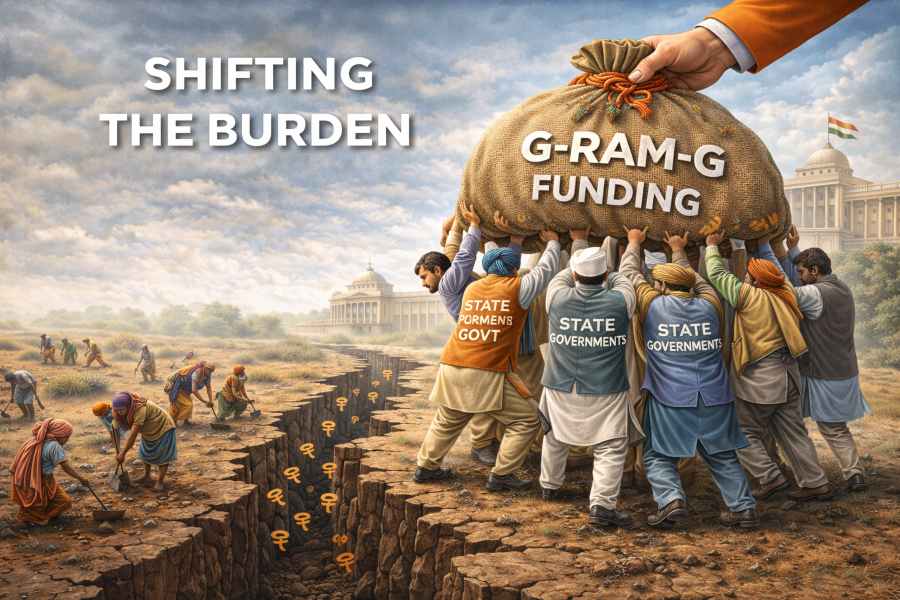
This clearly restricts its universal nature. Section 4(5) states that the Centre will decide state-wise allocations, while Section 4(6) makes states responsible for any expenditure beyond that.
The basic logic of MGNREGA is reversed — from a demand-driven system to a supply-driven one, where employment must fit a predetermined budget.
Earlier, 90% of MGNREGA funding came from the Centre. Under G-RAM-G, in most states the Centre will provide only 60%, with 40% to be borne by financially stressed state governments.

This may compel states to avoid registering employment demands. Earlier, Gram Sabhas planned work locally.
Now, Schedule 1 Clause 6(4) empowers a central infrastructure stack to guide states, districts and Panchayati Raj Institutions — significantly undermining decentralised democracy.
Also Read: Why BJP Is Undermining Democratic Traditions
Section 6(2) also mandates that states declare 60 days during peak agricultural seasons when no employment work will be undertaken — totally contrary to the spirit of MGNREGA.
Political Messaging: Removing Gandhi, Introducing RAM
The deletion of Gandhi’s name and the introduction of “RAM” through linguistic acrobatics is also politically symbolic.

It was the ideology of Hindu nationalism that created hatred leading to Gandhi’s assassination (as Sardar Patel himself noted).
Today, Gandhi is confined to Swachh Bharat, while his name is removed from a people-centric employment scheme. This clearly signals that his ideology is not what the BJP wishes to pursue.
This transition from MNREGA to G-RAM-G reveals much about the BJP’s agenda — moving away from Gandhi’s ideology, undermining federalism, dismantling rights-based welfare, and disregarding the marginalized. 
_________
Also Read:
SAHITYA AKADEMI AWARDS ROW: Power Comes A-Knocking, or Writers Go Knocking at Power’s Door?
Ram Puniyani
Author is a former professor of biomedical engineering and former senior medical officer affiliated with the Indian Institute of Technology Bombay.
Disclaimer : PunjabTodayNews.com and other platforms of the Punjab Today group strive to include views and opinions from across the entire spectrum, but by no means do we agree with everything we publish. Our efforts and editorial choices consistently underscore our authors’ right to the freedom of speech. However, it should be clear to all readers that individual authors are responsible for the information, ideas or opinions in their articles, and very often, these do not reflect the views of PunjabTodayNews.com or other platforms of the group. Punjab Today does not assume any responsibility or liability for the views of authors whose work appears here.
Punjab Today believes in serious, engaging, narrative journalism at a time when mainstream media houses seem to have given up on long-form writing and news television has blurred or altogether erased the lines between news and slapstick entertainment. We at Punjab Today believe that readers such as yourself appreciate cerebral journalism, and would like you to hold us against the best international industry standards. Brickbats are welcome even more than bouquets, though an occasional pat on the back is always encouraging. Good journalism can be a lifeline in these uncertain times worldwide. You can support us in myriad ways. To begin with, by spreading word about us and forwarding this reportage. Stay engaged.
— Team PT