


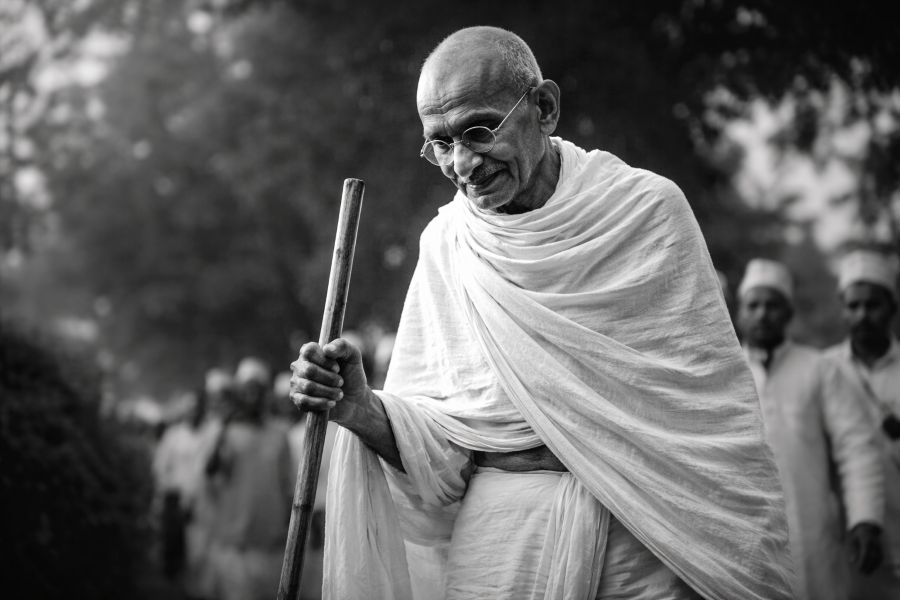
Remembering Gandhi without sanctifying power, silencing dissent, or emptying truth of meaning
ON JANUARY 30, India observes Martyrs’ Day in memory of Mahatma Gandhi. The ritual is familiar: floral tributes, official statements, a two-minute silence at 11 a.m. What is less familiar is genuine discomfort. And yet, discomfort is exactly what Gandhi’s life — and death — were meant to provoke.
 Gandhi was not assassinated because he was universally loved. He was killed because he refused to align with hatred, because he insisted on moral restraint at a moment when rage promised faster results. His death was not an accident of history; it was a consequence of ideas that challenged power, pride, and prejudice.
To remember Gandhi only as a saintly icon is to misunderstand him. He was not a symbol created to soothe us. He was a conscience meant to unsettle us.
From Man to Monument
Over the decades, Gandhi has slowly been transformed from a questioning human being into a ceremonial figure. His image is ubiquitous — on currency notes, statues, billboards, official functions — yet his philosophy is increasingly treated as impractical, outdated, or inconvenient.
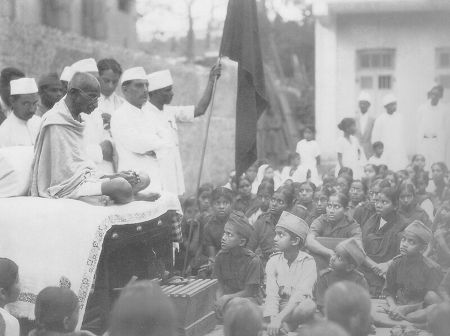
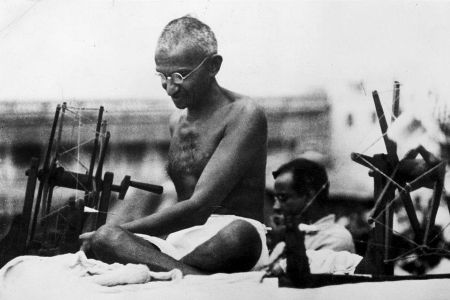
Gandhi during Non-Cooperation Movement
George Orwell, writing in 1949, captured this tension sharply when he noted that “saints should always be judged guilty until they are proved innocent.” Orwell admired Gandhi’s moral courage but warned against romanticising him into something unreal and unreachable. India, ironically, has done exactly that — turning Gandhi into a monument rather than engaging with him as a man.
The problem with monuments is that they demand reverence, not reflection. Gandhi never wanted reverence. He wanted debate, disagreement, and moral effort.
The Discipline of Non-Violence
Gandhi’s ahimsa is often misunderstood as passivity. It was anything but. Non-violence, for Gandhi, was an active discipline — requiring greater courage than retaliation.
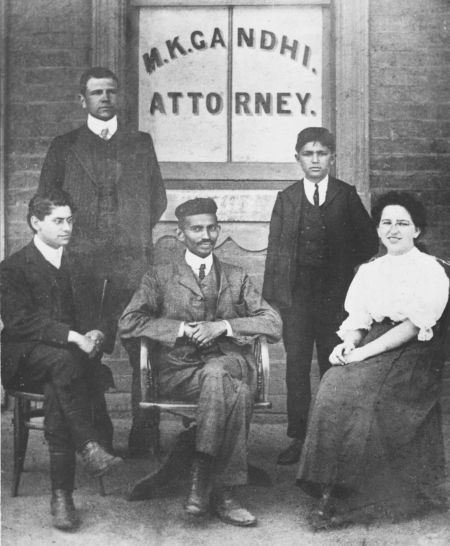
Mohandas Karamchand Gandhi (center) sits with co-workers at his Johannesburg law office in 1902.
“Non-violence is the greatest force at the disposal of mankind,” he wrote, “but it is a force that requires immense self-control.”
Martin Luther King Jr., who drew deeply from Gandhi’s methods, understood this well. “Christ furnished the spirit and Gandhi furnished the method,” King said, recognising that non-violence was not surrender but strategy rooted in moral authority.
In today’s climate — where outrage is rewarded and aggression is normalised — Gandhi’s insistence on restraint appears almost subversive. He believed violence corrupted not only institutions but the individual soul. That belief did not make him popular. It made him persistent.
Kasturba Gandhi: The Forgotten Partner
No serious reflection on Gandhi is complete without acknowledging Kasturba Gandhi, whose contribution to his philosophy is frequently understated.
Long before Gandhi became a global figure, Kasturba endured prison, poverty, illness, and public scrutiny — often without choice.
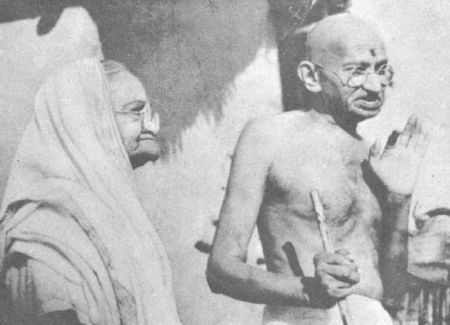
Kasturba And Gandhi
She challenged him too. She resisted some of his experiments, disagreed with his extreme vows, and paid a personal price for his public ideals.
When Gandhi spoke of self-discipline and sacrifice, Kasturba lived its consequences daily.
In many ways, she represented the quieter cost of moral absolutism — the toll it took on family life, companionship, and personal comfort. To acknowledge Kasturba is to recognise that Gandhi’s path, however principled, was not without collateral suffering.
The Nationalism Gandhi Warned Against
Gandhi was deeply nationalist, yet profoundly wary of nationalism unmoored from ethics. He feared that love for the nation could mutate into hatred for others. “I am patriotic because I am human,” he said, rejecting the idea that patriotism required hostility.
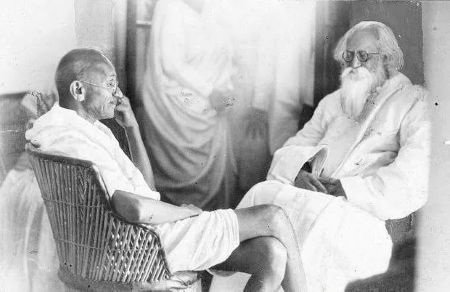
Mahatma Gandhi in conversation with Rabindranath Tagore
Rabindranath Tagore, who famously called Gandhi Mahatma, also disagreed with him at times. Tagore worried that moral purity could harden into rigidity, while Gandhi feared that compromise could slide into moral decay. Their disagreements were respectful, public, and deeply intellectual — a form of discourse that feels rare today.
Gandhi believed dissent was not a threat to the nation but its safeguard. That belief sits uneasily in an era where disagreement is often framed as disloyalty and conformity is rewarded as patriotism.
Journalism, Truth, and Moral Courage
For journalism, Gandhi’s relevance is unavoidable. He edited newspapers, understood mass communication, and warned against manipulation of public sentiment. “Truth is the first casualty when there is a clash of power,” he observed long before the age of algorithms and prime-time shouting matches.
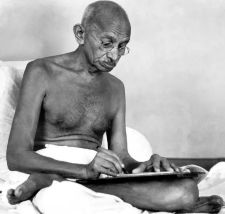
In a media environment driven by TRPs, virality, and ideological alignment, Gandhi’s insistence on calm truth-telling feels almost radical. He would have been suspicious of noise masquerading as debate and opinion presented as fact.
To invoke Gandhi while abandoning verification, balance, and restraint is hypocrisy. Martyrs’ Day demands that journalism recommit itself to truth — not as a slogan, but as a discipline.
Criticism That Cannot Be Ignored
An honest remembrance must also confront criticism of Gandhi’s lifestyle and choices. His experiments with celibacy, his rigid expectations of others, and his willingness to subject personal relationships to ideological tests have long been debated.
Even admirers concede that Gandhi’s moral absolutism sometimes left little room for human frailty. His lifestyle, while inspirational to many, could also appear austere to the point of severity.
Yet it is precisely this complexity — the blend of greatness and imperfection — that makes Gandhi relevant. He was not a flawless saint. He was a demanding moral actor, often struggling with his own contradictions.
Silence, Then and Now
At 11 a.m. on January 30, India observes a two-minute silence. But silence, for Gandhi, was never emptiness. It was introspection.
The question Martyrs’ Day asks is uncomfortable: have we learned to argue without dehumanising? To disagree without destroying? To exercise power without cruelty?
Also Read: The Speech That Transformed M. K. Gandhi into Mahatma Gandhi
Albert Einstein once remarked, “Generations to come will scarce believe that such a one as this ever in flesh and blood walked upon this earth.” Perhaps the greater tragedy is not that Gandhi seems unreal — but that his ideas are treated as unworkable.
Listening Instead of Worshipping
Gandhi did not ask to be immortalised. He asked to be understood. He believed moral progress was slow, difficult, and lonely — but necessary.
To remember him honestly is to resist easy slogans, loud nationalism, and comfortable myths. It is to accept that his life poses questions we would rather avoid.
Gandhi did not die on January 30, 1948, merely because a bullet struck him. He dies again whenever truth is inconvenient, restraint is mocked, and violence is excused.
Remembering him is not about becoming a Mahatma.
It is about refusing to become indifferent.
“The greatness of humanity is not in being human, but in being humane.” — Mahatma Gandhi 
_________
Also Read:
Basant in Pakistan, my friend Gobind Thukral, & Malkoo’s ‘Nak Da Koka’
Punjab Congress Infighting: When a Party Chooses Self-Destruction Over Revival

Punjab Today
punjabtodaynews@gmail.com
Disclaimer : PunjabTodayNews.com and other platforms of the Punjab Today group strive to include views and opinions from across the entire spectrum, but by no means do we agree with everything we publish. Our efforts and editorial choices consistently underscore our authors’ right to the freedom of speech. However, it should be clear to all readers that individual authors are responsible for the information, ideas or opinions in their articles, and very often, these do not reflect the views of PunjabTodayNews.com or other platforms of the group. Punjab Today does not assume any responsibility or liability for the views of authors whose work appears here.
Punjab Today believes in serious, engaging, narrative journalism at a time when mainstream media houses seem to have given up on long-form writing and news television has blurred or altogether erased the lines between news and slapstick entertainment. We at Punjab Today believe that readers such as yourself appreciate cerebral journalism, and would like you to hold us against the best international industry standards. Brickbats are welcome even more than bouquets, though an occasional pat on the back is always encouraging. Good journalism can be a lifeline in these uncertain times worldwide. You can support us in myriad ways. To begin with, by spreading word about us and forwarding this reportage. Stay engaged.
— Team PT