


How a Gang Canal event organised by BJP leaders has triggered backlash across Punjab.
UNION MINISTER Arjun Ram Meghwal is scheduled to tour Punjab and Rajasthan this week, with stops in Amritsar, Ferozepur and Sri Ganganagar, including an overnight stay at the BSF Sector Headquarters in Ferozepur.
The programme itself is routine, but one engagement linked to the visit has triggered unexpectedly sharp reactions in Punjab: a ceremony celebrating the centenary of the Gang Canal.
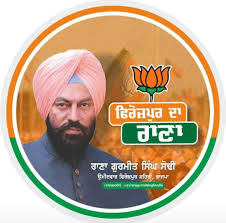
Rana Gurmit Singh Sodhi
Punjab BJP leader Rana Gurmit Singh Sodhi is organising the event, and for many Punjabis, the very mention of the Gang Canal reopens a century-old wound. The canal is remembered not as a symbol of progress but as the beginning of a long history of Punjab’s river waters flowing out to benefit territories outside the state.
That the celebration is being held in Punjab — rather than Rajasthan — has compounded public discomfort.
The sensitivity around the celebration does not arise from chronology but from context. Whether one commemorates the laying of the foundation stone or the later completion of the canal is secondary in Punjab.
What matters is the decision to foreground a project historically associated with the outflow of Punjab’s water — and to do so at a moment when farmer unrest, water anxiety and agrarian stress are already high. In a state where rivers and rights are tightly tied to identity and memory, the timing and framing of this celebration have triggered widespread unease.
The elebration and Its Political Optics
Rana Gurmit Singh Sodhi’s involvement adds a political edge. A former Congress minister who joined the BJP ahead of the 2022 elections, Sodhi is now central to an event Punjab’s public does not view as its own milestone.
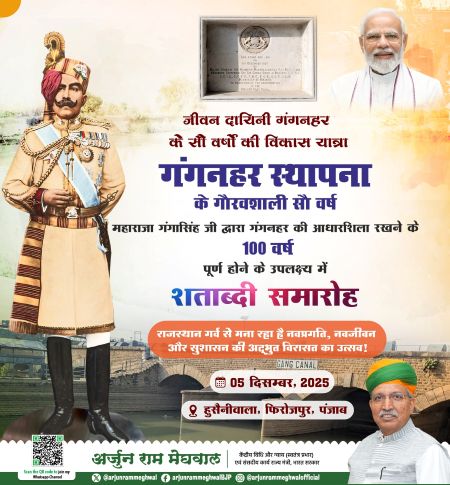
Poster shared by Union Minister Arjun Ram Meghwal.
Many question why such a celebration is being held in Punjab at all, and why a Union Minister is linked to a canal that, in the eyes of Punjab, symbolises historic resource loss.
The poster shared by Union Minister Arjun Ram Meghwal on his official Twitter account places the event at Hussainiwala in Ferozepur. But the concern in Punjab is not about technicalities; it is about symbolism.
Holding such a celebration on Punjab’s soil — in Hussainiwala, a highly sensitive border district — for a canal historically associated with carrying Punjab’s water into Rajasthan has struck a raw nerve.
At a time of renewed farmer agitation and deepening anxieties over water and agrarian policies, the choice of location has only intensified public discomfort.
The official tour programme of Minister Meghwal, accessed by Punjab Today, clearly lists the function as an event “organised by Dr. Rana Gurmit Singh Sodhi,” identifying him as a Special Invitee to the BJP National Executive and a former Punjab minister.
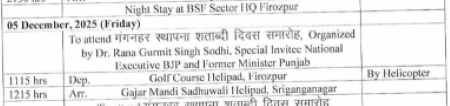
Tour programme listing Rana Sodhi as event organiser.
This establishes that the political initiative for the centenary celebration is being driven from within the Punjab BJP leadership rather than from Rajasthan — a detail that further complicates the optics of holding such a programme in Ferozepur.
Punjab Today attempted to contact Dr. Rana Gurmit Singh Sodhi for his response, but he could not be reached on phone. If any reaction is received, this story will be updated.
The Gang Canal’s History and Punjab’s Century of Hurt
To understand Punjab’s reaction, one must revisit the canal’s origins. The Gang Canal, also known as the Bikaner Gang Canal, was conceived and executed by Maharaja Ganga Singh of the Bikaner princely state. Construction began in 1922, with the foundation stone laid in December 1925, and the canal became operational a few years later.
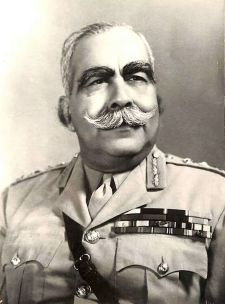
Maharaja Ganga Singh
Its purpose was to draw water from near the Harike headworks — where the Sutlej and Beas meet — and carry it into the arid Bikaner region, transforming what is now Sri Ganganagar and Hanumangarh into fertile agricultural districts.
For Rajasthan, the canal is a story of transformation. For Punjab, it is a story of loss. The canal marked the earliest large-scale diversion of Punjab’s river waters under arrangements made without Punjab’s consent.
This moment set the pattern for later disputes such as the Sutlej–Yamuna Link canal and contributed to Punjab’s enduring belief that decisions about its rivers have repeatedly been made elsewhere, leaving the state to bear the ecological cost.
This history still shapes Punjab’s present. The state’s farmers confront falling groundwater levels, fragile river systems, rising input costs and deep ecological stress.
Against this backdrop, celebrating — and celebrating on Punjab’s land — a project linked to the historic outflow of Punjab’s water appears to many as disregard for their lived reality. The resentment is rooted not in politics alone but in a century-old grievance tied to Punjab’s identity and survival.
A State on Edge: Farmers’ Anger and Federal Sensitivities
The controversy comes at a time of rising farmer mobilisation. Several Punjab farmer unions, led by the Kisan Mazdoor Morcha, have announced a statewide rail-roko protest on 5 December, to be held from 1 pm to 3 pm across nearly two dozen railway points.
The agitation targets the draft Electricity (Amendment) Bill 2025, the spread of prepaid meters, and broader agrarian grievances. Though the protest is described as symbolic, the scale of participation signals deep frustration on the ground.
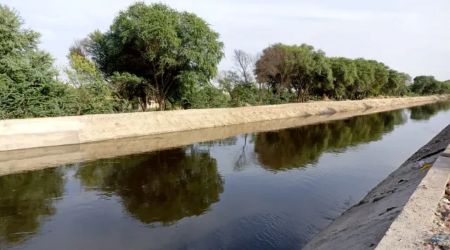
Water flowing in the Gang Canal in Sri Ganganagar, supplied from the Harike headworks in Punjab. (Courtesy: Express photo)
In such a volatile atmosphere, any celebration linked to historic water diversion appears politically tone-deaf. The BJP continues to face mistrust in rural Punjab after the farm laws agitation. Leaders often require heavy security to enter villages. For many Punjabis, the centenary event — its timing, its location, its framing — feels out of sync with ground realities.
Beyond the immediate unrest lies a broader federal question. Punjab has long expressed concern that decisions affecting its core resources — water, power, institutions, and administrative rights — are made without adequate consultation. Hosting a celebration for a canal that symbolises Punjab’s loss, and doing so in a sensitive border district, reinforces the perception that Punjab’s sensitivities remain unacknowledged in national politics.
A Baffling Silence From Punjab’s Political Class
What has surprised many observers is not only the controversy itself but the deafening silence from Punjab’s political class. On an issue as emotionally charged as river waters — one that has shaped the state’s politics, identity and federal debates for decades — most political parties have avoided taking any public position.

Bhagwant Mann and Arvind Kejriwal.
This is striking, given that Punjab’s leadership has historically reacted vigorously to even minor water-related developments.
The AAP government, the Congress, the Akali Dal and other regional formations have all maintained an unexplained distance from the issue. This silence stands in sharp contrast to public sentiment, where the canal’s centenary touches upon a deep historical wound.
Voters expect their political representatives to speak for Punjab’s rights, especially on matters involving its rivers and identity. The absence of political pushback has widened the gap between public anxieties and political messaging.

Sukhbir Singh Badal
Even leaders who have built their careers around Punjab’s water rights have chosen not to speak. Sukhbir Singh Badal, who has represented both Ferozepur and Faridkot in the Lok Sabha, has also remained silent.
His silence is particularly notable because the event is being held in Hussainiwala, Ferozepur — a constituency he has repeatedly invoked as central to Punjab’s cultural memory, border sensitivity and regional pride. For someone who has often spoken forcefully on Punjab’s riparian rights and federal injustices, this silence has surprised many and reinforced the perception that the state’s political class is disconnected from the sensitivities involved in this celebration.
A Miscalculation That Could Have Been Avoided
The episode underscores a simple truth: political engagement in Punjab requires historical awareness and emotional sensitivity. An approach grounded in empathy, dialogue and recognition of Punjab’s grievances would have been far more constructive.
 Instead, the centenary celebration — held in Punjab, organised by a Punjab BJP leader, and centred on a project Punjab associates with loss — has placed the BJP on the wrong foot at a moment when trust is already fragile.
For many Punjabis, the message is unmistakable. While the state grapples with shrinking water tables, unresolved river disputes and intensifying agrarian distress, the ruling party at the Centre appears prepared to commemorate the origins of a chapter Punjab remembers as painful.
Whether intentional or not, the optics deepen the distance between Punjab and the BJP at a time when the state needed understanding, not symbolism. 
_________
Also Read:
Chandigarh and Punjab: The Broken Promises, Political Betrayals and the Fight for the Capital
Are Bombay High Court Officials Unaware of Amended Court-Fee Law?

kanwar manjit singh
Kanwar Manjit Singh, Founder Editor of Punjab Today, writes extensively on Punjab’s history, governance, and the evolving landscape of civil liberties in India.
Disclaimer : PunjabTodayNews.com and other platforms of the Punjab Today group strive to include views and opinions from across the entire spectrum, but by no means do we agree with everything we publish. Our efforts and editorial choices consistently underscore our authors’ right to the freedom of speech. However, it should be clear to all readers that individual authors are responsible for the information, ideas or opinions in their articles, and very often, these do not reflect the views of PunjabTodayNews.com or other platforms of the group. Punjab Today does not assume any responsibility or liability for the views of authors whose work appears here.
Punjab Today believes in serious, engaging, narrative journalism at a time when mainstream media houses seem to have given up on long-form writing and news television has blurred or altogether erased the lines between news and slapstick entertainment. We at Punjab Today believe that readers such as yourself appreciate cerebral journalism, and would like you to hold us against the best international industry standards. Brickbats are welcome even more than bouquets, though an occasional pat on the back is always encouraging. Good journalism can be a lifeline in these uncertain times worldwide. You can support us in myriad ways. To begin with, by spreading word about us and forwarding this reportage. Stay engaged.
— Team PT