


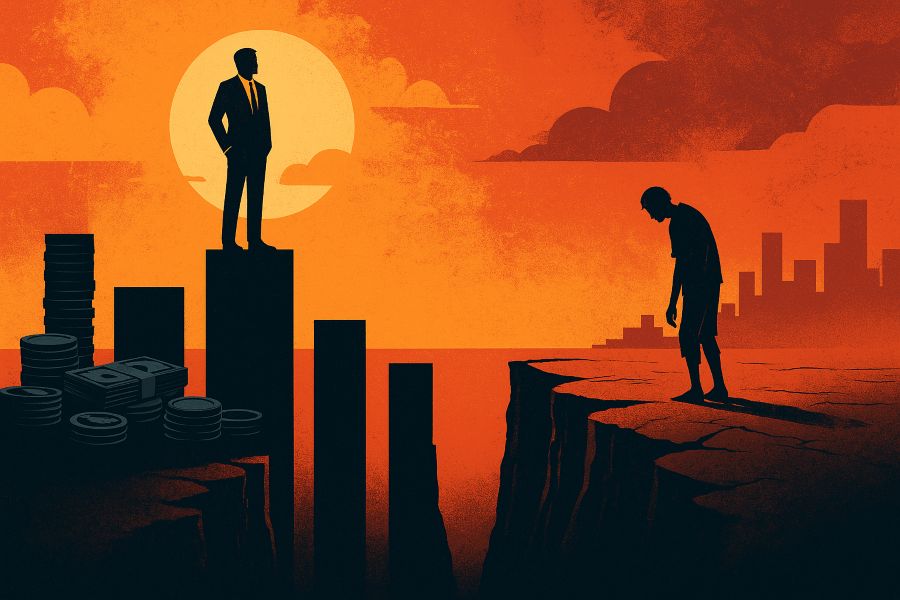
A world where the rich soar and the poor sink — the G-20 panel sounds an urgent alarm.
AN INTERNATIONAL Panel on Inequality has pointed out that global income inequality has reached “emergency levels,” endangering democracy and social cohesion. The report says that over the last 15 years, the rich have grown richer while the poor have become poorer.
Despite numerous welfare models being implemented across nations, the gap between the rich and the poor continues to widen. In India, the inequality is even more pronounced. India’s richest 1 per cent increased their wealth by 62 per cent between 2000 and 2023, according to a recent report commissioned by the G-20. This trend reflects global patterns of rising wealth concentration.
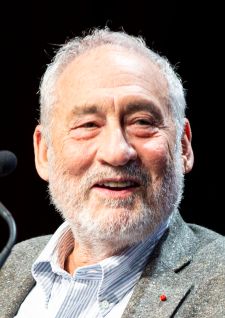
Joseph E. Stiglitz
The study found that the richest 1 per cent of people in the world captured 41 per cent of all new wealth created between 2000 and 2024, while the bottom half of the global population received only 1 per cent. Increasing wealth inequality is a worldwide crisis that threatens democracy and social cohesion.
Led by Nobel Prize-winning economist Joseph Stiglitz, the study warns that global inequality has reached “emergency levels,” putting economic stability and climate progress at risk. Inequality erodes trust in institutions, fuels political polarisation, reduces participation among poorer citizens, and creates multiple types of social tensions.
The report was prepared by the G-20 Extraordinary Committee of Independent Experts on Global Inequality, which includes economists Jayati Ghosh, Winnie Byanyima, and Imraan Valodia.
Around 2.3 billion people now face food insecurity—an increase of 335 million since 2019—and half the world’s population still lacks access to basic health services, with 1.3 billion people pushed into poverty by medical expenses. One in four people worldwide now regularly skips meals, even as global wealth has reached its highest level in history.
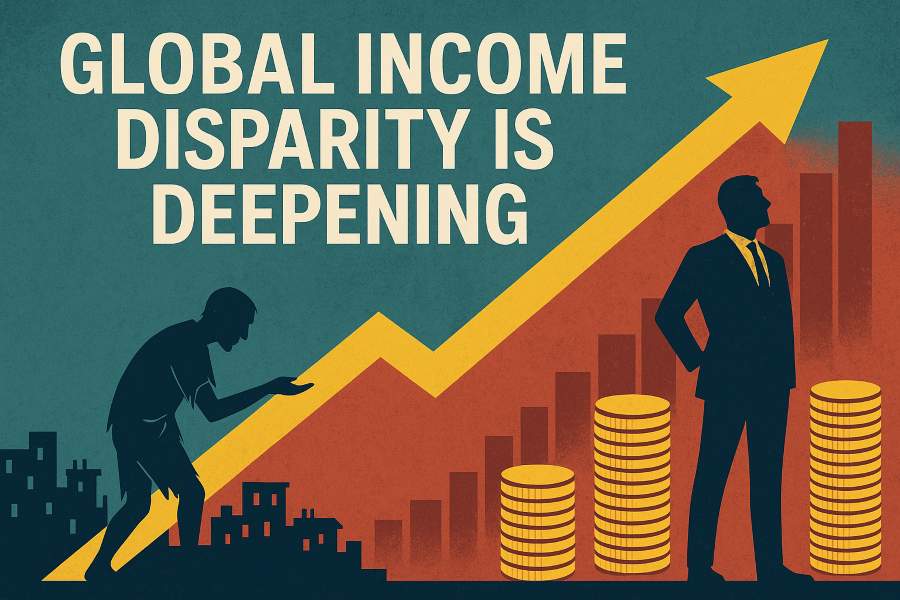
However, the experts believe that the problem of inequality can be tackled through international cooperation. The panel’s recommendation for the creation of a new body—the International Panel on Inequality (IPI)—deserves serious consideration.
Modelled on the Intergovernmental Panel on Climate Change (IPCC), the proposed body would track inequality trends worldwide and give governments clear, reliable data to guide policy. This is crucial because the report warns that countries with high inequality are seven times more likely to face democratic decline than those with fairer wealth distribution.
Over the past 40 years, the average income of individuals in the bottom 50 per cent of the world’s population has increased by just USD 358, while the top 1 per cent recorded an increase of USD 191,000 (at constant 2024-dollar rates), the report said. The findings should prompt policymakers to identify ways and means to bridge the ever-increasing gap.
The rich are steadily getting richer in the world’s fourth-largest economy, while the poor are getting poorer.

India’s rapid growth has not narrowed the income divide.
Earlier this year, the World Bank reported that India managed to lift 17 crore people out of extreme poverty between 2011–12 and 2022–23. The Centre hailed this as a major achievement, even as the methodology behind the poverty estimates came under scrutiny.
Efforts to reduce poverty should lead to qualitative improvements on the ground. While economists are generally not keen on imposing a wealth tax, the government must ensure that the super-rich contribute their fair share to the exchequer.
In India, the study further reveals, the richest added to their wealth by 62 per cent between 2000 and 2023, compared to China’s 54 per cent. India’s economic story therefore needs a closer look. India’s rapid growth—from the tenth-largest economy in 2014 to the fourth-largest today—rings hollow when it ignores the plight of the bottom 50 per cent who are fighting for survival.
Even if we set aside the lower strata of society, which survives mostly on welfare schemes and has negligible political representation, India’s middle class—considered the engine of the Indian economy—is also finding it increasingly difficult to sustain its middle-class ethos. Maintaining middle-class status requires a certain level of consumption consistent with modern demands, something the middle class is struggling to maintain amid rising inflation and declining real income.
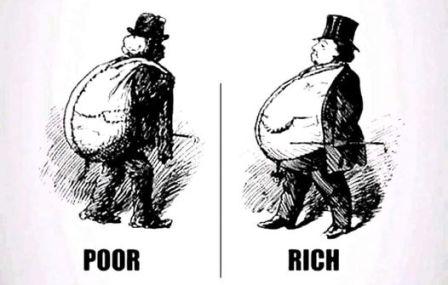
The gap between the wealthy and the poor continues to widen.
The report also demonstrates that high inequality is fuelling pandemics and deepening global vulnerability. Recent years have seen the African continent battling simultaneous pandemics—with Covid-19 and the ongoing AIDS crisis overlapping with mpox, Ebola, tuberculosis and others. Just last week, Namibia declared a new mpox outbreak.
Moreover, progress on addressing inequalities related to gender, sexuality and race has stalled. As the report notes, these inequalities can be addressed. South Africa, for instance, has listed equality as one of the pillars of its G-20 presidency.
The inequality–pandemic cycle works like this: Inequality makes communities and countries more vulnerable to disease outbreaks turning into pandemics. It also undermines effective responses, prolonging pandemics and making them deadlier and more economically disruptive.
Inequality between countries globalises this vulnerability by limiting access to international finance and cutting-edge science. And when pandemics strike, they further increase inequality within and between countries, reinforcing the cycle.
It is not only that low-income populations are more vulnerable during pandemics; inequality also undermines public health responses. Eight of the world’s 20 most unequal countries are in Africa, where multiple pandemics are converging. The report shows that the wider the gap between rich and poor—even after accounting for poverty levels—the higher the rates of HIV infections, AIDS deaths, and Covid-19 fatalities.
It becomes harder to coordinate effective responses in highly unequal societies where, instead of being “in it together,” the elite seek escape routes, pushing their pandemic risks onto others.
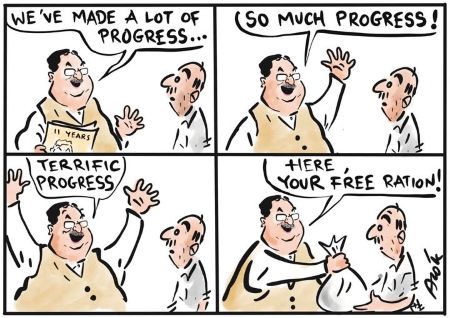
The biggest impact of economic inequality in India—and the world—has been on society. As education and healthcare remain inaccessible to the poor, their participation in nation-building becomes negligible, reducing them to mere vote banks for politicians. Furthermore, this inequality threatens the democratic process itself.
For any country to grow and sustain itself on the international stage, a certain level of social and political awareness among its people is essential—awareness that comes only with prosperity.
In a country where half the population struggles to make ends meet, such efforts are often met with indifference, leading to political polarisation and social fragmentation. This is reflected during elections, where voting is often based on caste or religion rather than performance.
India will need strong and united political will to counter the weight of growing inequality if it hopes to claim its rightful place on the global stage. Otherwise, the rising gap between the haves and the have-nots will undermine whatever progress has been made so far—economically and socially. 
________
Also Read:
Asad Mirza
The author is a New Delhi-based senior commentator on national and international affairs, defence and strategic issues, and environmental concerns. He is also an interfaith practitioner and a media consultant. Previously, he was associated with the BBC Urdu Service and the Khaleej Times in Dubai.
Disclaimer : PunjabTodayNews.com and other platforms of the Punjab Today group strive to include views and opinions from across the entire spectrum, but by no means do we agree with everything we publish. Our efforts and editorial choices consistently underscore our authors’ right to the freedom of speech. However, it should be clear to all readers that individual authors are responsible for the information, ideas or opinions in their articles, and very often, these do not reflect the views of PunjabTodayNews.com or other platforms of the group. Punjab Today does not assume any responsibility or liability for the views of authors whose work appears here.
Punjab Today believes in serious, engaging, narrative journalism at a time when mainstream media houses seem to have given up on long-form writing and news television has blurred or altogether erased the lines between news and slapstick entertainment. We at Punjab Today believe that readers such as yourself appreciate cerebral journalism, and would like you to hold us against the best international industry standards. Brickbats are welcome even more than bouquets, though an occasional pat on the back is always encouraging. Good journalism can be a lifeline in these uncertain times worldwide. You can support us in myriad ways. To begin with, by spreading word about us and forwarding this reportage. Stay engaged.
— Team PT