


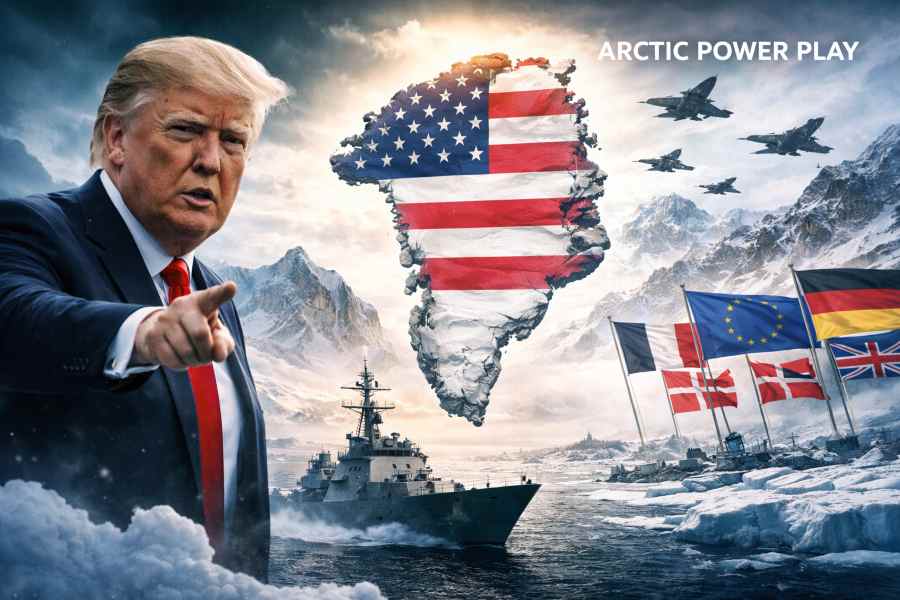
Greenland has resurfaced as an international flashpoint after US President Donald Trump renewed calls for control of the territory on national security grounds, hinting at military force and threatening tariffs on European allies.
IT SEEMS THERE is never a dull day under President Donald Trump’s watch. After allegedly kidnapping the Venezuelan president, he has again ratcheted up his demands for Greenland’s annexation to the United States or for greater control over its natural resources.
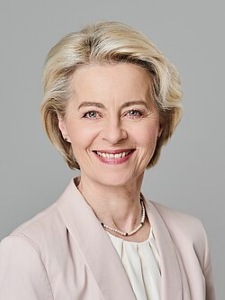
Ursula Von Der Leyen
Meanwhile, European Commission President Ursula von der Leyen said in a post on X that she had discussed Greenland and US actions with NATO Secretary-General Mark Rutte, French President Emmanuel Macron, Italian Prime Minister Giorgia Meloni, UK Prime Minister Keir Starmer, and German Chancellor Friedrich Merz.
She emphasised that the European Union would always defend its strategic economic and security interests. “We will face these challenges to our European solidarity with steadiness and resolve,” she added.
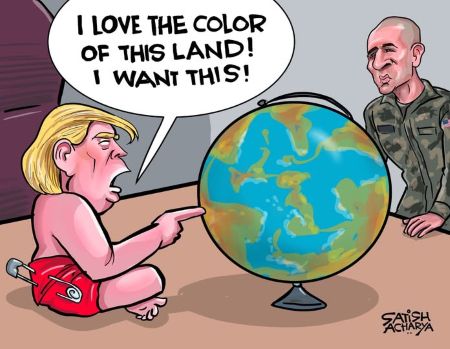
These comments came as NATO Secretary-General Mark Rutte confirmed that he had spoken with President Donald Trump on January 18 regarding the security situation in Greenland and the Arctic.
US President Donald Trump has doubled down on his threats to deploy troops to Greenland, this time accusing Denmark of not doing enough to counter potential threats from Russia.
“NATO has been telling Denmark for 20 years that ‘you have to get the Russian threat away from Greenland,’” he wrote on his Truth Social platform.
Europe Pushes Back as Trump Escalates Greenland Threats
Belgium’s defence minister has played down his country’s role in European military deployments to Greenland, saying the mission is focused on reconnaissance and coordination rather than confronting the US.
Belgium is sending a single officer to the autonomous Danish territory as part of a European detachment deployed at Copenhagen’s request.
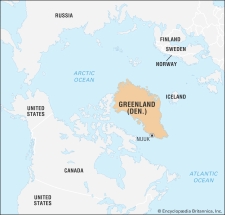
Greenland’s strategic position between North America and Europe.
UK opposition leaders also criticised Trump’s announcement. Conservative Party leader Kemi Badenoch said the tariffs were a “terrible idea”, while Reform UK leader and Trump ally Nigel Farage said they “will hurt us”. Liberal Democrat leader Ed Davey called Trump’s behaviour “unhinged” but said that how the UK responds “matters a lot”.
France’s President Emmanuel Macron has called for the EU to activate its most potent trade weapon against the US after Trump threatened to impose additional tariffs on several European countries in response to the Greenland dispute.
An Élysée official said on Sunday (January 18) that the French president would request the EU to activate its so-called anti-coercion instrument, which can restrict access to the single market for American companies.
Also Read: Trump’s Plan to Reshape Global Power Dynamics
Germany’s Vice-Chancellor and Finance Minister Lars Klingbeil said that “a line has been crossed”, adding that the affected nations “must not allow ourselves to be blackmailed”.
“It is unacceptable to hit countries that are now taking more responsibility for our common security in NATO,” said Denmark’s Defence Minister Troels Lund Poulsen.
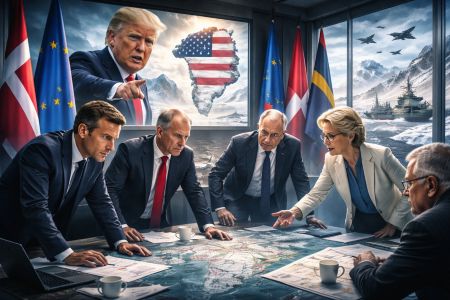
Denmark’s Foreign Minister Lars Løkke Rasmussen said the tariff move was “surprising” because he had had a “constructive dialogue” with Vice President JD Vance.
“It is paradoxical,” he said, “because what makes the president react is that we are doing what we are criticised for not doing—namely, taking care of the Arctic.”
Finnish President Alexander Stubb warned that tariffs would undermine the transatlantic relationship, while Swedish Prime Minister Ulf Kristersson and Norwegian Prime Minister Jonas Gahr Støre said Europe would not allow itself to be blackmailed.
EU Trade Commissioner Maroš Šefčovič said that implementation of the US-EU trade deal would be “very complicated” in light of Trump’s threats.
Why Greenland Matters: Strategic Power and Critical Minerals
Greenland’s strategic importance to the US dates back to the 19th century, and successive US administrations have explored acquiring the island.
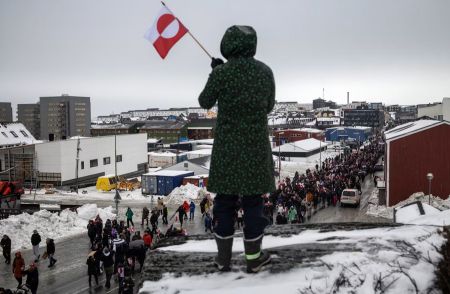
Residents protest Trump’s statements on Greenland in Nuuk. Photo: Marko Djurica/Reuters
Since the Second World War, Washington has enjoyed extensive access to Greenland under the 1951 Greenland Defence Agreement. However, US Arctic engagement declined after the Cold War.
Trump’s fixation on Greenland emerged during his first term, when he publicly proposed purchasing the island. European leaders largely treated the episode as a curiosity rather than a warning. Yet his interest persisted.
Trump reopened a US consulate in Nuuk in 2020, and officials who worked with him described his focus on acquiring Greenland as unusually intense and enduring.
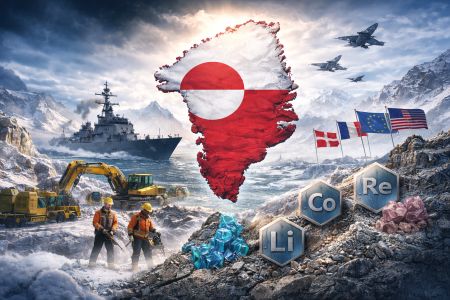
Greenland’s mineral wealth and its growing geopolitical importance.
Upon returning to office in 2025, he framed Greenland as a national security necessity and accused Denmark of failing to defend the territory adequately.
Greenland is home to massive deposits of rare earth minerals, crucial to US efforts to maintain its technological edge over China. However, experts note that extracting these minerals—vital for modern technology—is far from straightforward.
The US Geological Survey identifies 60 minerals as critical for the American economy and national security.
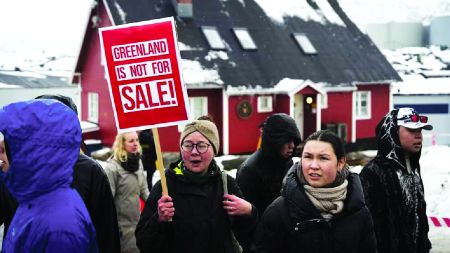
Public opposition in Greenland to foreign control narratives.
Rare earth elements such as neodymium and dysprosium are essential for magnets, motors, and advanced electronics, while others are central to semiconductor manufacturing and artificial intelligence technologies.
China dominates rare earth production and refining and has used this leverage in trade negotiations with Washington. Greenland’s mineral wealth therefore represents both an opportunity and a geopolitical flashpoint.
What Should Be the European Response?
Europeans have real leverage in the face of Donald Trump’s threats towards Greenland—and time is on their side. They must use it to raise the prospective costs of annexation.
Also Read: American Onslaught on Latin America
Trump thrives on ambiguity and fear of US power. Europe’s task is to fill that space calmly, collectively, and pre-emptively. The joint statement by European leaders on January 6 was a good start, as is the limited deployment of European troops to Greenland. But more coordinated action is required.

By acting swiftly, European leaders can outflank the US administration. In Trump’s own language, they have cards. Time is the decisive factor. Trump faces bipartisan criticism in Congress, midterm elections later this year, and the end of his presidential term in three years.
Political shifts within Greenland—and any commercial gains from US annexation—would take far longer to materialise, if they materialise at all.
Europe must therefore act decisively now. Caution in rhetoric is sensible, but clarity of purpose and resolve are essential to prevent escalation. 
__________
Also Read:
JAN 21 – when US Supreme Court opened billion-dollar road for the ilk of Trump in politics

Asad Mirza
The author is a New Delhi-based senior commentator on national and international affairs, defence and strategic issues, and environmental concerns. He is also an interfaith practitioner and a media consultant. Previously, he was associated with the BBC Urdu Service and the Khaleej Times in Dubai.
Disclaimer : PunjabTodayNews.com and other platforms of the Punjab Today group strive to include views and opinions from across the entire spectrum, but by no means do we agree with everything we publish. Our efforts and editorial choices consistently underscore our authors’ right to the freedom of speech. However, it should be clear to all readers that individual authors are responsible for the information, ideas or opinions in their articles, and very often, these do not reflect the views of PunjabTodayNews.com or other platforms of the group. Punjab Today does not assume any responsibility or liability for the views of authors whose work appears here.
Punjab Today believes in serious, engaging, narrative journalism at a time when mainstream media houses seem to have given up on long-form writing and news television has blurred or altogether erased the lines between news and slapstick entertainment. We at Punjab Today believe that readers such as yourself appreciate cerebral journalism, and would like you to hold us against the best international industry standards. Brickbats are welcome even more than bouquets, though an occasional pat on the back is always encouraging. Good journalism can be a lifeline in these uncertain times worldwide. You can support us in myriad ways. To begin with, by spreading word about us and forwarding this reportage. Stay engaged.
— Team PT