


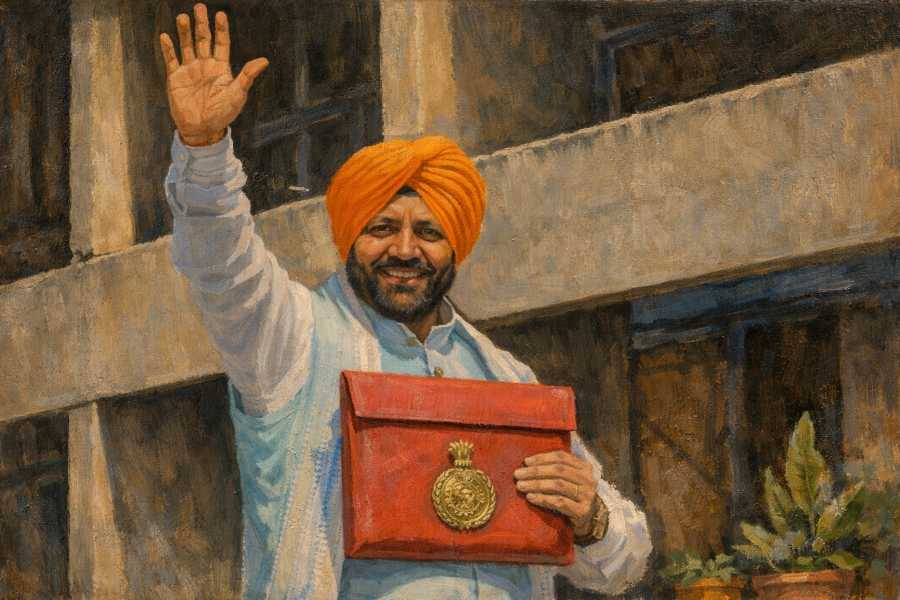
Before a single fiscal number was read aloud, Haryana’s Budget had already made its first impression. Chief Minister Nayab Singh Saini walked into the Vidhan Sabha wearing a saffron turban — a visual departure from routine budget presentations and one that immediately invited interpretation beyond economics.
IN NORTH INDIAN public life, symbolism often precedes policy. Saini’s references to Guru Nanak and Sant Ravidas during his address lent the occasion a cultural tone rarely associated with budget speeches.
The imagery resonated not only within Haryana but across the broader Punjabi cultural landscape, reflecting shared historical and social traditions that continue to shape regional politics. Seen in the wider political context, the gestures also carried a measured outreach dimension.
With the BJP seeking to expand its political space in Punjab ahead of the 2027 Assembly elections, the emphasis on shared spiritual idioms appeared less incidental and more reflective of a broader communication approach — subtle enough to remain within the framework of governance, yet visible enough to signal cultural familiarity beyond state boundaries.
In contemporary politics, symbolism often speaks before policy — and sometimes travels farther than numbers.
The messaging remained implicit, allowing the budget to retain its administrative character while acknowledging regional realities.
Yet symbolism was only the preface. Once the cultural overture concluded, the Chief Minister turned to the central task of presenting the ₹2.23 lakh crore Haryana Budget for 2026–27 in the Vidhan Sabha on March 2, 2026, outlining the state’s economic priorities at a time when Haryana itself is navigating transition.
Rooted in Agriculture, Responding to Rural Realities
Haryana’s politics continues to begin in its fields, and the budget ensured agriculture remained the starting point. The proposal to establish a dedicated agricultural power distribution system aims to address one of the most persistent concerns among farmers — reliable electricity supply for irrigation.
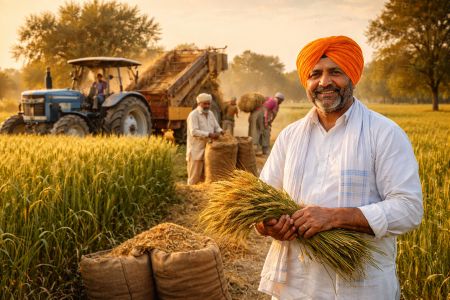
Agriculture remains key focus of the budget
Across rural Haryana, farming schedules often depend less on daylight and more on power availability. By focusing on electricity reform and crop diversification incentives, the government appears to be responding to practical challenges rather than offering headline announcements alone.
Measures encouraging alternative crops and strengthening rural credit institutions suggest an acknowledgement that long-term sustainability now matters as much as production volumes in a state shaped by the legacy of the Green Revolution.
For many farmers, policy debates translate into simple everyday calculations — whether electricity arrives on time, whether input costs remain manageable, and whether the next crop cycle feels financially secure.
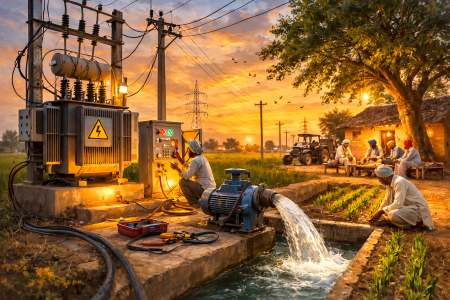
Power supply reforms for farmers in Haryana
In parts of rural Haryana, irrigation schedules still depend on late-night power supply windows, forcing families to reorganise daily routines around uncertainty.
By addressing power distribution and diversification together, the government appears to be acknowledging that agricultural stability today is less about higher procurement prices alone and more about predictability in farming conditions.
The success of these measures, however, will depend on administrative coordination at the ground level, where reform often meets resistance shaped by habit, risk and market anxiety.
The emphasis signals a gradual shift from subsidy-driven reassurance toward structural rural adjustment, even if political messaging continues to remain farmer-centric.
From Tractor Economy to Artificial Intelligence
If the early sections of the budget speak to Haryana’s agrarian foundations, its later announcements look firmly toward the future. The government’s proposed artificial intelligence mission and skill development initiatives aim to prepare large numbers of youth for emerging sectors, reflecting changing aspirations among the state’s younger population.
Haryana’s budget attempts to reassure the farmer while preparing a generation whose future may lie beyond the farm.
In towns across Haryana, coaching centres that once focused almost exclusively on government recruitment exams increasingly promote digital skills and technology training. The budget appears to recognise this social transition — that economic mobility for the next generation may depend less on land ownership and more on knowledge-based employment.
Higher allocations for education, health and skill development reinforce this shift toward human capital investment. The ambition is clear: Haryana seeks to evolve from an industrial and agricultural success story into a participant in the digital economy.

AI and skill development push in the budget
The broader economic challenge, however, lies in execution. Skill development announcements across India have often struggled to convert training into sustained employment, particularly in emerging technology sectors where industry absorption evolves unevenly.
Haryana’s ambition to prepare youth for artificial intelligence and digital governance will therefore require partnerships with private industry and educational institutions that extend beyond budgetary allocation.
Without such alignment, the risk remains that aspiration may outpace opportunity — a gap increasingly visible among young graduates navigating a rapidly changing job market.
Cultural Signalling and Political Subtext
What distinguished this budget from many earlier financial statements was its cultural framing. By invoking figures associated with social equality and spiritual reform, the speech positioned governance within a moral vocabulary rather than purely administrative language.
The budget reflects a state negotiating transition — where governance becomes a conversation about identity as much as economics.
Such symbolism inevitably carried regional resonance. Haryana and Punjab share deep linguistic, cultural and historical linkages, and political communication in the region often travels through shared cultural references.
Without explicit political messaging, the presentation hinted at broader outreach at a time when regional political alignments remain fluid ahead of upcoming electoral cycles.
In contemporary politics, gestures often communicate intent without declaration — allowing leaders to speak simultaneously to multiple audiences while maintaining institutional neutrality.
Development Ambitions Under Fiscal Constraints
Despite expansive announcements, fiscal realities remain central to Haryana’s economic story. A significant share of expenditure continues to be directed toward debt servicing, highlighting the structural pressures faced by rapidly developing states attempting to balance welfare commitments with infrastructure expansion.
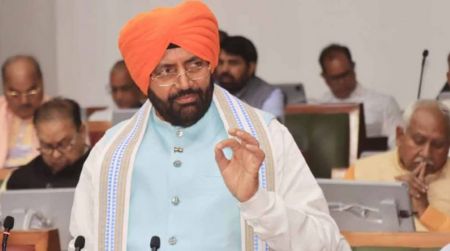
Haryana CM Nayab Singh Saini presenting the 2026–27 state budget in the Vidhan Sabha
The government has emphasised fiscal discipline, keeping deficit targets within manageable limits while increasing capital expenditure. Supporters describe the approach as calibrated growth; critics argue that rising liabilities could constrain future flexibility.
The debate reflects a familiar challenge across Indian states — how to sustain development momentum without deepening financial vulnerability.
A State Negotiating Its Next Identity
In the end, Haryana’s 2026–27 Budget may be remembered as much for its tone as for its allocations. It attempted to reassure the farmer without ignoring the aspirations of a digitally minded generation, to speak the language of tradition while outlining a future shaped by technology and skills.
Whether these promises translate into visible change will depend less on announcements in the Assembly and more on execution in districts and villages where governance is ultimately judged.
For now, the budget reflects a state negotiating transition — economically, socially and politically — where even a financial statement becomes a conversation about identity, direction and the evolving grammar of politics in northern India. 
_____________
Also Read:
Kejriwal’s Tearful Vindication Gives AAP Moral Oxygen in Punjab

Punjab Today
punjabtodaynews@gmail.com
Disclaimer : PunjabTodayNews.com and other platforms of the Punjab Today group strive to include views and opinions from across the entire spectrum, but by no means do we agree with everything we publish. Our efforts and editorial choices consistently underscore our authors’ right to the freedom of speech. However, it should be clear to all readers that individual authors are responsible for the information, ideas or opinions in their articles, and very often, these do not reflect the views of PunjabTodayNews.com or other platforms of the group. Punjab Today does not assume any responsibility or liability for the views of authors whose work appears here.
Punjab Today believes in serious, engaging, narrative journalism at a time when mainstream media houses seem to have given up on long-form writing and news television has blurred or altogether erased the lines between news and slapstick entertainment. We at Punjab Today believe that readers such as yourself appreciate cerebral journalism, and would like you to hold us against the best international industry standards. Brickbats are welcome even more than bouquets, though an occasional pat on the back is always encouraging. Good journalism can be a lifeline in these uncertain times worldwide. You can support us in myriad ways. To begin with, by spreading word about us and forwarding this reportage. Stay engaged.
— Team PT