


Congress and BJP Signal Divergent Political Motives in Himachal
HIMACHAL PRADESH has entered an early phase of political churn, well ahead of the 2027 Assembly election.
Two major political mobilisations held within days of each other — one by the Congress in Mandi and the other by the BJP in Shimla — were not routine party exercises. They were carefully choreographed political signals, revealing intent, internal dynamics, and competing strategies for the next electoral battle.
Mandi: Congress Pushes Back, but Old Fault Lines Resurface
The Congress’s decision to hold its three-year completion event of the Sukhu government in Mandi was a calculated political move.
Mandi had delivered one of the Congress’s worst electoral humiliations in 2022, when it lost nine of ten Assembly seats, with the remaining seat going to an Independent — a rout widely attributed to the BJP’s organisational grip and the influence of former Chief Minister Jai Ram Thakur. Choosing Mandi was therefore not symbolic celebration but deliberate confrontation.
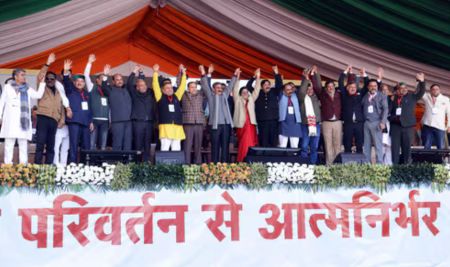
CM Sukhvinder Singh Sukhu with Congress leaders during the Sankalp rally in Mandi. (Courtesy: Birbal Sharma/HT)
The mobilisation was impressive and largely state-driven. Ministers, MLAs, senior leaders and cadres ensured turnout, while the absence of top central leaders from Delhi — due to Parliament — did not blunt the impact.
Instead, it reinforced Chief Minister Sukhvinder Singh Sukhu’s effort to project a leadership style rooted in state authority rather than constant high-command supervision.
Deputy Chief Minister Mukesh Agnihotri emerged as the rally’s most compelling voice. When AICC in-charge Rajani Patil publicly described him as the “Man of the Match,” it resonated because Agnihotri combined aggression against the BJP with candour directed inward.
His warning that loyal party workers could not be ignored indefinitely, and that appointments and recognition were long overdue, reflected a deeper organisational anxiety within the Congress. His remarks about certain bureaucrats covertly aligning with BJP leaders — and his demand for action against them — added a governance edge that went beyond rhetoric.
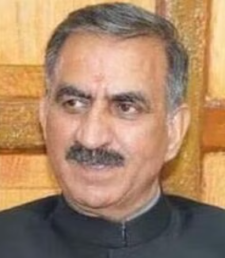
Sukhvinder Singh Sukhu
Sukhu’s own speech was politically sharper. He accused the BJP of repeated attempts to destabilise his government through defections, claimed that the electorate had already punished such tactics, and alleged that BJP leaders were lobbying in Delhi to block Himachal’s legitimate financial dues.
His assertion that Prime Minister Narendra Modi’s announced ₹1,500-crore post-disaster assistance had not reached the state sought to recast Himachal’s financial stress as political discrimination rather than administrative failure. Sukhu also reiterated that six poll guarantees had been fulfilled, promising delivery on the rest.
Also Read: Himachal Pradesh’s Long Wait for Disaster Relief
Yet, the Mandi event also exposed unresolved internal contradictions. The omission of former Chief Minister Virbhadra Singh’s photograph from rally posters triggered immediate backlash from party veterans, notably Kuldeep Singh Rathore.
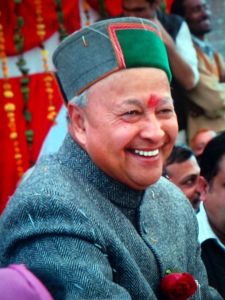
Late Virbhadra Singh
The controversy revived long-standing suspicion among Virbhadra loyalists that Sukhu is attempting to sideline the late leader’s political legacy. Statements from Virbhadra Singh’s family sought to defuse the issue, but the damage was done.
The conspicuous absence of cabinet minister Vikramaditya Singh — in London to receive an international honour — and of former state Congress chief Pratibha Singh further fuelled speculation.
Within party circles, the old “Holly Lodge versus new power centre” debate resurfaced, raising uncomfortable questions about whether Sukhu has decisively displaced the once-dominant Virbhadra camp or merely postponed an inevitable internal reckoning. The rivalry between Sukhu and Virbhadra Singh is no secret, and its echoes remain politically relevant.
Shimla and Dharamshala: BJP Reasserts Central Command
The BJP’s response was swift, disciplined, and unmistakably centralised. Its Shimla event at the historic Peterhoff, led by national president J.P. Nadda, was designed to send a contrasting signal: while the Congress experiments with state-centric autonomy, the BJP offers central authority, organisational coherence, and alignment with power in Delhi.
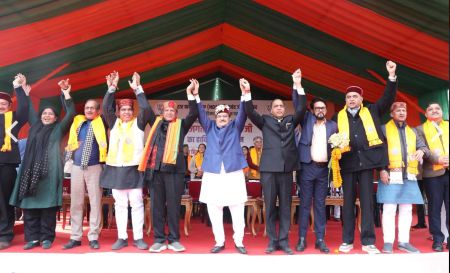
BJP leaders at Peterhof, Shimla.
Nadda’s attack on the Sukhu government was blunt. He accused it of corruption, financial mismanagement, and administrative collapse, alleging failure to utilise thousands of crores in central funds — including disaster relief allocations, Smart City projects, national highways, and AIIMS Bilaspur.
His invocation of the “double-engine government” slogan was a reminder that the BJP intends to frame development as contingent on political alignment between the state and the Centre.
Senior leaders Anurag Thakur, Jai Ram Thakur, and state BJP chief Dr Rajiv Bindal amplified the critique, targeting unfulfilled Congress guarantees, mounting state debt, and delayed disaster rehabilitation.
The BJP’s messaging sought to contrast Congress’s Mandi optics with public anger among disaster-affected families still awaiting relief.
 The BJP’s Dharamshala mobilisation during the winter session of the Vidhan Sabha further reinforced this strategy. Timed carefully, it blended legislative opposition with street-level politics, signalling organisational rebuilding while keeping sustained pressure on the Sukhu government.
The party’s argument was simple and politically potent: while people struggle to rebuild lives, the government is busy projecting anniversaries.
Speculation in Shimla’s political corridors about Nadda’s future role in state politics — possibly even leading the BJP into 2027 with the backing of the Modi-Shah leadership — has added another layer to the unfolding contest.
The Opening Act of 2027

These political exercises were not about crowd size alone; they were about narrative control. The Congress is attempting to project confidence, autonomy, and resilience under Sukhu, even as it wrestles with internal fault lines, legacy politics, and organisational impatience.
The BJP, meanwhile, is positioning itself as the party of authority, alignment, and governance discipline, ready to capitalise on Congress’s internal contradictions.
This is not yet a formal election campaign. But in a state like Himachal Pradesh — where political memory is long and margins are thin — such early positioning matters.
The battle for 2027 has begun quietly, through symbolism, strategy, and signal-sending. And as these early moves suggest, the real contest may be as much about internal cohesion and leadership credibility as about governance itself. 
__________
Also Read:

K. S. Tomar
The writer, a senior political analyst, is a former Editor of the Hindustan Times' Rajasthan edition and has spent nearly four decades in journalism, including a six year stint in Nepal where he covered Sino-India-Nepal complex relationship and had a ringside seat to the Himalayan Kingdom's transition into democracy.
Disclaimer : PunjabTodayNews.com and other platforms of the Punjab Today group strive to include views and opinions from across the entire spectrum, but by no means do we agree with everything we publish. Our efforts and editorial choices consistently underscore our authors’ right to the freedom of speech. However, it should be clear to all readers that individual authors are responsible for the information, ideas or opinions in their articles, and very often, these do not reflect the views of PunjabTodayNews.com or other platforms of the group. Punjab Today does not assume any responsibility or liability for the views of authors whose work appears here.
Punjab Today believes in serious, engaging, narrative journalism at a time when mainstream media houses seem to have given up on long-form writing and news television has blurred or altogether erased the lines between news and slapstick entertainment. We at Punjab Today believe that readers such as yourself appreciate cerebral journalism, and would like you to hold us against the best international industry standards. Brickbats are welcome even more than bouquets, though an occasional pat on the back is always encouraging. Good journalism can be a lifeline in these uncertain times worldwide. You can support us in myriad ways. To begin with, by spreading word about us and forwarding this reportage. Stay engaged.
— Team PT