


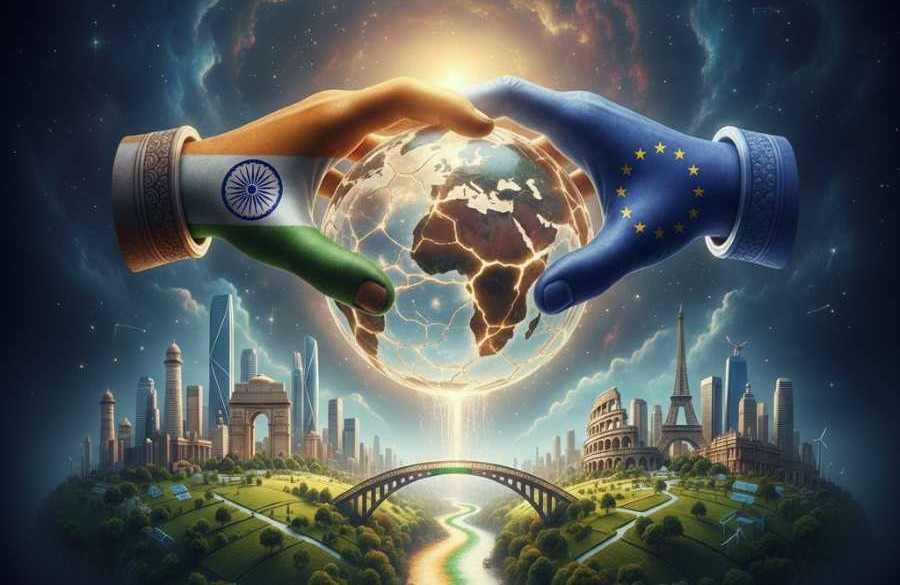
In a fractured global trade order, India and the European Union have finalised a long-awaited free trade agreement aimed at sharply cutting tariffs and deepening cooperation in services and investment.
FOR EVERY NATION, safeguarding trade interests to strengthen domestic manufacturing and associated services sectors has become paramount. Bogged down by non-business-like tariff impositions and illogical concessions under the Trump administration, the global economy has undergone a churn driven by the imperative of conducting trade on a more equal footing.
This churn has worked not only against but also in favour of countries like India. New Delhi has succeeded in stitching together a long-pending Free Trade Agreement with the European Union after 18 years of negotiations — talks that received a decisive push over the past year.
On Tuesday, January 27, India and the European Union further elevated their long-standing strategic engagement with the signing of a Security and Defence Partnership (SDP) at the 16th India–EU Summit.
India–EU Trade Parleys
The conclusion of the EU–India FTA marks the end of a two-decade-old process initiated in 2007. With bilateral trade already exceeding $136 billion, the agreement is expected to become “one of the biggest” bilateral trade deals in the world.
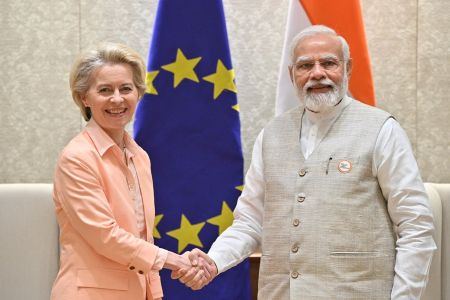
PM Narendra Modi with EU Commission President Ursula von der Leyen
The urgency and shared interests that propelled both sides towards agreement were articulated clearly by European Commission President Ursula von der Leyen, who stated that India and the European Union are offering a “fractured world” an alternative.
While the FTA will be closely watched for its bilateral economic gains, the timing of the Summit — amid unprecedented transatlantic tensions between the EU and the United States over territorial disputes and trade — is equally significant.
“India and Europe have made a clear choice… strategic partnership, dialogue and openness,” von der Leyen said in a social media post. “We are showing a fractured world that another way is possible.”
European Council President António Costa echoed this sentiment, noting:
“In our multipolar world, it’s essential that the EU and India become closer and closer partners, because together we can be strong providers of stability, predictability and reliability in international relations, and protect our international rules-based order.”
“Our trade agreement is a very important geopolitical stabiliser and a showcase of how it is possible to protect international rules-based trade,” Costa — who traces his roots to Goa — said against the backdrop of turmoil triggered by recent US trade policies.
India–EU Trade Dynamics
The EU is India’s largest trading partner bloc, accounting for goods trade worth €120 billion in 2024, or 11.5% of India’s total trade. Trade in services stood at €59.7 billion in 2023, while the EU’s share of foreign direct investment (FDI) in India reached €140.1 billion in 2023, up from €82.3 billion in 2019.
Once the FTA is signed and ratified by the European Parliament — a process that could take at least a year — the agreement is expected to significantly expand bilateral trade. Indian exports such as textiles and jewellery, which have been hit by 50% US tariffs since last August, are likely to benefit substantially.
For the EU, which has now signed both a security and defence partnership and a free trade agreement with New Delhi, India will provide strategic heft to the 27-nation bloc on multiple fronts.
The defence pact will strengthen cooperation in areas such as maritime security, counter-terrorism, cyber defence, and maritime domain awareness, with a particular focus on stability in the Indo-Pacific.
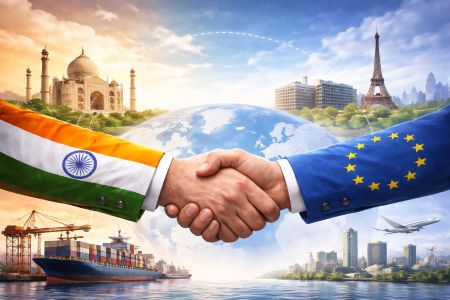
Analysts believe the India–EU defence and security partnership will place New Delhi within a framework previously extended only to Japan and South Korea. It offers an institutional platform to deepen cooperation at a time when both sides are reassessing their long-term security priorities.
Moreover, shifts in the geopolitical landscape — combined with Trump’s unpredictable behaviour — have compelled the EU to recalibrate its outlook towards India.
Instead of a buyer–seller relationship dominated by France and Germany, EU–India engagement is now set to evolve into a structured industrial partnership with long-term implications.
With the long-negotiated FTA in place, the EU will gain deeper access to India’s vast market, diversify supply chains, and expand services exports. In the longer run, it may also enable the EU to reduce dependence on the US and other unreliable partners such as China.
For India, the FTA offers an opportunity to restore access to the Generalised System of Preferences (GSP), which removes import duties on products entering the EU from developing nations. Sectors such as garments, pharmaceuticals, steel, petroleum products and machinery are expected to see a rise in exports.
It is estimated that two-way trade under the FTA could grow to $200–250 billion in goods and services within a decade, building on current levels of $137 billion in goods and $50 billion in services.
The US Reaction
As European Council President Costa described the India–EU FTA as an “important political message to the world that India and the EU believe more in trade agreements than in tariffs” — at a time when protectionism is rising — the US response was swift.
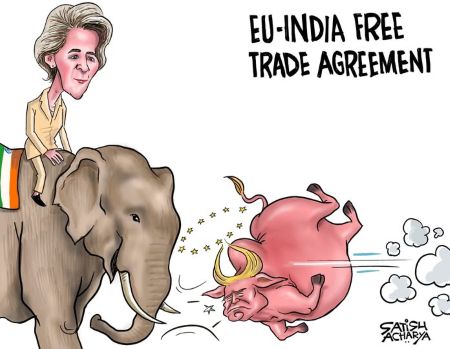
Washington doubled down on allegations that India’s oil trade with Russia finances the war in EU-backed Ukraine.
Also Read:
Greenland Crisis: Trump’s Tariffs and Europe’s Strategic Test
“We have put 25 per cent tariffs on India for buying Russian oil. Guess what happened last week? The Europeans signed a trade deal with India,” US Treasury Secretary Scott Bessent said in an interview on Sunday.
Indian Economic Diplomacy
With the latest deal firmed up, Indian trade negotiators and diplomats are now focusing on expanding trade relations and signing new FTAs with countries such as Canada.
Last week, Canada’s International Trade Minister Maninder Sidhu called for deeper trade engagement with India as both countries prepare to restart negotiations. Canadian Prime Minister Mike Carney is expected to visit India in March 2026 to finalise a new agreement.
Meanwhile, British Columbia Premier David Eby recently led a delegation to India, prioritising business and technological cooperation over political friction, with a focus on protecting the living standards of his province’s residents from the fallout of the US trade war.
Also Read:
US Withdraws from UN Agencies: Opportunity for India?
Eby and his team advanced key partnerships with government and business leaders in Bengaluru, Karnataka, India’s leading innovation hub, to attract investment, foster collaboration, and build long-term relationships.
The India–EU trade deal has thus redefined not only bilateral ties but also global economic alignments, at a time when the traditional architecture of global commerce faces serious challenges. India has demonstrated that it has strategic options beyond the United States, and that ideological considerations carry little weight when set against core trade interests. 
__________
Also Read:
Basant in Pakistan, my friend Gobind Thukral, & Malkoo’s ‘Nak Da Koka’
Davos Diversion: How Public Money Is Burnt for Promises That Never Deliver
Asad Mirza
The author is a New Delhi-based senior commentator on national and international affairs, defence and strategic issues, and environmental concerns. He is also an interfaith practitioner and a media consultant. Previously, he was associated with the BBC Urdu Service and the Khaleej Times in Dubai.
Disclaimer : PunjabTodayNews.com and other platforms of the Punjab Today group strive to include views and opinions from across the entire spectrum, but by no means do we agree with everything we publish. Our efforts and editorial choices consistently underscore our authors’ right to the freedom of speech. However, it should be clear to all readers that individual authors are responsible for the information, ideas or opinions in their articles, and very often, these do not reflect the views of PunjabTodayNews.com or other platforms of the group. Punjab Today does not assume any responsibility or liability for the views of authors whose work appears here.
Punjab Today believes in serious, engaging, narrative journalism at a time when mainstream media houses seem to have given up on long-form writing and news television has blurred or altogether erased the lines between news and slapstick entertainment. We at Punjab Today believe that readers such as yourself appreciate cerebral journalism, and would like you to hold us against the best international industry standards. Brickbats are welcome even more than bouquets, though an occasional pat on the back is always encouraging. Good journalism can be a lifeline in these uncertain times worldwide. You can support us in myriad ways. To begin with, by spreading word about us and forwarding this reportage. Stay engaged.
— Team PT