


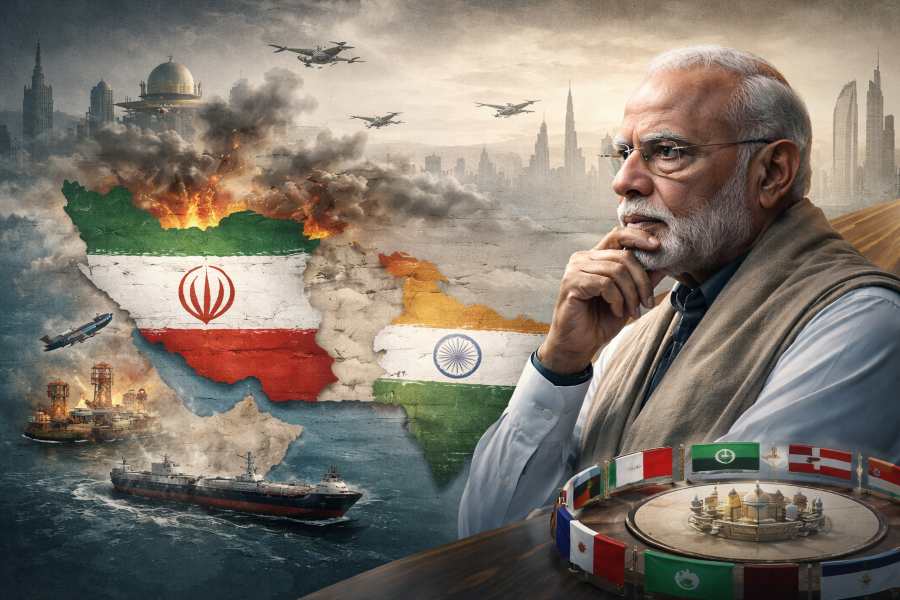
The US-Israel attacks on Iran have placed India in an uncomfortable diplomatic position, exposing the limits of its much-touted strategic autonomy.
Less said, the better, about India’s stand on the current tensions in West Asia. The US-Israel alliance’s attack on Iran has, in no uncertain terms, exposed the weakness of the country’s foreign policy.
Reportedly, PM Modi made telephonic calls to the UAE President, the Saudi Crown Prince, the King of Bahrain, the Sultan of Oman, the Crown Prince of Kuwait, and the Emir of Qatar between March 1 and 3, condemning attacks on their respective countries and violations of their sovereignty and territorial integrity.
Diplomatic Hesitation and Delayed Response
Further, PM Modi even spoke to Israeli PM Benjamin Netanyahu and King Abdullah II of Jordan on March 2 and conveyed deep concern at the evolving situation in the region, but avoided speaking to Iranian President Dr Masoud Pezeshkian, despite the fact that Iran faced direct attacks from the US-Israel alliance.
Delayed responses reflect diplomatic hesitation
Factually, it took 13 days for the Ministry of External Affairs (MEA) to express grief over the deaths of scores of school children in Iran.
On February 28, the first day of the US-Israel war with Tehran, 175 people—166 of them girl students—were killed in the American-led attack on the Shajareh Tayyebeh girls’ elementary school in Minab city.
In its response on March 12, essentially 13 days after the tragic strike, MEA spokesperson Randhir Jaiswal said:
“As far as the question of the schoolchildren you talked about is concerned… as I have said, we have issued several statements on the ongoing conflict. We have underlined the need for prioritising the safety of all children. We regret the precious lives lost and express our grief in this regard.”
On the same day, PM Modi also spoke to the Iranian President and posted on X:
“Had a conversation with Iranian President, Dr. Masoud Pezeshkian, to discuss the serious situation in the region. Expressed deep concern over the escalation of tensions and the loss of civilian lives, as well as damage to civilian infrastructure.”
This was seen as a major development in diplomatic circles but appeared largely perfunctory, lacking conviction or any forceful messaging.
Energy Concerns Driving Foreign Policy
Essentially, the Indian response began to take shape only after a domestic energy crisis started brewing due to alleged delays in gas and petrol supply chains.
Following Iran’s closure of the Strait of Hormuz, the supply of oil and gas to India was hampered. Around 90% of India’s gas imports and 45% of its crude oil pass through the Strait of Hormuz.
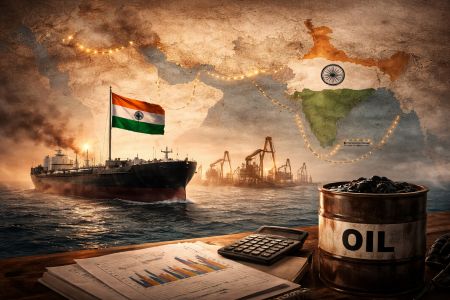
Energy dependence shapes India’s response
The situation worsened further when Qatar halted gas production after Iran targeted the Gulf country’s gas fields.
India imports about 60% of its LPG consumption from Gulf countries. Of this, Qatar accounts for nearly 45% of India’s LNG imports, while the rest is sourced from countries such as the UAE and Saudi Arabia.
PM Modi’s conversation with the Iranian leadership, in this context, appeared confused and largely delayed.
Globally, the assassination of Iran’s Supreme Leader Ayatollah Ali Khamenei has been condemned by most world leaders.
Yet India’s hesitation to condemn it—doing so five days after the attack—highlights a lack of diplomatic agility and underscores the limited importance India appeared to attach to the development. This has also dented its reputation as the current BRICS president.
India’s Diplomatic Balancing Act
It would not be wrong to surmise that the Iran war has posed a serious challenge to India’s foreign policy establishment. While Iran is a BRICS member, so too are Saudi Arabia and the UAE. However, BRICS has yet to issue a unified statement on the war.
Although Iran has urged India, as the current BRICS chair, to issue a statement condemning the US-Israel strikes and the killing of Ayatollah Khamenei, member states are still awaiting a response.
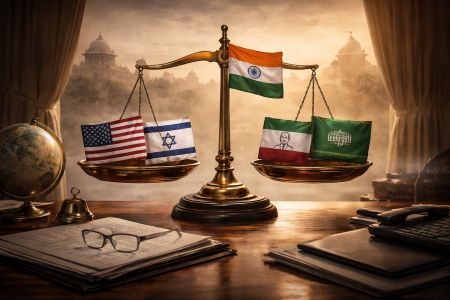
India navigates competing geopolitical interests
What emerges is that India is currently in a bind, hesitant to take sides in one of the most serious conflicts in West Asia—one that could ultimately imperil global stability. The larger question, however, is whether India has truly maintained neutrality in the ongoing war.
How should one interpret Prime Minister Modi’s telephonic outreach to Gulf leaders and Jordan—condemning attacks on their territories—while initially avoiding direct engagement with Iranian authorities?
In this context, India’s response appears guided primarily by economic, investment, and energy considerations. The Persian Gulf countries are home to nearly 9.6 million Indians and remain central to India’s energy security.
They have also made substantial investments across sectors in India. For instance, under the Bilateral Investment Treaty signed with the UAE in 2024, the Gulf nation has committed $75 billion towards infrastructure development in India. Additionally, the UAE is planning to develop a Special Investment Region in Dholera, Gujarat.
Despite these influencing factors, India should have demonstrated greater diplomatic maturity and avoided appearing swayed by selective responses, particularly when condemning attacks on Saudi Arabia, the UAE, and other Gulf nations.
Overall, the ongoing Iran war has placed India in an uncomfortable diplomatic position, exposing the limits of its strategic autonomy.
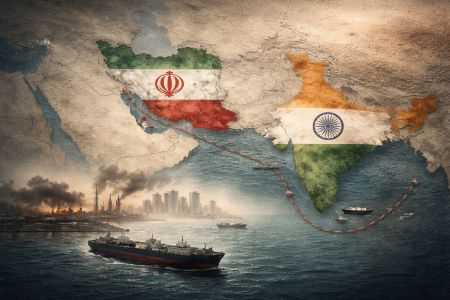
Strategic routes underline India’s stakes in the crisis
New Delhi’s cautious and delayed responses suggest that its foreign policy is increasingly being shaped by immediate economic and energy concerns rather than by a consistent strategic doctrine.
While safeguarding national interests and maintaining relations with Gulf partners is undoubtedly important, diplomacy also demands balance, clarity, and timeliness.
India has traditionally prided itself on pursuing an independent foreign policy and maintaining cordial relations with all sides in West Asia.
However, recent developments indicate that this balance is becoming increasingly difficult to sustain amid shifting geopolitical alignments and competing economic interests.
If India wishes to retain credibility as a responsible and influential global actor, it must demonstrate greater diplomatic coherence, act more promptly in moments of crisis, and ensure that its commitment to strategic neutrality is not perceived as selective or inconsistent. 
___________
Also Read:
Asad Mirza
The author is a New Delhi-based senior commentator on national and international affairs, defence and strategic issues, and environmental concerns. He is also an interfaith practitioner and a media consultant. Previously, he was associated with the BBC Urdu Service and the Khaleej Times in Dubai.
Disclaimer : PunjabTodayNews.com and other platforms of the Punjab Today group strive to include views and opinions from across the entire spectrum, but by no means do we agree with everything we publish. Our efforts and editorial choices consistently underscore our authors’ right to the freedom of speech. However, it should be clear to all readers that individual authors are responsible for the information, ideas or opinions in their articles, and very often, these do not reflect the views of PunjabTodayNews.com or other platforms of the group. Punjab Today does not assume any responsibility or liability for the views of authors whose work appears here.
Punjab Today believes in serious, engaging, narrative journalism at a time when mainstream media houses seem to have given up on long-form writing and news television has blurred or altogether erased the lines between news and slapstick entertainment. We at Punjab Today believe that readers such as yourself appreciate cerebral journalism, and would like you to hold us against the best international industry standards. Brickbats are welcome even more than bouquets, though an occasional pat on the back is always encouraging. Good journalism can be a lifeline in these uncertain times worldwide. You can support us in myriad ways. To begin with, by spreading word about us and forwarding this reportage. Stay engaged.
— Team PT