


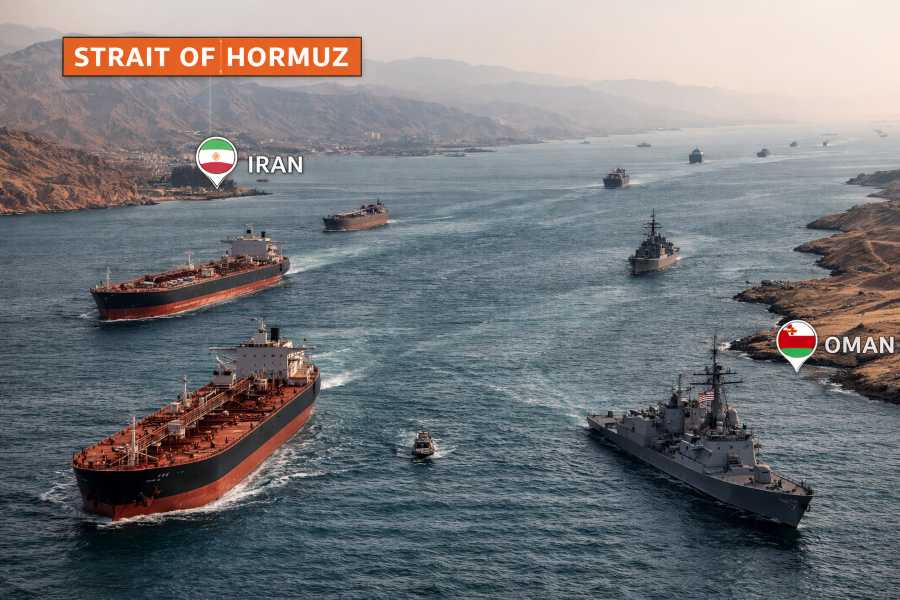
The killing of Iran’s supreme leader, missile attacks across the Gulf and a looming battle over the Strait of Hormuz have pushed the Middle East to the brink of a wider war.
FOUR DAYS AFTER coordinated strikes by the United States and Israel triggered open conflict with Iran, the Middle East is facing one of its most dangerous moments in decades. The killing of Iran’s Supreme Leader Ayatollah Ali Khamenei along with several senior military commanders has transformed what initially appeared to be a targeted military operation into a confrontation with far-reaching geopolitical consequences.
Iran has retaliated with waves of missiles and drones targeting Israeli territory and U.S. military bases and diplomatic facilities across the Gulf.
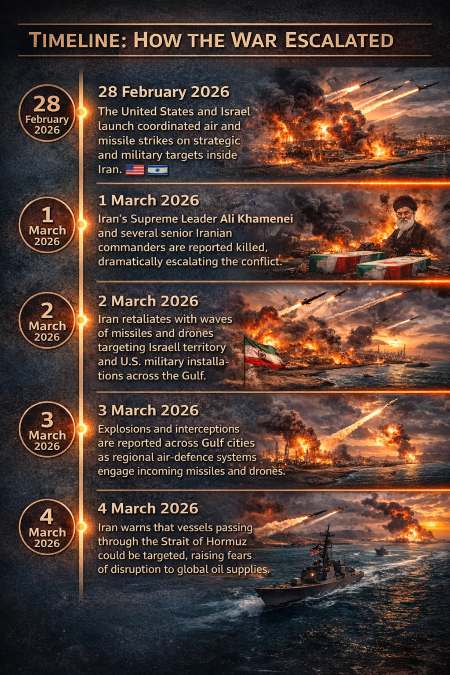
Explosions and interceptions have been reported in cities including Dubai, Doha, Kuwait City and Manama, while a drone strike caused damage and fire near a U.S. diplomatic facility in Dubai. Regional air-defence systems have intercepted many incoming projectiles, but falling debris and several impacts have caused casualties and infrastructure damage.
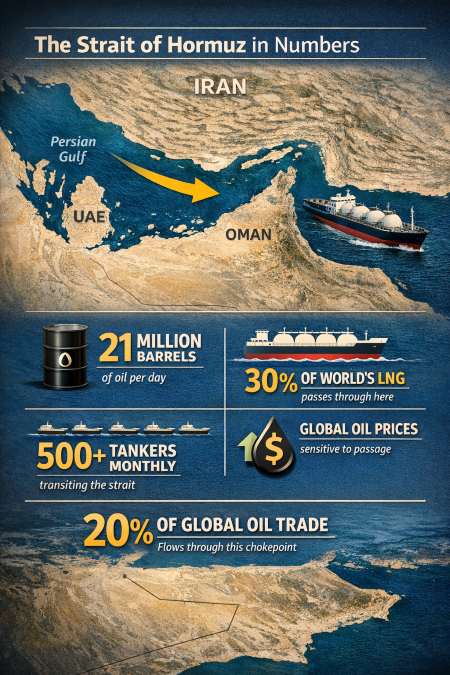
Meanwhile Israeli forces have intensified air strikes on Tehran and on Hezbollah positions in Lebanon, widening the scope of the conflict. At the same time Tehran has warned that shipping through the Strait of Hormuz—the narrow waterway through which nearly one-fifth of global oil trade flows—could be targeted, raising fears that the confrontation could soon spill into the world’s most critical energy corridor.
Adding a new political dimension to the crisis, several reports say Iran’s clerical establishment has chosen Mojtaba Khamenei, the son of the slain leader, as the country’s new Supreme Leader. If confirmed, the development would represent the first effective dynastic succession in the history of the Islamic Republic.
Leadership Transition in Tehran
Reports that Mojtaba Khamenei has been selected as Iran’s new Supreme Leader add another layer of complexity to the unfolding crisis.
Mojtaba Khamenei has long been regarded as an influential but largely behind-the-scenes figure within the Iranian political system.
He is believed to maintain close ties with the Islamic Revolutionary Guard Corps, the powerful military institution that plays a central role in Iran’s security and regional strategy.
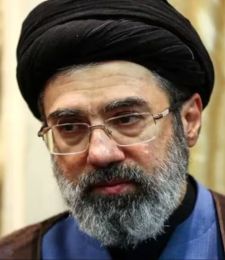
Mojtaba Hosseini Khamenei
If his appointment is confirmed, analysts say it could consolidate the influence of Iran’s security establishment at a moment when the country is already engaged in a high-stakes confrontation with the United States and Israel.
The possibility of a father-to-son succession is politically sensitive. Iran’s 1979 revolution overthrew a hereditary monarchy, and the idea of dynastic leadership within the Islamic Republic has long been controversial.
However supporters argue that Mojtaba Khamenei’s close links with the security establishment could help ensure continuity and stability during wartime.
Why the Strait of Hormuz Matters
At the centre of the crisis lies the Strait of Hormuz, the narrow maritime corridor connecting the Persian Gulf with the Arabian Sea.
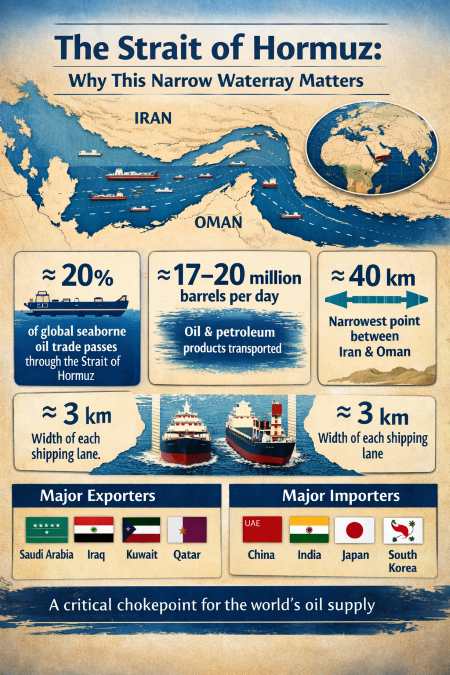
Despite its modest size, the strait plays an outsized role in the global economy. Roughly 20 percent of the world’s traded oil and a large share of liquefied natural gas shipments pass through this route every day.
Tankers leaving the export terminals of Saudi Arabia, Iraq, Kuwait, Qatar and the United Arab Emirates must pass through this narrow passage before reaching global markets.
Any disruption can therefore send immediate shockwaves through energy markets and the global economy.
The Immediate Military Situation
The military situation in the Persian Gulf remains tense and fluid.
Iranian missile and drone strikes have targeted Israeli territory and U.S. military facilities across the Gulf. Naval forces from the United States and allied countries have increased their presence in the region, deploying warships capable of missile defence and maritime patrol.
At the same time Iran’s Islamic Revolutionary Guard Corps has placed its naval forces, missile batteries and drone units on heightened alert.
Although no large-scale naval clash has yet occurred, the presence of heavily armed forces operating in close proximity creates a volatile environment in which even a minor incident could escalate rapidly.
Conflict Expands to the Lebanon Front
The confrontation is also widening along Israel’s northern border.
Israeli authorities report that rockets were launched from Lebanese territory, triggering air-raid sirens in northern Israel. Most projectiles were intercepted by Israeli air-defence systems, though at least one rocket landed in an open area.
The attacks highlight the risk that the conflict could evolve into a broader regional war involving Hezbollah, the Iran-aligned armed group based in Lebanon.
Energy Infrastructure Under Fire
The war is already affecting key energy facilities across the Gulf.
Drone strikes and security shutdowns have disrupted operations near the Ras Tanura Refinery in Saudi Arabia, one of the world’s most important crude oil export hubs.
Energy facilities around Ras Laffan Industrial City in Qatar, the world’s largest LNG export complex, have also faced operational disruptions.
Several oil storage and export terminals across the Gulf have heightened security amid fears that the conflict could expand to maritime energy infrastructure.
The expanding conflict is already sending shockwaves through global energy markets.
Attacks on energy facilities and uncertainty over shipping through the Strait of Hormuz have pushed oil prices sharply upward while natural-gas prices have surged amid fears of supply disruptions.
Analysts warn that if the crisis continues, the impact could quickly spread through the global economy—raising the cost of gasoline, electricity and heating while adding new inflationary pressures.
The Interceptor Dilemma
Another factor shaping the trajectory of the war is the cost of missile defence.
Political analyst Ali Alizadeh argues that Iran’s strategy relies on large numbers of relatively inexpensive domestically produced missiles and drones designed to overwhelm costly interception systems used by Israel and the United States.
Systems such as Iron Dome and the Patriot Missile System rely on expensive interceptor missiles.
If missile exchanges continue over an extended period, the financial and logistical burden of maintaining defensive coverage could become significant.
Political Debate in Washington
The war is also generating debate inside the United States.

US–Israel coordination has been central to the escalating conflict with Iran.
Several members of United States Congress have questioned whether the administration of Donald Trump has the legal authority to conduct large-scale military operations against Iran without explicit congressional approval.
The United States Senate may soon consider a resolution addressing the legality of the military campaign.
However the outcome remains uncertain, as Republicans currently control both chambers of Congress.
India’s Stakes
For India, the crisis carries significant economic implications.
India imports a substantial share of its crude oil from the Middle East, much of it transported through the Strait of Hormuz.
Any prolonged disruption could affect fuel prices, shipping costs and domestic inflation.
At the same time India must carefully balance its diplomatic relationships with all sides while protecting its economic interests.
Who Holds the Advantage?
In purely military terms the United States and Israel possess overwhelming technological superiority.
However geography gives Iran a different form of leverage. By threatening the Strait of Hormuz, Tehran can exert pressure on the global energy system and international markets.
 This creates a strategic balance in which each side possesses a different type of advantage—military strength on one side and geographic and economic leverage on the other.
The confrontation between Iran, the United States and Israel may not be decided by a single decisive battle. More likely it will be shaped by endurance—by which side can sustain economic pressure, manage domestic political realities and maintain strategic alliances over time.
At the heart of the crisis lies the Strait of Hormuz, a narrow waterway carrying a substantial share of the world’s energy trade.
Also Read: Treating Iran Like Venezuela: Why Trump’s Playbook May Fail
In an interconnected world, a war fought along the shores of the Persian Gulf can reshape energy markets, global economies and geopolitical calculations thousands of kilometres away. 
______________
Also Read:

Punjab Today
punjabtodaynews@gmail.com
Disclaimer : PunjabTodayNews.com and other platforms of the Punjab Today group strive to include views and opinions from across the entire spectrum, but by no means do we agree with everything we publish. Our efforts and editorial choices consistently underscore our authors’ right to the freedom of speech. However, it should be clear to all readers that individual authors are responsible for the information, ideas or opinions in their articles, and very often, these do not reflect the views of PunjabTodayNews.com or other platforms of the group. Punjab Today does not assume any responsibility or liability for the views of authors whose work appears here.
Punjab Today believes in serious, engaging, narrative journalism at a time when mainstream media houses seem to have given up on long-form writing and news television has blurred or altogether erased the lines between news and slapstick entertainment. We at Punjab Today believe that readers such as yourself appreciate cerebral journalism, and would like you to hold us against the best international industry standards. Brickbats are welcome even more than bouquets, though an occasional pat on the back is always encouraging. Good journalism can be a lifeline in these uncertain times worldwide. You can support us in myriad ways. To begin with, by spreading word about us and forwarding this reportage. Stay engaged.
— Team PT