


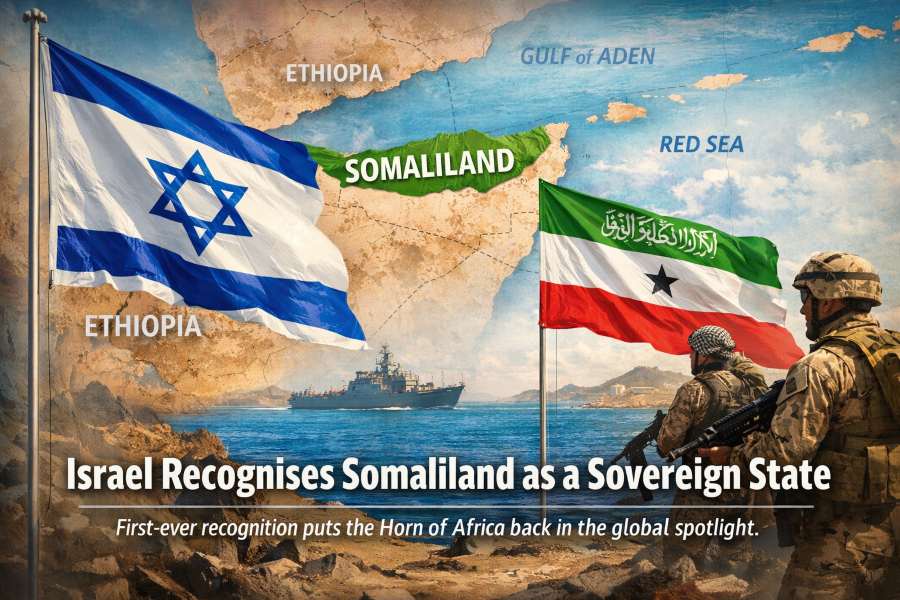
Recognition puts the Horn of Africa back in the global spotlight
ON FRIDAY (26 December 2025), Israel became the first country to recognise Somaliland as a sovereign state — a breakthrough in its quest for international recognition since it declared independence from Somalia 34 years ago.
However, the move has prompted strong international and regional reactions.

Somalis in Mogadishu react after Israel recognises Somaliland. (Reuters/Feisal Omar)
The Guardian reported that Israeli foreign minister Gideon Sa’ar announced on Friday that Israel and Somaliland have signed an agreement establishing full diplomatic relations, including the opening of embassies and the appointment of ambassadors.
The recognition marks a historic moment for Somaliland, which declared its independence from Somalia in 1991 but until now had failed to gain recognition from any UN member state.
Somaliland controls the north-western tip of Somalia, where it operates as a de facto state.
It is bordered by Djibouti to the north-west and Ethiopia to the west and south, and sits close to key maritime chokepoints linking Africa, the Middle East, and global trade routes.
For more than three decades, Somaliland has functioned like a country in all but name. That changed when Israel announced it was formally recognising Somaliland as a sovereign state — the first UN member to do so.

Hassan Sheikh Mohamud
The move has elevated Somaliland’s diplomatic profile but also triggered sharp regional pushback, underlining how geopolitics in the Horn of Africa are increasingly entangled with West Asian rivalries.
Somali President Hassan Sheikh Mohamud told an emergency parliamentary session on Sunday (28 December) that Israel’s recognition of the breakaway region of Somaliland “is a threat to the security and stability of the world and the region.”
What is Somaliland?
Somaliland emerged on the global map in 1991 after the collapse of Somalia’s central government and years of civil war. It declared independence from Somalia, reclaiming the borders of the former British Somaliland protectorate.
 Since then, it has operated as a de facto state. It has held elections, maintained relative internal stability, issued its own currency, and built domestic security institutions — in sharp contrast to prolonged instability in much of southern Somalia.
Despite this, no country had formally recognised it as sovereign until Israel’s announcement.
Most countries have avoided recognising Somaliland out of concern that it would encourage separatist movements elsewhere in Africa and undermine the principle of inherited colonial borders.

A polling station in Hargeisa during the 2024 presidential election in Somaliland. Photo courtesy: Luis Tato/AFP
The African Union has consistently backed Somalia’s territorial integrity, even while acknowledging Somaliland’s relative success in governance.
For Somaliland, this lack of recognition has meant limited access to international finance, constrained trade links, and exclusion from global institutions — despite functioning independently for over 30 years.
Israel’s geopolitically significant decision
For Somaliland, recognition by a UN member state strengthens its claim to sovereignty and could open the door to further diplomatic engagement, investment, and security cooperation.
For Israel, the move expands its strategic footprint in Africa, especially near the Red Sea and the Gulf of Aden — one of the world’s busiest maritime corridors. Somaliland’s proximity to Yemen adds further strategic value, given Israel’s security concerns in the region.

Abdirahman Mohamed Abdullahi
The Bab al-Mandab Strait separates these two bodies of water and serves as an economic chokepoint for shipping moving from the Mediterranean to the Indian Ocean. It is widely regarded as a vitally important global trade zone.
The Iranian-backed Houthis have terrorised shipping in this area for several years, claiming to do so due to the war in Gaza. Decades earlier, Somali pirates routinely attacked ships off East Africa’s coast.
This area is once again in the spotlight following Israel’s recognition of Somaliland. Some may see the move as marking the beginning of a new era of international competition in this part of Africa.
The territory already hosts a military facility run by the United Arab Emirates at the port of Berbera — a base analysts say plays a key role in regional maritime and security operations.
Many commentators see Israel’s move as strategic, seemingly placing Israel and the UAE on one side, sharing interests in the region, while states such as Turkey stand on the other.
According to the Jerusalem Post, however, nothing is that simplistic. Saudi Arabia and the UAE have agreed on Yemen.

Egypt is unlikely to favour changes in the Horn of Africa and already has deep concerns about the Rapid Support Forces’ increased presence in Sudan and about a new dam in Ethiopia. Qatar and many other countries also oppose Israel’s move.
The issues in the Horn of Africa revolve largely around strategic considerations.
While naval or military assets in the area appear important, the Houthis’ attacks have shown that relatively simple and inexpensive drones and missiles can significantly disrupt global shipping.
The Horn of Africa is resource-poor, and many of its states are weak for structural reasons. From a grand strategic perspective, Israeli recognition may therefore prove less consequential than it currently appears.
It is true that many countries — including France, the US, Turkey, Iran, the UAE, and Saudi Arabia — have interests in this region. However, these interests have so far translated into limited engagement. Most countries clearly see more pressing priorities elsewhere.
Recognition and the Abraham Accords
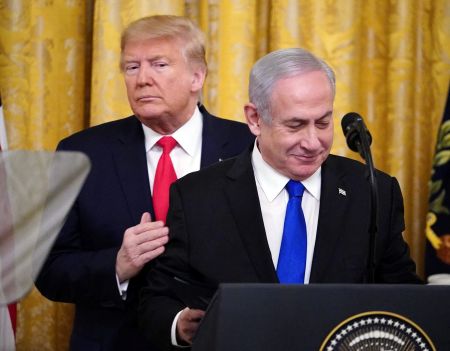
Benjamin Netanyahu with Trump
Israeli Prime Minister Benjamin Netanyahu framed the recognition as being “in the spirit” of the Abraham Accords.
He has promised rapid cooperation with Somaliland in agriculture, health, technology, and economic development, and has invited Somaliland President Abdirahman Mohamed Abdullahi to visit Israel.
For Israel, this signals an effort to extend the logic of the Abraham Accords beyond the Middle East, linking diplomatic normalisation with strategic geography.
The international backlash
Former US President Donald Trump has said he opposes US recognition of Somaliland. In an interview with the New York Post published Friday, he said: “No,” when asked whether the US should recognise Somaliland, adding: “Does anyone really know what Somaliland is?”
The announcement also prompted swift opposition from countries wary of destabilising precedents.

Egypt, Turkey, and others reaffirmed support for Somalia’s unity and warned that recognising breakaway regions threatens regional stability.
These concerns are not just legal but strategic. Somaliland sits at the intersection of rivalries involving Somalia, Ethiopia, and Egypt, particularly over Red Sea access and influence in the Horn of Africa.
Israel’s entry into this sensitive equation heightens anxieties about militarisation and external power competition.
Going forward
Israel’s recognition does not automatically secure broader international acceptance for Somaliland, but it changes the conversation. Other states may now reassess their long-held reluctance, especially if strategic or economic incentives align.
Also Read: Trump’s Plan to Reshape Global Power Dynamics
At the same time, Somalia is likely to intensify diplomatic efforts to block further recognition, while regional powers weigh how this development affects their own interests in one of the world’s most geopolitically volatile corridors.
For Somaliland, the moment marks a long-sought breakthrough — but one that comes with heightened scrutiny and new geopolitical risks. 
_________
Also Read:
SAHITYA AKADEMI AWARDS ROW: Power Comes A-Knocking, or Writers Go Knocking at Power’s Door?
Asad Mirza
The author is a New Delhi-based senior commentator on national and international affairs, defence and strategic issues, and environmental concerns. He is also an interfaith practitioner and a media consultant. Previously, he was associated with the BBC Urdu Service and the Khaleej Times in Dubai.
Disclaimer : PunjabTodayNews.com and other platforms of the Punjab Today group strive to include views and opinions from across the entire spectrum, but by no means do we agree with everything we publish. Our efforts and editorial choices consistently underscore our authors’ right to the freedom of speech. However, it should be clear to all readers that individual authors are responsible for the information, ideas or opinions in their articles, and very often, these do not reflect the views of PunjabTodayNews.com or other platforms of the group. Punjab Today does not assume any responsibility or liability for the views of authors whose work appears here.
Punjab Today believes in serious, engaging, narrative journalism at a time when mainstream media houses seem to have given up on long-form writing and news television has blurred or altogether erased the lines between news and slapstick entertainment. We at Punjab Today believe that readers such as yourself appreciate cerebral journalism, and would like you to hold us against the best international industry standards. Brickbats are welcome even more than bouquets, though an occasional pat on the back is always encouraging. Good journalism can be a lifeline in these uncertain times worldwide. You can support us in myriad ways. To begin with, by spreading word about us and forwarding this reportage. Stay engaged.
— Team PT