



A school textbook, a suo motu intervention, and the uneasy balance between institutional dignity and democratic scrutiny.
तुम ने सच बोलने की जुरअत की
ये भी तौहीन है अदालत की
— सलीम कौसर
Tum ne sach bolne ki jur’at ki
Ye bhi tauheen hai adalat ki
India witnessed an extraordinary constitutional moment when a school textbook unsettled the country’s most powerful institution. A Class 8 NCERT Social Science book — Exploring Society: India and Beyond, Part II — prompted the Supreme Court of India to take suo motu cognisance, suspend circulation of the book nationwide, and initiate proceedings over its contents.
During the hearing, the Chief Justice of India remarked in open court:
“They have fired the gunshot and the judiciary is bleeding today.”
He further declared:
“I will not allow anyone on earth to defame the institution.”
The Bench also described the inclusion of the chapter as appearing to be part of a “deep-rooted and well-planned conspiracy” capable of eroding public faith in courts.
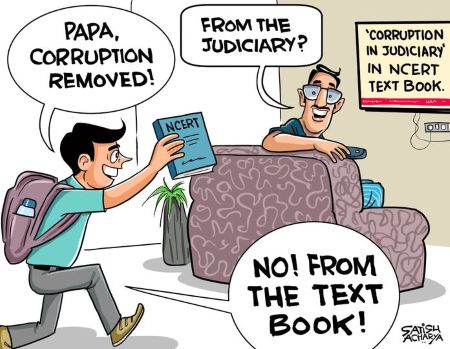 A civics lesson had suddenly become a constitutional confrontation.
And here lies the paradox. A judiciary whose authority flows from constitutional openness reacted to discussion with prohibition.
A chapter meant to introduce students to democratic accountability was treated as institutional injury.
When explanation begins to resemble defamation, democracy must pause and ask whether respect is being defended — or scrutiny quietly discouraged.
What the Chapter Actually Said
Public outrage often travelled faster than facts. The controversial subsection on “Corruption in the Judiciary” appeared within the chapter The Role of the Judiciary in Our Society.
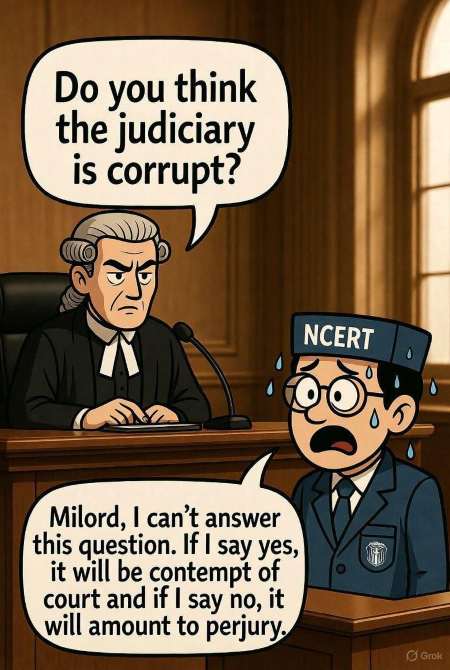
The text explained that even limited instances of misconduct could weaken public confidence in courts, emphasised that judicial independence must coexist with accountability, and discussed systemic challenges such as judicial delays and shortage of judges.
The chapter presented corruption not as the defining character of the judiciary but as one among several institutional challenges requiring reform.
Its pedagogical message was simple: democratic institutions remain credible because they acknowledge problems and correct them.
The irony is unavoidable. The lesson widely described as defamatory did not accuse individuals, question constitutional authority, or diminish judicial importance. It articulated realities already debated in public life.
Suo Motu Action and Institutional Anxiety
Acting on its own motion, the Supreme Court initiated proceedings and ordered withdrawal of copies from circulation, expressing concern that discussion of corruption in school education could erode faith among impressionable young minds.
Respect imposed by silence fades; respect earned through transparency endures.
The anxiety is understandable. Courts possess neither electoral mandate nor executive power; their legitimacy rests entirely on moral authority. Yet confidence in institutions has historically grown through engagement with criticism rather than insulation from it.
A Debate Older Than the Textbook
Discussion of judicial corruption did not begin in classrooms. In September 2015, former Supreme Court judge Justice Markandey Katju publicly stated that, in his assessment, corruption existed within a significant portion of the higher judiciary — remarks he reiterated on multiple occasions thereafter.
Whether one agrees with his assessment or not, the fact remains that debate over judicial accountability has long existed within India’s own legal discourse. The textbook reflected a conversation already underway.
आप ही की है अदालत आप ही मुंसिफ़ भी हैं
ये तो कहिए आप के ऐब-ओ-हुनर देखेगा कौन
— मंज़र भोपाली
Aap hi ki hai adalat, aap hi munsif bhi hain
Ye to kahiye, aap ke aib-o-hunar dekhega kaun
If institutions judge themselves alone, who evaluates the system from the citizen’s perspective?
Public perception of the judiciary has been shaped less by textbooks than by lived experience — court delays, procedural complexity, and access barriers faced daily by ordinary litigants. Institutional credibility grows from the delivery of justice as much as from constitutional ideals.
If the judiciary feels wounded, the source of injury may lie not in education but in experience.
Democracies That Trust Scrutiny
Across mature democracies, civic education discusses judicial controversies alongside achievements. Accountability is taught as a pillar of institutional strength, not its enemy.
For a democracy, truth spoken with respect is not defiance; it is faith in its institutions.
Public institutions are often judged by a higher ethical expectation — captured in the timeless principle that Caesar’s wife must be above suspicion. Trust survives not merely through authority, but through visible integrity.
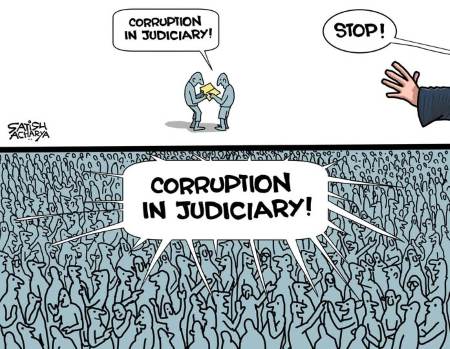 India now faces a quiet but profound choice. Institutions may respond to criticism with prohibition, or with engagement and reform.
Public trust cannot be commanded; it must be earned continuously.
Democracy weakens not when institutions are questioned, but when questioning itself becomes unacceptable.
In the end, democratic honesty requires neither anger nor accusation — only the courage to name reality as it is.
रात को रात ही इस बार कहा है हम ने
हम ने इस बार भी तौहीन-ए-अदालत नहीं की
— सलीम कौसर
Raat ko raat hi is baar kaha hai hum ne
Hum ne is baar bhi tauheen-e-adalat nahin ki
For a democracy, truth spoken with respect is not defiance; it is faith in its institutions. 
____________
Also Read:

Punjab Today
punjabtodaynews@gmail.com
Disclaimer : PunjabTodayNews.com and other platforms of the Punjab Today group strive to include views and opinions from across the entire spectrum, but by no means do we agree with everything we publish. Our efforts and editorial choices consistently underscore our authors’ right to the freedom of speech. However, it should be clear to all readers that individual authors are responsible for the information, ideas or opinions in their articles, and very often, these do not reflect the views of PunjabTodayNews.com or other platforms of the group. Punjab Today does not assume any responsibility or liability for the views of authors whose work appears here.
Punjab Today believes in serious, engaging, narrative journalism at a time when mainstream media houses seem to have given up on long-form writing and news television has blurred or altogether erased the lines between news and slapstick entertainment. We at Punjab Today believe that readers such as yourself appreciate cerebral journalism, and would like you to hold us against the best international industry standards. Brickbats are welcome even more than bouquets, though an occasional pat on the back is always encouraging. Good journalism can be a lifeline in these uncertain times worldwide. You can support us in myriad ways. To begin with, by spreading word about us and forwarding this reportage. Stay engaged.
— Team PT