


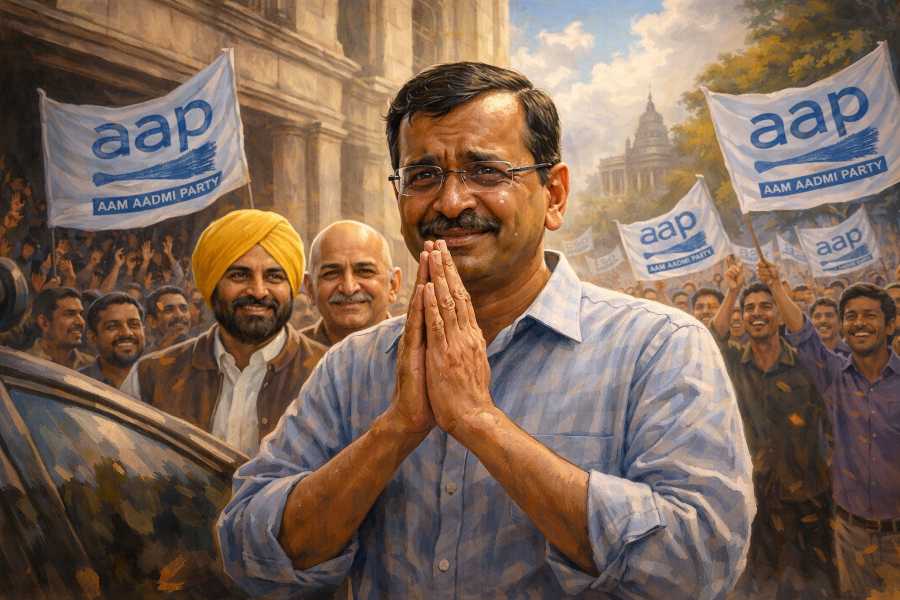
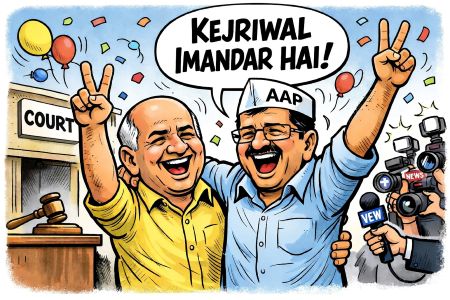
IN A SCENE straight out of a political drama, Arvind Kejriwal broke down in tears outside the Rouse Avenue Court on 27 February 2026, declaring “Kejriwal imandaar hai” after a Delhi court discharged him and Manish Sisodia in the excise policy case.
The judge cited insufficient evidence and criticised the CBI for relying on conjectures and surmises rather than concrete proof. For the Aam Aadmi Party, this development represents far more than legal relief. It marks a significant moral reset that could reshape political narratives in Punjab ahead of the 2027 Assembly elections.
A Political Burden Finally Lifted
The excise policy controversy had been AAP’s most persistent political burden. For nearly three years, the BJP, Congress and Shiromani Akali Dal repeatedly labelled the party the “Alcohol Aaya Party”, alleging that Delhi’s liquor policy kickbacks financed AAP’s campaigns in Punjab and Goa.
The allegation gradually gained traction in Punjab, where liquor addiction, farmer distress, unemployment and rising state debt dominate everyday political conversations. Anna Hazare’s public remark that Kejriwal had “got entangled in liquor” further reinforced doubts among sections of voters and added to the political damage.
 The discharge now allows AAP to reverse the narrative decisively. The party’s central message is simple and politically potent: it was targeted for challenging the system and has now been proved honest.
In Punjab’s political culture, where moral credibility often carries as much weight as administrative performance, this shift in perception can have significant consequences.
The AAP wave of 2022 was built largely on anti corruption anger directed at established political forces led by the Badals and Captain Amarinder Singh. With the corruption cloud lifted, Kejriwal can now present himself as a leader who endured prolonged investigation and emerged vindicated.
Each political rally can reinforce a story of resilience that resonates strongly with voters who view politics through narratives of struggle and injustice.
Chief Minister Bhagwant Mann also stands to benefit from this change. His accessible and folksy image had at times been overshadowed by criticism that decision making remained concentrated in Delhi. The renewed “imandaar” image provides Mann with a stronger national political backing while helping blunt opposition attacks portraying the Punjab government as controlled remotely.
Opposition Narrative Weakens as Political Space Reopens
The immediate political advantage for AAP is evident. Opposition parties now have far less to say on corruption, an issue that dominated political debate for years. Rivals consistently centred their criticism on the alleged liquor scam, but that line of attack has now weakened considerably.
Punjabis, who have historically resisted perceived interference from distant political high commands, may find it harder to portray AAP as corrupt outsiders. The perception of Mann as a remote controlled Chief Minister loses force when the national leader associated with that criticism has been cleared by a court of law.
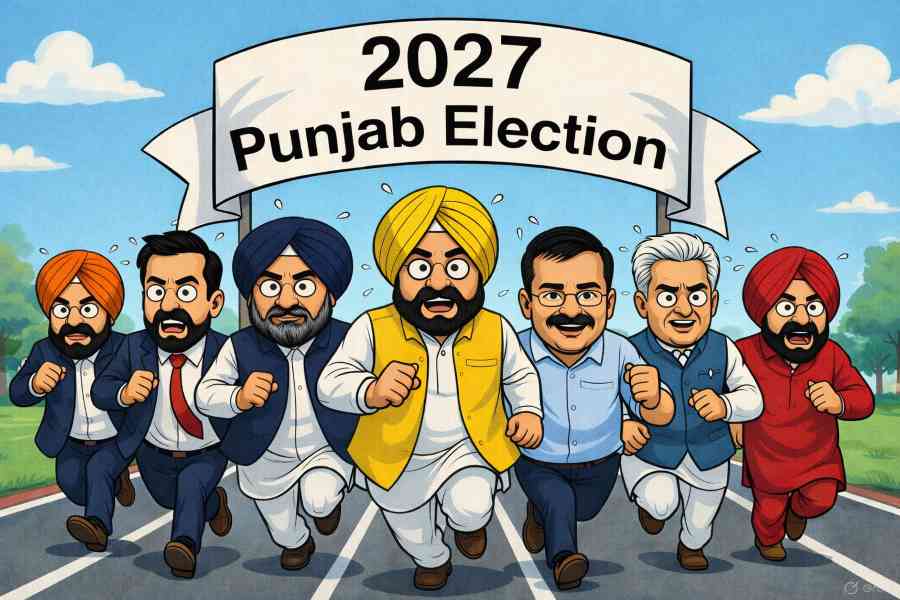 The crucial question, however, is whether moral vindication will translate into electoral success in 2027. Supporters point to the 2022 election, when Kejriwal’s personal campaigning significantly influenced rural constituencies.
With corruption allegations temporarily neutralised, the party can now shift focus towards governance delivery and welfare commitments that formed the backbone of its political promise.
Free electricity schemes, expanded public health services, Mohalla Clinic style health centres, financial assistance to women, education reforms and employment generation can once again become the centre of political messaging.
At the same time, voters remain concerned about deeply rooted local issues including groundwater depletion, stubble burning, law and order challenges and economic stress. The removal of the “scam” label gives AAP political breathing space, but it also raises expectations that governance outcomes will now take priority over political confrontation.
Governance Test Before the 2027 Verdict
Challenges still remain despite the courtroom relief. The Enforcement Directorate’s money laundering investigation continues and the possibility of further legal developments cannot be ruled out.
Yet public perception after the discharge may increasingly interpret new actions through a political lens, strengthening AAP’s claim of sustained targeting. In such a scenario, political advantage will depend less on legal arguments and more on governance performance during the next year.
AAP’s immediate task therefore lies in political craftsmanship rather than courtroom battles. The party must demonstrate administrative autonomy within Punjab, visibly empower Bhagwant Mann’s leadership and deliver measurable improvements in governance. Electoral momentum in Punjab has historically depended on visible delivery rather than narrative alone.
Kejriwal’s emotional reaction outside the court has provided AAP with a compelling political story centred on honesty and endurance. In Punjab’s sceptical political environment, such narratives often shape public perception as strongly as policy outcomes.
With opposition parties temporarily deprived of their strongest corruption argument, AAP appears better positioned than at any time since its 2022 victory to convert this legal moment into political advantage.
Also Read: PUNJAB KNOWS – “Kitne Ghazi Aaye, Kitne Ghazi Gaye”!
The “imandaar” moment therefore goes beyond symbolism. It represents a potential turning point that allows Punjab’s government to refocus attention on development, service delivery and governance outcomes. Whether this moral high ground ultimately overshadows unresolved local issues will determine the political trajectory leading into the 2027 Punjab Assembly elections. 
____________
Also Read:
Gurinder Dhillon, Bikram Majithia and Bhagwant Mann: When Faith, Power and Justice Collide in Punjab
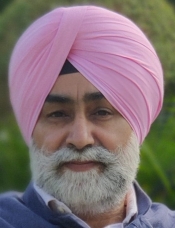
Gurpartap Singh Mann
With prior experience as a Member of the Punjab Public Service Commission, the author brings a nuanced perspective to issues of governance and social change.
Disclaimer : PunjabTodayNews.com and other platforms of the Punjab Today group strive to include views and opinions from across the entire spectrum, but by no means do we agree with everything we publish. Our efforts and editorial choices consistently underscore our authors’ right to the freedom of speech. However, it should be clear to all readers that individual authors are responsible for the information, ideas or opinions in their articles, and very often, these do not reflect the views of PunjabTodayNews.com or other platforms of the group. Punjab Today does not assume any responsibility or liability for the views of authors whose work appears here.
Punjab Today believes in serious, engaging, narrative journalism at a time when mainstream media houses seem to have given up on long-form writing and news television has blurred or altogether erased the lines between news and slapstick entertainment. We at Punjab Today believe that readers such as yourself appreciate cerebral journalism, and would like you to hold us against the best international industry standards. Brickbats are welcome even more than bouquets, though an occasional pat on the back is always encouraging. Good journalism can be a lifeline in these uncertain times worldwide. You can support us in myriad ways. To begin with, by spreading word about us and forwarding this reportage. Stay engaged.
— Team PT