


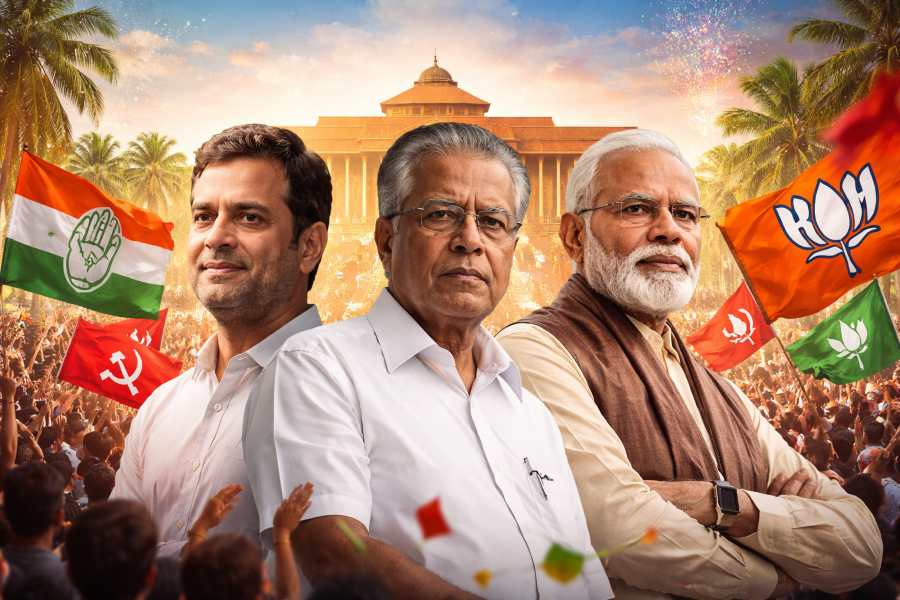
UDF revival, LDF decline, and BJP’s breakthrough in Thiruvananthapuram set the stage for high-stakes 2026 Assembly politics.
THE RECENTLY CONCLUDED local body elections in Kerala have marked a significant moment in the state’s political landscape, sending clear signals ahead of the Assembly elections due in April next year.

The Congress-led United Democratic Front (UDF) has emerged stronger, wresting control of several rural and urban local bodies long dominated by the ruling CPI(M)-led Left Democratic Front (LDF), which has been in power for a decade.
Simultaneously, the Bharatiya Janata Party (BJP) has made an unexpected breakthrough in the capital, Thiruvananthapuram, ending the Left’s 45-year hold on the municipal corporation.
While the results cannot be simply extrapolated to predict Assembly poll outcomes, they reveal shifting voter sentiments and highlight challenges facing both fronts in Kerala politics.
Five Factors Behind the LDF’s Setback
1. Sabarimala Gold Scandal
One of the key issues that seemingly worked against the LDF was the alleged gold theft from the Sabarimala temple, in which a senior CPI(M) leader has been implicated.

Priests performing rituals at Sabarimala temple linked to gold controversy discussion
This controversy hit the Left particularly hard in central and southern Kerala, regions where the party traditionally commands a substantial Hindu vote base.
Both the Congress and BJP capitalized on the scandal during campaigning, projecting it as evidence of moral and administrative failure within the ruling dispensation.
Despite Chief Minister Pinarayi Vijayan’s efforts to portray the Congress as historically reliant on right-wing support, the CPI(M) found itself on the defensive, struggling to retain its core constituency.
2. Lacklustre Left Campaign
The LDF’s electoral strategy, heavily reliant on highlighting its development and welfare achievements, failed to resonate this time.

LDF campaign promotion in Kerala
The government has, over the years, expanded social security measures—raising monthly pensions for nearly 49 lakh beneficiaries, providing financial assistance to women from below-poverty-line families, and implementing targeted housing and poverty alleviation schemes.
While these welfare interventions contributed to its victories in the 2020 local body elections and the 2021 Assembly polls, voters in the latest elections appeared more concerned with present grievances than historical achievements.
Issues such as ineffective local infrastructure, slow progress in waste management, and perceived gaps in addressing human–animal conflicts in rural areas undermined the Left’s narrative of development.
3. Alienation of Muslim Voters
The LDF also faced erosion of support among Muslim communities, a demographic that has traditionally balanced Kerala’s complex electoral equation.

Women participating in a public gathering, symbolising shifting political mood among Muslim voters.
The perception that the CPI(M) was softening its stance against Hindutva narratives created disillusionment among minority voters.
Controversies surrounding Central government schemes like PM-SHRI, which the Kerala government eventually joined after initially opposing, added to suspicions.
Additionally, high-profile statements from community leaders criticizing minority representation and governance in districts such as Malappuram, coupled with the Left’s muted response, amplified the sense of alienation. Consequently, the Indian Union Muslim League (IUML), a key UDF constituent, was able to consolidate Muslim votes, particularly in northern Kerala.
4. Shift in Christian Vote
In central Kerala, the Christian vote, historically split between the Congress, CPI(M), and BJP, leaned decisively toward the UDF in these elections.

Christian community members standing outside polling area in Kerala
Despite the absence of prominent Christian leaders within Congress in this region, the party successfully regained ground lost in previous elections when regional Christian-oriented parties like Kerala Congress (M) aligned with the LDF.
The BJP’s outreach to the Christian community, with 15% of its candidates from the community, did not translate into significant electoral gains.
The consolidation of Catholic Christian support behind the UDF was particularly visible in districts such as Kottayam, Idukki, and Ernakulam, contributing substantially to the Congress’s rural and semi-urban wins.
5. Anti-Incumbency and Rising Public Grievances
After nearly a decade in power, the Vijayan government faced a natural wave of anti-incumbency.

The perception of governmental apathy toward rising inflation, particularly affecting low-income households engaged in traditional sectors such as coir and cashew production, weighed heavily on voter sentiment.
Simultaneously, a social media campaign portraying a third consecutive Vijayan term as a “certainty” may have backfired, further cementing a desire for electoral change. Local-level concerns such as wildlife attacks affecting a quarter of Kerala’s villages and insufficient mitigation measures also contributed to voter dissatisfaction.
BJP’s Emergence in Urban Centres
While the UDF benefited from anti-LDF consolidation, the BJP’s performance, especially in urban local bodies, was noteworthy. Its capture of the Thiruvananthapuram municipal corporation marks a historic breakthrough, ending a 45-year Left stronghold.

BJP’s growing presence in Kerala urban centres
Despite not commanding the highest vote share statewide, strategic vote consolidation and focused campaigning allowed the BJP to capitalize on urban discontent and position itself as an alternative political force.
However, the party’s performance remains uneven; in districts such as Thrissur, where it had previously won parliamentary representation, results were underwhelming, and it even lost some grama panchayats.
The BJP’s challenge will be to consolidate these gains while bridging gaps in regions where its influence remains limited.
Implications for the 2026 Assembly Polls
While local body elections do not directly determine Assembly outcomes, they offer a bellwether for voter sentiment.

Supporters celebrating electoral success with joy and party colours in Kerala.
The UDF’s resurgence signals that the Left’s base is not invincible, and targeted strategies by the opposition can yield results in both rural and semi-urban areas. Yet extrapolating local body trends to the Assembly level requires caution.
Assembly polls are influenced by broader statewide issues, candidate selection, and national narratives that may not fully reflect localized electoral patterns.
Meanwhile, the BJP has demonstrated its ability to chip away at the Left’s urban dominance, potentially influencing coalition dynamics and vote shares in key constituencies.
Strategic Lessons and the Way Forward
For the LDF: The setback underscores the importance of reinvigorating its grassroots connect and addressing anti-incumbency sentiment before the Assembly polls. The CPI(M) will need to carefully balance welfare achievements with tangible solutions to contemporary grievances—from inflation to local infrastructure challenges—while consolidating its minority and traditional voter base.
For the UDF: The Congress-led front must capitalize on momentum by maintaining coalition cohesion and extending outreach beyond central and northern districts. While anti-incumbency has provided an advantage, long-term gains will require clear policy articulation and a credible governance narrative.

For the BJP: The Thiruvananthapuram victory demonstrates the party’s potential to emerge as a third political front in Kerala. Its strategy must focus on urban consolidation, targeted candidate placement, and community-specific outreach, especially given its limited penetration in rural pockets.
Conclusion
Kerala’s local body elections have reshaped the state’s political narrative. The UDF’s gains reflect the leveraging of anti-incumbency and strategic consolidation of minority and Christian votes, while the LDF faces the challenge of countering discontent over governance gaps and scandals.
The BJP’s urban breakthrough signals its emergence as a viable player capable of influencing political equations. As the state moves toward the Assembly elections, the interplay of these dynamics will define not only the electoral outcome but also the future trajectory of governance and coalition politics in Kerala. 
________
Also Read:
Sekhonwal Gram Sabha Orders Return of Panchayat Land Taken for Mattewara Project
Vande Mataram Controversy: The Author, the Ideological Roots, and the Debate in Parliament

K. S. Tomar
The writer, a senior political analyst, is a former Editor of the Hindustan Times' Rajasthan edition and has spent nearly four decades in journalism, including a six year stint in Nepal where he covered Sino-India-Nepal complex relationship and had a ringside seat to the Himalayan Kingdom's transition into democracy.
Disclaimer : PunjabTodayNews.com and other platforms of the Punjab Today group strive to include views and opinions from across the entire spectrum, but by no means do we agree with everything we publish. Our efforts and editorial choices consistently underscore our authors’ right to the freedom of speech. However, it should be clear to all readers that individual authors are responsible for the information, ideas or opinions in their articles, and very often, these do not reflect the views of PunjabTodayNews.com or other platforms of the group. Punjab Today does not assume any responsibility or liability for the views of authors whose work appears here.
Punjab Today believes in serious, engaging, narrative journalism at a time when mainstream media houses seem to have given up on long-form writing and news television has blurred or altogether erased the lines between news and slapstick entertainment. We at Punjab Today believe that readers such as yourself appreciate cerebral journalism, and would like you to hold us against the best international industry standards. Brickbats are welcome even more than bouquets, though an occasional pat on the back is always encouraging. Good journalism can be a lifeline in these uncertain times worldwide. You can support us in myriad ways. To begin with, by spreading word about us and forwarding this reportage. Stay engaged.
— Team PT