


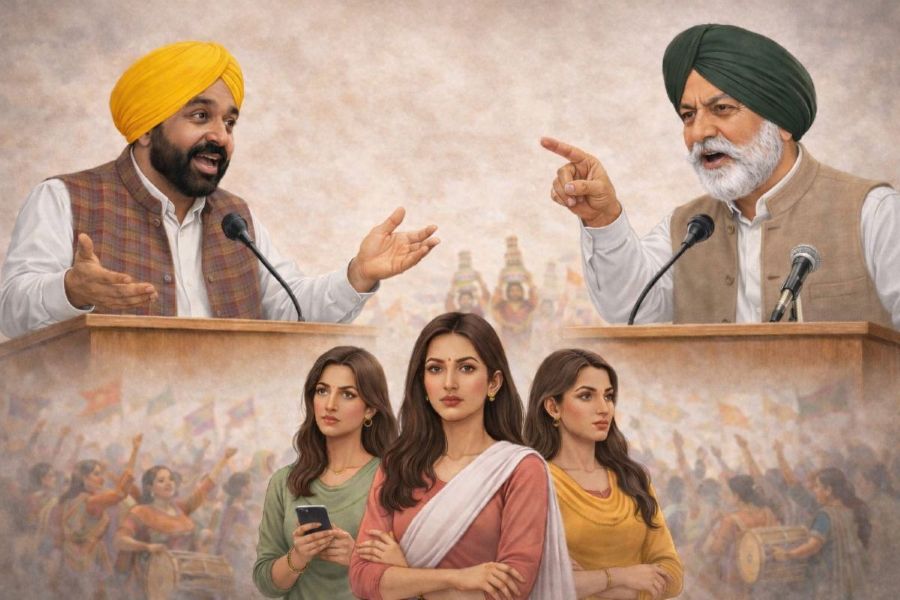
A story that reveals how power, politics and imagery shape the narrative around women
किसी के ऐब छुपाना सवाब है लेकिन,
कभी कभी कोई पर्दा उठाना पड़ता है।
Kisi ke aib chhupana sawaab hai lekin,
kabhi kabhi koi parda uthana padta hai.
— Azhar Inayati
WITHIN DAYS, Punjab found itself confronting two controversies around remarks on women — but the real story lay not in what was said, but in how outrage unfolded.
One involved Chief Minister Bhagwant Mann. The other, Congress MLA Sukhpal Singh Khaira.
What might have remained isolated political episodes quickly turned into a larger commentary on how language, power and institutions operate in public life — and how differently they respond, depending on who is speaking.
Because in the end, the issue is not merely about what was said. It is about who said it, how it was received, and what that response reveals about the standards we claim to uphold.
At a college function on International Women’s Day, the Chief Minister narrated a story from his youth.
What was said matters. What it reveals matters more.
He described a girl he admired as a “patola”, referred to her as “tuhadi bhabhi”, and joked about the colours of her dresses — comparing a yellow suit to a “bhrind” and a green one to the Pakistan flag.
Recalling a later visit to the same college after he had become successful, he said the same “bhabhi” was standing there in a saree with an aarti thali to welcome him.
He added that he told her that if she had not rejected his proposal in college, she would not have been standing there to welcome him — she would have been stepping out of the same car with him.
When humour crosses a line
This is not casual humour. It is a complete narrative built on a clear idea: that a woman’s choice is ultimately measured against a man’s later success.
The humour lies not in nostalgia, but in reversal of power — the rejected man becoming successful, and the woman being repositioned in relation to that success.
That is precisely where the anecdote stops being harmless.
Because the message it carries is subtle but unmistakable: that a woman who once exercised her choice is later shown, even jokingly, to have chosen wrongly.
Power may change positions, but it should not determine the value of a woman’s choice.
When such a narrative is delivered by a Chief Minister — before young women — on International Women’s Day, the question is not about intent. It is about judgment.
A public leader is not merely speaking; he is setting a tone.
And that raises a simple but uncomfortable question: would such a story be told in the same manner if one’s own daughter were sitting in that audience?
The fact that the Chief Minister himself has a daughter of comparable age to many of the students present only sharpens that question — not as a personal remark, but as a reflection on the sensitivity expected from public office.
From Comedian to Chief Minister — Where Is the Shift?
Part of the answer lies in the blurring of roles. Bhagwant Mann built his public persona as a satirist — someone who connected with audiences through humour, exaggeration and storytelling.
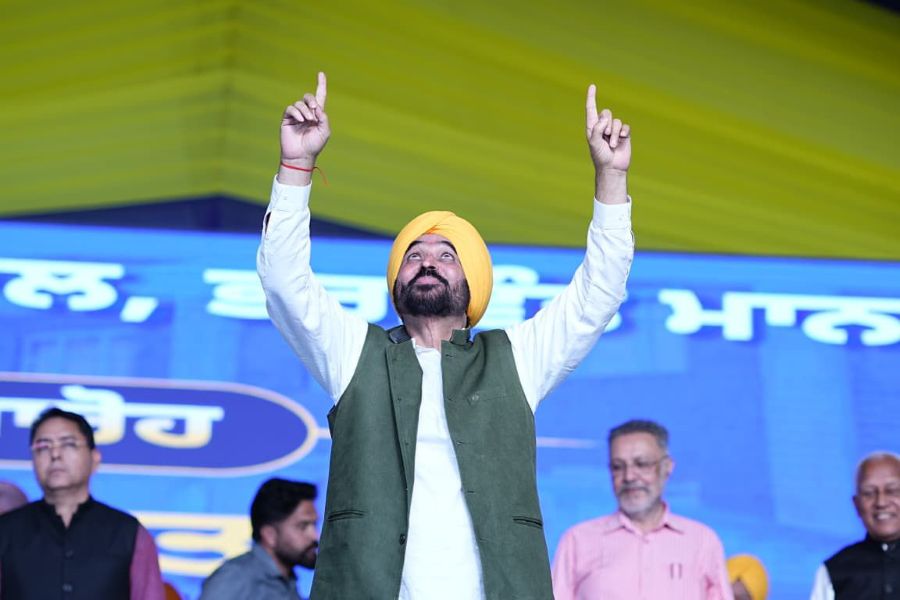
Bhagwant Mann addressing rally
But governance demands a different language.
The transition from entertainer to Chief Minister is not merely about office — it is about evolution of voice. What draws laughter in a performance does not necessarily uphold dignity in a constitutional setting.
The anecdote reflects not just a personal story, but an incomplete transition — where the instincts of performance continue to overshadow the responsibility of position.
Selective Outrage, Selective Accountability
Almost simultaneously, remarks by Sukhpal Singh Khaira questioning the celebration by women after the announcement of the ₹1000 monthly assistance scheme triggered swift institutional action.
In his comments, while quoting a YouTuber, Khaira used a line that drew particular criticism:
“₹1000 ਪਿੱਛੇ ਗਿੱਧਾ ਪਾਉਣ ਵਾਲੀਆਂ ਬੀਬੀਆਂ ਕਿੱਥੋਂ ਜੰਮ ਲੈਣਗੀਆਂ ਸੂਰਮੇ?”
The statement — questioning how women who celebrate such assistance could “give birth to brave sons” — introduced an explicit patriarchal framing. It reduced women to a traditional role and imposed a moral judgment on their behaviour.
Sukhpal Khaira’s remarks trigger action
At the same time, Khaira maintained that his larger point was about political theatrics. He argued that such celebrations were staged, that the scheme itself was a delayed and vote-seeking measure, and that the women seen dancing were not ordinary beneficiaries but party workers mobilised for political optics.
Whether staged or spontaneous, the remark did not question politics alone — it reduced women to a metaphor.
However, the reaction to his remarks was immediate and institutional.
The Punjab Legislative Assembly passed a resolution condemning him. The Punjab State Commission for Women, headed by Raj Lali Gill, took suo motu cognisance and issued summons seeking his explanation.
Yet, despite complaints, no comparable institutional action followed in the case of the Chief Minister’s speech.
This is not merely contrast — it is institutional asymmetry.
Selective outrage says more about power than principle.
When standards are enforced selectively, they cease to be standards. They become instruments of convenience.
The difference is not just in remarks, but in who speaks them — and who is expected to answer for them.
The contradiction becomes sharper when the very Chairperson of the Women’s Commission is seen in a viral clip saying she too is waiting to apply for the ₹1000 scheme.
If even those in positions of authority present themselves as beneficiaries, the line between policy and optics begins to blur.
An institution that summons others in the name of dignity must first ensure that its own conduct does not dilute that dignity.
The Spectacle of Welfare and the Reality of Women
But the deeper issue lies beyond both Mann and Khaira.
Who are the women seen dancing before cameras, performing Giddha and bringing out Jagos on the announcement of ₹1000 per month?
Are these organic expressions of relief — or curated visuals designed for political messaging?
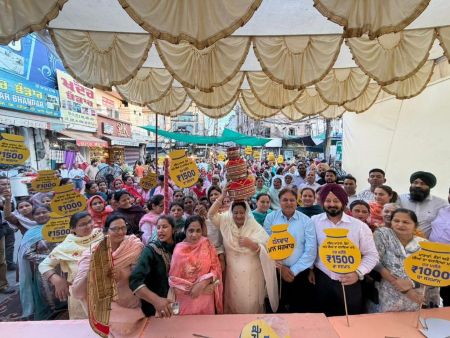
Celebration — or curated optics?
Punjab’s reality offers a different answer.
Women who genuinely struggle do not assemble for cameras. They do not wait for announcements to celebrate.
They work — relentlessly, often invisibly — sustaining households through labour and sacrifice.
Punjabi women do not beg. They earn.
They do not define themselves by what they receive, but by what they build.
To portray them as dancing recipients of assistance is not empowerment. It is reduction.
This is not empowerment — it is choreography.
It replaces dignity with imagery, strength with spectacle.
What the Debate Still Misses
But even this debate, sharp as it appears, misses something fundamental.
It is often argued that the women seen in such visuals are engaged in honest work and are not dependent on handouts. That observation is valid — and important. It also recognises that much of our political discourse continues to carry a deeply patriarchal undertone.
But that is only part of the picture.
The real question is not whether women who dance are dignified — they are. The question is whether what is being presented to the public is an authentic social reality or a constructed political narrative.
Women aren’t diminished by aid — but by how they’re portrayed.
If such scenes are organised, amplified and projected as part of political messaging, then the issue is no longer about dignity of labour. It becomes a question of representation — of how women are being portrayed in the political imagination.
By focusing only on what politicians say, the debate risks missing what is equally significant: what is being shown.
Because in public life, imagery is not incidental. It is deliberate.
And what is repeated often enough eventually begins to look like reality.
Beyond Words, Towards Accountability
The issue, ultimately, is not one anecdote or one tweet. It is a pattern.
A pattern where humour slips into stereotype, welfare becomes performance, institutions act selectively, and political language fails to evolve with the responsibilities it carries.

Representation vs reality
Respect for women cannot be situational. It cannot depend on who speaks or who is being criticised. It must reflect in language, in imagery, and in institutional conduct.
If remarks about women invite resolutions and summons, that standard must apply equally — irrespective of office.
Otherwise, what is presented as defence of dignity risks becoming yet another form of political theatre.
And in that theatre, the women of Punjab are not diminished by what they receive, but by how they are imagined.
And as Iqbal Azeem reminds us:
हम मानते हैं आप बड़े ग़म-गुसार हैं,
लेकिन ये आस्तीन में क्या है दिखाइए।
Hum maante hain aap bade gham-gusaar hain,
lekin ye aasteen mein kya hai dikhaiye. 
___________
Also Read:

Punjab Today
Punjab Today is an independent media platform committed to rigorous journalism, critical analysis, and perspective-led reporting on politics, society, and public affairs.
Disclaimer : PunjabTodayNews.com and other platforms of the Punjab Today group strive to include views and opinions from across the entire spectrum, but by no means do we agree with everything we publish. Our efforts and editorial choices consistently underscore our authors’ right to the freedom of speech. However, it should be clear to all readers that individual authors are responsible for the information, ideas or opinions in their articles, and very often, these do not reflect the views of PunjabTodayNews.com or other platforms of the group. Punjab Today does not assume any responsibility or liability for the views of authors whose work appears here.
Punjab Today believes in serious, engaging, narrative journalism at a time when mainstream media houses seem to have given up on long-form writing and news television has blurred or altogether erased the lines between news and slapstick entertainment. We at Punjab Today believe that readers such as yourself appreciate cerebral journalism, and would like you to hold us against the best international industry standards. Brickbats are welcome even more than bouquets, though an occasional pat on the back is always encouraging. Good journalism can be a lifeline in these uncertain times worldwide. You can support us in myriad ways. To begin with, by spreading word about us and forwarding this reportage. Stay engaged.
— Team PT