


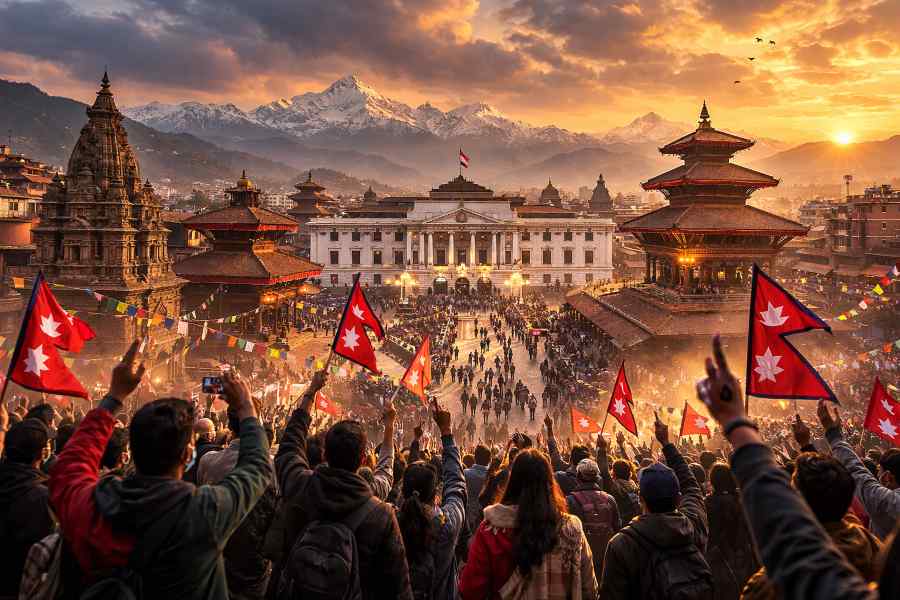
Nepal will go to the polls on March 5 to elect a new government. Nearly 19 million people will take part in the ballot for Nepal’s House of Representatives. The general election will be the first the country has held since youth-led anti-corruption protests toppled the government in September 2025. The republic has since been governed by an interim administration led by former chief justice Sushila Karki, which promised to hold fresh elections within six months.
INDIA’S NEIGHBOUR NEPAL will hold its ninth parliamentary election since the first one in 1959. Nepal follows a mixed electoral system introduced under its 2015 Constitution.
Several political parties and politicians are being closely watched. Balendra Shah, the 35-year-old former mayor of Nepal’s capital, Kathmandu, is one of them.
Better known as Balen, the former rapper is taking on the country’s former prime minister, KP Sharma Oli, who resigned last September amid mounting public anger over long-entrenched corruption and social inequality in the Himalayan republic.
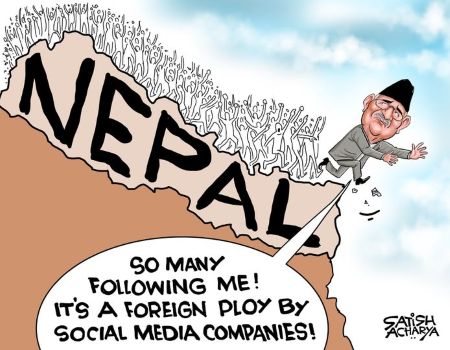 Most political parties have focused their manifestos on issues such as better governance, fighting corruption, and reducing unemployment, which is widely seen as a response to the frustrations that led to the toppling of the previous government.
The campaign is heavily focused on the demands of the “Gen Z movement”, emphasising:
Accountability — investigating the assets of public officials and ending endemic corruption;
Employment — addressing the mass exodus of youth seeking work abroad by promising job creation; and
Structural Reform — proposals include directly elected executives, term limits for prime ministers, and decentralisation of power.
The main political parties participating in these elections are:
Nepali Congress: The party is contesting the 2026 elections under the leadership of Gagan Thapa. Its campaign focuses on a new generation taking over the party leadership and projecting a “renewed” image. The manifesto calls for structural reforms centred on good governance, administrative efficiency, and strict term limits. It proposes a one-term limit for the president, two terms for the prime minister and chief ministers, three terms for ministers, and a single term for party-list MPs.
CPN (UML): The party held its 11th general convention on 18 December 2025 and re-elected K. P. Sharma Oli as chairman. Oli was subsequently declared the party’s candidate for the prime minister’s post. The party’s manifesto promises a welfare system with comprehensive social security nets.
Nepali Communist Party: The party was formed through the merger of CPN (Maoist Centre), CPN (Unified Socialist), and eight other left-wing groups. Its manifesto, unveiled on 10 February, focuses on good governance, employment creation, social welfare, and institutional reform.
Rastriya Swatantra Party: The party signed an agreement bringing independent Kathmandu mayor Balen Shah, who led the 2025 Gen Z protests, into the party and declared him its prime ministerial candidate. The manifesto advocates constitutional amendments and institutional reforms aimed at streamlining bureaucracy. It proposes a transition to a directly elected executive and a fully proportional parliament, alongside a separation of powers preventing legislators from serving as cabinet members.
Rastriya Prajatantra Party: The party’s manifesto calls for a return to a constitutional monarchy, restoration of a Sanatan Hindu state with religious liberty, and scrapping the federal system in favour of a two-tier governance structure consisting of a central government and strong, non-partisan local governments.
People’s Socialist Party Nepal: Loktantrik Samajwadi Party–Nepal, Terai Madhesh Loktantrik Party, and Janata Pragatisheel Party merged with the party ahead of the nomination deadline. The party released a 27-point manifesto on 26 January 2026 focusing on strengthening the federal structure. It advocates implementing a “10+1” federal model based on the 2012 High-Level State Restructuring Commission’s report to ensure ethnic identity. The manifesto also calls for constitutional amendments incorporating demands from the Madhesh and Janajati movements, as well as the 2025 Gen Z protests.
Pragatisheel Loktantrik Party: The party was formed by leaders of CPN (Maoist Centre) who opposed the creation of the Nepali Communist Party, along with the Nepal Socialist Party (Naya Shakti) led by former prime minister Baburam Bhattarai and former chief whip of the Rastriya Swatantra Party, Santosh Pariyar. Its manifesto calls for a transition to a directly elected presidential system, direct elections for provincial heads, and a fully proportional electoral system. It proposes limiting the federal parliament to legislative duties and forming a cabinet chosen by the executive head.
Ujyaalo Nepal Party: The party was formed after the elections were announced. On 15 February 2026, it released its manifesto aiming for a “Development Decade”. The party proposes significant administrative downsizing, reducing federal legislators to 201 and provincial legislators to 330, alongside directly elected chief ministers and non-partisan local elections.
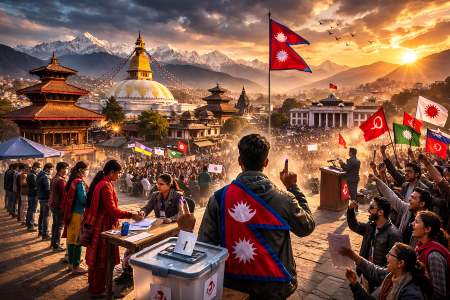
Representative illustration of voter participation under Nepal’s mixed electoral system.
In Nepal, the electoral system combines two methods. The first is the First-Past-the-Post (FPTP) system, in which the candidate receiving the most votes wins the seat. The second is Proportional Representation (PR), which allocates seats based on the proportion of votes received by political parties. A total of 165 seats will be filled through FPTP, while the remaining 110 seats will be elected through PR.
The dual system aims to ensure inclusion as well as proportional representation across society. However, it makes it difficult for a single party to secure an outright majority, meaning the leading party will most likely need to form a coalition government.
This election also carries significant geopolitical ramifications. Neighbouring India, which has historically played an outsized role in Nepal’s political history, is watching closely.
It has had a fractious relationship with former prime minister KP Sharma Oli, largely because he has pursued closer ties with China during his previous terms in office. The United States has also been active in Nepal and has broadly aligned with India in terms of strategic objectives.
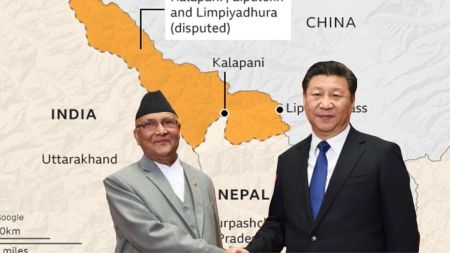
Former Nepal PM Oli with President of China Xi Jinping (File photo)
China maintains considerable influence in Nepal and will be closely observing the outcome, hoping that any future government supports its interests, including the Belt and Road Initiative (BRI).
Nepal is integrated into cross-border infrastructure networks in both directions: electricity generated by hydropower projects flows to India, while China connects through Belt and Road projects across the Himalayas via Tibet, investing in airports and railway infrastructure.
For nearly two decades, Nepal’s political landscape has been dominated by veteran leaders — many of them former Maoist insurgents — who have alternated in power since the end of the 10-year civil war in 2006.
Last September’s unrest began as youth protests against a brief social media ban but was fuelled by broader anger over economic stagnation and corruption.
Whoever prevails will become Nepal’s 16th prime minister in less than two decades, underscoring the recurring political instability that has marked the Himalayan nation since the monarchy was abolished in 2008. 
___________
Also Read:
Asad Mirza
The author is a New Delhi-based senior commentator on national and international affairs, defence and strategic issues, and environmental concerns. He is also an interfaith practitioner and a media consultant. Previously, he was associated with the BBC Urdu Service and the Khaleej Times in Dubai.
Disclaimer : PunjabTodayNews.com and other platforms of the Punjab Today group strive to include views and opinions from across the entire spectrum, but by no means do we agree with everything we publish. Our efforts and editorial choices consistently underscore our authors’ right to the freedom of speech. However, it should be clear to all readers that individual authors are responsible for the information, ideas or opinions in their articles, and very often, these do not reflect the views of PunjabTodayNews.com or other platforms of the group. Punjab Today does not assume any responsibility or liability for the views of authors whose work appears here.
Punjab Today believes in serious, engaging, narrative journalism at a time when mainstream media houses seem to have given up on long-form writing and news television has blurred or altogether erased the lines between news and slapstick entertainment. We at Punjab Today believe that readers such as yourself appreciate cerebral journalism, and would like you to hold us against the best international industry standards. Brickbats are welcome even more than bouquets, though an occasional pat on the back is always encouraging. Good journalism can be a lifeline in these uncertain times worldwide. You can support us in myriad ways. To begin with, by spreading word about us and forwarding this reportage. Stay engaged.
— Team PT