


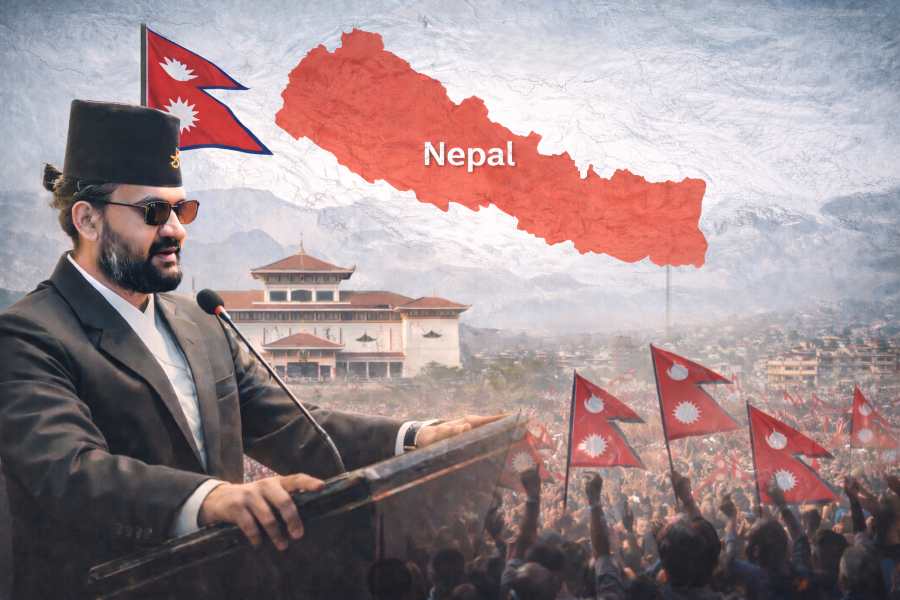
The rise of Balen Shah and the Rastriya Swatantra Party signals a generational shift in Nepal’s politics.
Nepal’s recent parliamentary elections have triggered one of the most dramatic political transformations in the country’s contemporary history.
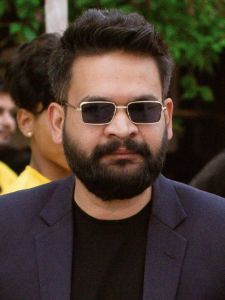
Balen Shah
The meteoric rise of the Rastriya Swatantra Party (RSP), led by rapper-turned-politician Balendra Shah—now poised to assume the office of prime minister—has fundamentally disrupted the political order that has dominated Kathmandu since the end of the monarchy.
In a single electoral sweep, the new political formation has pushed aside long-entrenched parties and exposed deep public fatigue with Nepal’s traditional leadership.
For India, this political upheaval carries implications that extend well beyond Nepal’s internal power shift. The emergence of a youthful political leadership in Kathmandu represents both a diplomatic challenge and a strategic opening for New Delhi as it seeks to stabilise and revitalise its relationship with a key Himalayan neighbour.
Collapse of Nepal’s Traditional Political Order
The scale of the RSP’s electoral success reflects a profound transformation within Nepal’s political landscape.
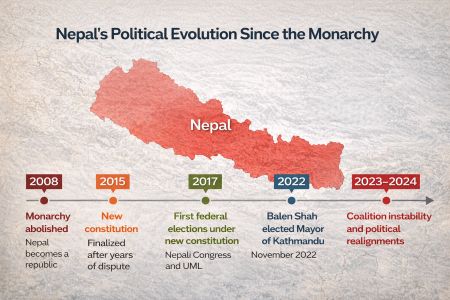
Since the abolition of the monarchy in 2008, the country’s politics had largely revolved around two dominant forces—the Nepali Congress and the Communist Party of Nepal (Unified Marxist–Leninist). Both parties alternated in power while maintaining a firm grip over the state apparatus.
 This electoral cycle, however, shattered that entrenched structure. Voters decisively rejected the familiar leadership class that had presided over years of instability, corruption allegations and governance paralysis.
The RSP’s emergence therefore symbolises not merely a change of government but the collapse of a political ecosystem that many citizens had begun to see as disconnected from contemporary realities.
The new party itself is a relatively recent entrant in Nepali politics. Founded in 2022 by journalist-turned-politician Rabi Lamichhane, it capitalised on widespread public frustration and presented itself as an alternative to the old political elite.
Within a remarkably short period, the party succeeded in transforming public anger into an organised electoral movement.
A Generational Revolt in Nepal’s Politics
At the heart of this political upheaval lies a generational revolt. Nepal’s electorate has become increasingly youthful, and younger voters have displayed growing impatience with ageing leaders and outdated political narratives.
Balendra Shah, who first rose to prominence as the mayor of Kathmandu, emerged as a figure capable of channeling these aspirations into a broader political movement.
Unlike conventional politicians, Shah cultivated an image that blended cultural influence with administrative reform. His campaign relied heavily on digital communication, grassroots activism, and the language of transparency and accountability.
By rejecting rigid ideological positioning, the RSP framed itself as a pragmatic force focused on governance rather than doctrinal politics.
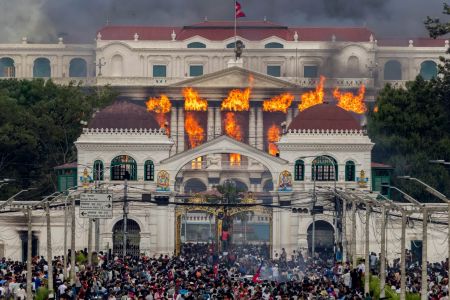
Fire engulfs the Singha Durbar palace, whose grounds house government and parliament buildings. [Narendra Shrestha/EPA]
That movement, largely driven by Generation Z activists, challenged the authority of the government led by K. P. Sharma Oli and exposed the widening disconnect between the country’s youthful society and its entrenched leadership.
The protests eventually led to the collapse of the Oli administration and opened political space for new leadership to emerge.
India, observing these developments closely, publicly welcomed the democratic mobilisation of Nepal’s youth.
Prime Minister Narendra Modi described the youth-led awakening as the arrival of a “new dawn” in the political life of the neighbouring country.
Governance Challenges Facing the New Leadership
The transition from electoral success to effective governance will now determine the long-term credibility of the RSP experiment. Shah’s anticipated premiership will be accompanied by enormous public expectations, particularly among young voters who propelled his party to power.
Nepal’s administrative framework, however, remains complex and often resistant to rapid reform. Coalition dynamics, bureaucratic inertia and institutional limitations have historically slowed the pace of governance in Kathmandu. A relatively new political formation will therefore have to quickly master the practical realities of managing the state.
Economic challenges further complicate the task ahead. Nepal’s economy continues to depend heavily on remittances and tourism, leaving it vulnerable to external shocks.
Delivering employment opportunities, curbing corruption and modernising governance systems will require both political stability and sustained policy innovation.
Maintaining unity within a rapidly expanding party structure will also test Shah’s leadership capacity as he moves from being a political insurgent to the head of government.
Decline of the Communist Bloc
One of the most striking aspects of the election has been the sharp reversal suffered by the Communist Party of Nepal (Unified Marxist–Leninist) led by K. P. Sharma Oli. Once a dominant force in the country’s political landscape, the party experienced a severe erosion of its electoral base.
Critics had long accused the Oli administration of authoritarian tendencies and ineffective governance. The government’s response to youth protests further alienated large sections of the electorate. At the same time, persistent factional struggles within the communist movement weakened organisational cohesion and diluted its ideological appeal.
For many voters, parties that once promised sweeping social transformation began to appear indistinguishable from the political establishment they had originally opposed.
Nepali Congress and the Crisis of Relevance
The Nepali Congress also struggled to maintain its historical position as Nepal’s principal democratic force. Despite its legacy in the country’s democratic movement, the party appeared increasingly out of touch with the aspirations of younger voters.
Leadership stagnation, allegations of corruption and the absence of a compelling reform agenda all contributed to the party’s electoral setback. While the RSP presented itself as a vehicle for systemic renewal, the Nepali Congress struggled to articulate a convincing vision for governance and economic revival.
India’s Strategic Opportunity
For India, Nepal’s political transition offers a moment to recalibrate its diplomatic engagement. Relations between the two neighbours have occasionally faced strain in recent years, particularly during periods when Kathmandu’s communist leadership pursued closer strategic engagement with China.
The RSP leadership has indicated that it intends to pursue a “Nepal First” foreign policy designed to safeguard national sovereignty and dignity. At the same time, it has spoken of transforming Nepal from a traditional “buffer state” between India and China into a “vibrant bridge” linking the two Asian powers.
Such a formulation reflects Kathmandu’s desire to maintain balanced relations with both neighbours while asserting greater strategic autonomy.
For New Delhi, the key will be to respond with sensitivity and patience—avoiding perceptions of interference while strengthening practical cooperation.
Prime Minister Narendra Modi has already conveyed India’s willingness to work closely with the incoming government. Emphasising the deep civilisational and economic ties between the two nations, he reaffirmed that India remains committed to advancing “shared peace, progress and prosperity” with Nepal.
A renewed Indian approach could focus on deepening cross-border infrastructure projects, accelerating hydropower partnerships and expanding economic connectivity. Equally important will be engaging Nepal’s younger generation whose aspirations have reshaped the country’s political landscape.
China Watches Closely
China, which had cultivated close relations with Nepal’s communist leadership, will carefully monitor the new political configuration in Kathmandu. Over the past decade, Beijing has invested considerable diplomatic and economic energy in expanding its influence through infrastructure initiatives and connectivity projects.
With the weakening of traditional communist parties, China may adapt its strategy and pursue pragmatic engagement with the Shah administration. Nepal’s new leadership is likely to follow a balanced foreign policy that preserves relations with both India and China while prioritising national interests.
A New Phase in Nepal’s Democracy
Nepal’s latest election marks a decisive moment in the country’s democratic evolution. The rise of the Rastriya Swatantra Party represents the arrival of a new political generation determined to challenge entrenched power structures and redefine governance priorities.
For India, this transformation provides an opportunity to reconnect with a changing Nepal whose politics will increasingly be shaped by youthful aspirations rather than rigid ideological alignments.
Whether this political upheaval ultimately produces lasting reform will depend on the ability of Nepal’s new leadership to translate popular enthusiasm into effective governance.
Yet one conclusion already stands clear: Nepal’s democracy has once again demonstrated its remarkable capacity for renewal—and India must adapt its diplomacy to this emerging political reality. 
____________
Also Read:
How $20,000 Drones Are Forcing Million-Dollar Missile Defences
The Strait of Hormuz Crisis: The Global Stakes of the Iran–US–Israel War

K. S. Tomar
The writer, a senior political analyst, is a former Editor of the Hindustan Times' Rajasthan edition and has spent nearly four decades in journalism, including a six year stint in Nepal where he covered Sino-India-Nepal complex relationship and had a ringside seat to the Himalayan Kingdom's transition into democracy.
Disclaimer : PunjabTodayNews.com and other platforms of the Punjab Today group strive to include views and opinions from across the entire spectrum, but by no means do we agree with everything we publish. Our efforts and editorial choices consistently underscore our authors’ right to the freedom of speech. However, it should be clear to all readers that individual authors are responsible for the information, ideas or opinions in their articles, and very often, these do not reflect the views of PunjabTodayNews.com or other platforms of the group. Punjab Today does not assume any responsibility or liability for the views of authors whose work appears here.
Punjab Today believes in serious, engaging, narrative journalism at a time when mainstream media houses seem to have given up on long-form writing and news television has blurred or altogether erased the lines between news and slapstick entertainment. We at Punjab Today believe that readers such as yourself appreciate cerebral journalism, and would like you to hold us against the best international industry standards. Brickbats are welcome even more than bouquets, though an occasional pat on the back is always encouraging. Good journalism can be a lifeline in these uncertain times worldwide. You can support us in myriad ways. To begin with, by spreading word about us and forwarding this reportage. Stay engaged.
— Team PT