


Justice Markandey Katju (Retd.) explains why he observes one day roza in Ramadan as a symbolic gesture to promote unity among Indians across religions and communities.
For the last 25–30 years I have been keeping one day roza during the holy month of Ramadan. Today, on 13th March 2026, I am doing the same.
I am an atheist and technically a Hindu, so why do I do this? Is it a hypocritical sham, a drama, a stunt, or a gimmick?
It is not. It is a very serious symbolic act aimed at uniting the Indian people.
By Indian people, I include Pakistanis and Bangladeshis as well, because historically and culturally we are one people who were temporarily divided in 1947 by a British political maneuver based on the flawed two-nation theory. In the long run, our destinies remain interconnected.
The Larger National Objective
India’s national aim should be to transform itself from a relatively backward country into a modern industrial giant, similar to China.
Without such transformation, it will be impossible to eliminate massive poverty, widespread unemployment, the alarming level of child malnutrition, and the severe shortage of quality healthcare and education available to the masses.
Economic progress and industrial growth are essential if India is to provide a dignified standard of living for its people.
Development must not remain limited to a small section of society but should uplift the entire population.
The Need for a United People’s Struggle
Achieving this transformation will require a mighty and united people’s struggle led by modern-minded leadership. Such a struggle would likely be prolonged, lasting many years, and would demand great sacrifices from the population.
Ultimately, this struggle could culminate in a historic people’s movement that establishes a political and social system capable of rapid industrialization and continuous improvement in the standard of living of ordinary citizens.
However, for such a historic transformation to succeed, unity among the people is absolutely essential.
The Problem of Division in Society
Unfortunately, powerful forces have long attempted to divide and polarize society by spreading religious, caste, and ethnic hostility.
During colonial rule, the British adopted the policy of divide and rule. By encouraging divisions among Indians, they strengthened their control over the country.

Mass migration during the Partition of India in 1947
Even after independence in 1947, divisions have continued to weaken society. True independence does not only mean political freedom; it also means economic freedom—freedom from poverty, hunger, unemployment, and social deprivation. In many ways, this deeper independence is yet to be achieved.
Modern politics has often reinforced divisions rather than reducing them. Many political leaders rely heavily on caste or communal vote banks to win elections, which further deepens social fragmentation.
A significant number of elected representatives in recent elections have faced criminal cases. This reflects a troubling reality: many voters prioritize caste or religious identity over merit or integrity when choosing candidates.
Democracy is often described as an ideal system of governance. However, it must be examined not only in theory but also in practice.
In India, democratic politics frequently revolves around caste and communal loyalties. These forces are remnants of feudal structures that hinder social progress. Yet the electoral system often strengthens them, because political success is closely tied to mobilizing these identity-based groups.
When society remains trapped in such divisions, genuine national progress becomes extremely difficult.
The Symbolism of My One Day Roza
This brings me back to the reason I observe one day roza during Ramadan every year.
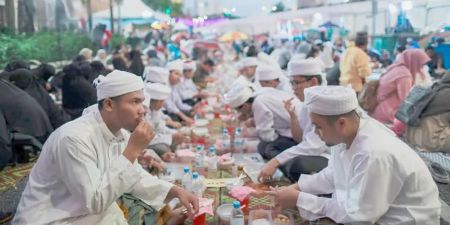
Muslims gathering to break their fast during Ramadan
For the past 25 to 30 years, I have kept this fast as a symbolic gesture of solidarity with my Muslim brothers and sisters. It is not about religious conversion or religious practice. It is about empathy, respect, and unity.
Every year I also appeal to non-Muslims to observe one day of fasting during Ramadan. Similarly, I encourage non-Hindus to fast for one day during Navratri.
The purpose is not to abandon or replace anyone’s religion. The objective is simply to demonstrate solidarity and mutual respect among people of different communities.
Small symbolic acts can help break barriers and build emotional bonds among citizens.
Unity in Diversity
India is a country of immense diversity. We have multiple religions, numerous languages, a wide range of cultures, and many ethnic communities.
This diversity is a strength, but it can also become a weakness if it leads to division and hostility.
 Despite these differences, unity is essential if we want to launch a powerful and sustained national effort to transform the country. Only a united population can achieve large-scale social and economic change.
History offers several examples where unity helped nations overcome powerful adversaries.
Vietnam, despite its diverse religious and cultural landscape, defeated a much stronger military power because its people remained united in their struggle.
Similarly, unity within a society often determines whether a nation succeeds or fails during times of conflict or crisis.
These examples highlight the power of collective resolve.
A Small Gesture for a Larger Cause
My observance of one day roza during Ramadan is only a small symbolic gesture. It may seem insignificant in the larger context of national transformation.
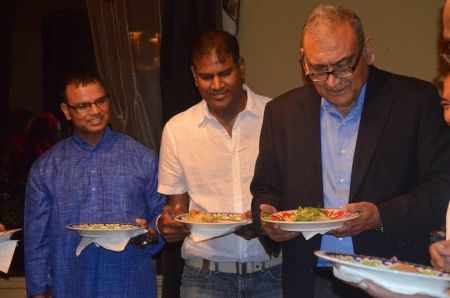
Justice Markandey Katju joining others to break roza during Ramadan (File pic)
However, symbols can carry powerful messages. They can remind people that beyond religious, caste, or ethnic identities, we share a common destiny.
If Indians can learn to stand together—respecting each other’s beliefs while working toward a common national goal—then the country can achieve extraordinary progress.
A united people can transform India into a modern industrial powerhouse where every citizen enjoys dignity, opportunity, and a rising standard of living.
My roza is simply a humble contribution toward encouraging that unity. 
__________
Also Read:
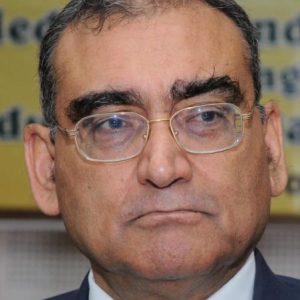
Markandey Katju
Justice Markandey Katju is former Judge, Supreme Court of India and former Chairman, Press Council of India.
Disclaimer : PunjabTodayNews.com and other platforms of the Punjab Today group strive to include views and opinions from across the entire spectrum, but by no means do we agree with everything we publish. Our efforts and editorial choices consistently underscore our authors’ right to the freedom of speech. However, it should be clear to all readers that individual authors are responsible for the information, ideas or opinions in their articles, and very often, these do not reflect the views of PunjabTodayNews.com or other platforms of the group. Punjab Today does not assume any responsibility or liability for the views of authors whose work appears here.
Punjab Today believes in serious, engaging, narrative journalism at a time when mainstream media houses seem to have given up on long-form writing and news television has blurred or altogether erased the lines between news and slapstick entertainment. We at Punjab Today believe that readers such as yourself appreciate cerebral journalism, and would like you to hold us against the best international industry standards. Brickbats are welcome even more than bouquets, though an occasional pat on the back is always encouraging. Good journalism can be a lifeline in these uncertain times worldwide. You can support us in myriad ways. To begin with, by spreading word about us and forwarding this reportage. Stay engaged.
— Team PT