


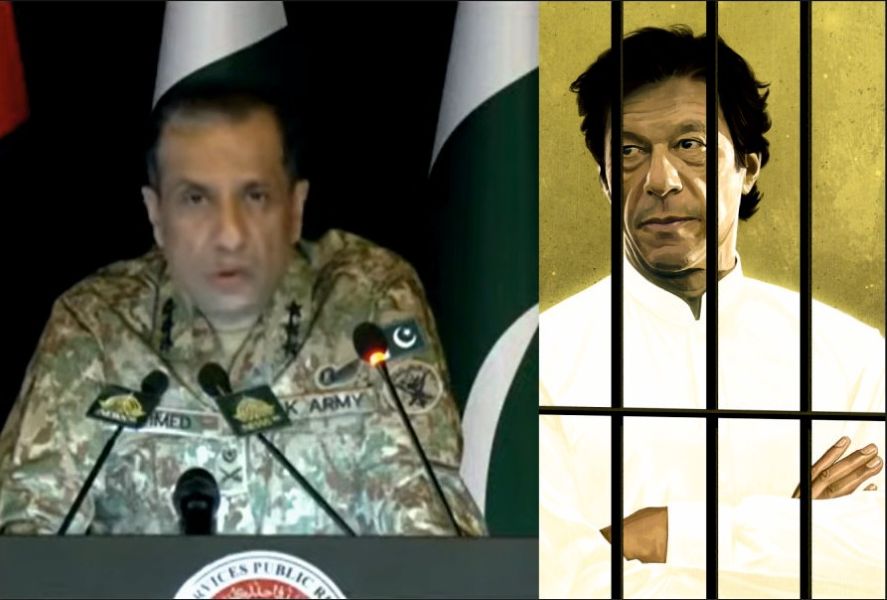
The former Supreme Court judge says Pakistan risks long-term instability if the army continues silencing dissent and curbing democratic rights.
THE FIERY AND unusually aggressive press conference by Lt Gen Ahmed Sharif, DG ISPR, on 5 December 2025 has raised profound concerns about the shrinking space for democratic freedoms in Pakistan.
The tone of the briefing suggested not merely a defence of state policy, but a hardening stance against even the limited dissent that survives in the country.

DG ISPR Lt Gen Ahmed Sharif Chaudhry speaking at the 5 December 2025 press conference broadcast live on PTV.
As in all societies, freedom functions as a safety valve. When even nominal liberties are curtailed, frustration does not disappear; it simply retreats underground, where it becomes more unpredictable and potentially explosive.
What Pakistan’s military leadership—particularly Field Marshal Asim Munir—must recognize is that freedom does not weaken a state; it stabilises it. By suppressing criticism and widening the gap between the rulers and the ruled, institutions risk creating the very instability they seek to avoid.
History offers countless reminders that no authority, however powerful, can indefinitely insulate itself from the mood of its people.
When a Nation Is Silenced, Pressure Builds Below the Surface
Today, many ordinary Pakistanis are frightened, cautious, and pessimistic. The fear of arbitrary detention has forced citizens, journalists, activists, and even political workers into a state of silence. Such despondency creates the illusion that repression has succeeded.
Yet, the collective memory of nations shows that when freedoms are crushed, resistance eventually emerges in new and unexpected forms.
As the oft-quoted adage goes, “Whenever there is oppression, there is resistance.” No population remains passive forever, and no institution—not even an army—can maintain long-term order solely through coercion.

The Intolerable Acts of 1774—one of history’s turning points when repression sparked mass resistance.
Historical parallels reinforce this truth. When the British Parliament passed the “Intolerable Acts” in 1774, the American colonists saw no option but to organise politically and militarily for their freedom.
France in 1789 and Russia in 1917 witnessed similar implosions, despite having strong, well-armed regimes. These examples are not predictions for Pakistan; rather, they illustrate the universal principle that when governance becomes synonymous with repression, legitimacy decays and the social fabric becomes brittle.
Akbar Allahabadi captured this shift poetically:
“Khabar deti hai tehreek-e-hawa tabdeel-e-mausam ki;
Khilenge aur hi gul, zamzame bulbul ke kam honge.”
The winds often change quietly, long before anyone hears the first signs of a new season.

Growing civil–military tensions have fuelled concerns about Pakistan’s political stability
Pakistan’s own demographics present a striking contrast. The Pakistan Army has roughly 1.2 million personnel, including reservists, whereas the nation holds over 240 million people.
History repeatedly demonstrates that no force—no matter how disciplined or well-equipped—can sustain order without the cooperation, consent, or confidence of the people it governs.
The Lesson Pakistan’s Leaders Cannot Ignore
The great Indian nationalist Bal Gangadhar Tilak once warned, during British rule, that when rulers turn a nation into a prison, the people eventually express their discontent in ways that authorities cannot foresee or control. His observation was not a justification of violence but a caution to governments that repression inevitably produces consequences.
 Pakistan today stands at a similar juncture. Stability cannot be secured through intimidation, nor can the future of a nation be safeguarded by silencing the very citizens whose trust forms the bedrock of national unity.
If Pakistan is to reclaim democratic dignity, restore economic confidence, and rebuild public trust, its leadership must embrace dialogue, constitutional rule, and genuine space for dissent.
Silencing critics may offer short-term quiet, but it leads inevitably to long-term instability. A secure and prosperous Pakistan requires openness, accountability, and respect for its people.
Also Read: Unmasking the Pakistan Army: From Protector to Oppressor
The path ahead is clear: nations remain strongest when they listen to their citizens, not when they silence them.
My warning is not a threat, nor a prophecy of turmoil, but a reminder—drawn from history and grounded in experience—that suppressing democratic freedoms carries consequences that no state can ultimately escape.
Pakistan’s stability, dignity, and future will depend not on the force it can deploy, but on the trust it can rebuild with its own people. 
_________
Also Read:
Freedom of Speech in India: Why Criticism of the Government Is Not Sedition
HC Orders CFSL Probe Into Patiala Police Audio Leak; AAP Government Under Pressure

Markandey Katju
Justice Markandey Katju is former Judge, Supreme Court of India and former Chairman, Press Council of India.
Disclaimer : PunjabTodayNews.com and other platforms of the Punjab Today group strive to include views and opinions from across the entire spectrum, but by no means do we agree with everything we publish. Our efforts and editorial choices consistently underscore our authors’ right to the freedom of speech. However, it should be clear to all readers that individual authors are responsible for the information, ideas or opinions in their articles, and very often, these do not reflect the views of PunjabTodayNews.com or other platforms of the group. Punjab Today does not assume any responsibility or liability for the views of authors whose work appears here.
Punjab Today believes in serious, engaging, narrative journalism at a time when mainstream media houses seem to have given up on long-form writing and news television has blurred or altogether erased the lines between news and slapstick entertainment. We at Punjab Today believe that readers such as yourself appreciate cerebral journalism, and would like you to hold us against the best international industry standards. Brickbats are welcome even more than bouquets, though an occasional pat on the back is always encouraging. Good journalism can be a lifeline in these uncertain times worldwide. You can support us in myriad ways. To begin with, by spreading word about us and forwarding this reportage. Stay engaged.
— Team PT