


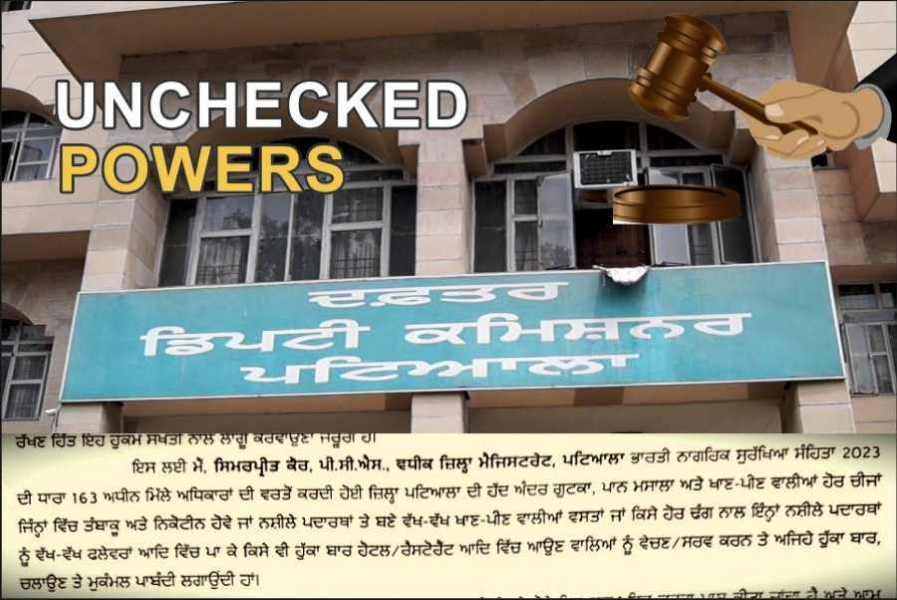
Patiala ADM’s diktat raises concerns over the mechanical and unchecked use of Section 163 BNSS
WHAT WAS presented as a public-health crackdown in Patiala has turned into a troubling case study in the misuse of emergency powers, reliance on outdated legal references, conflicting official records, and a visible breakdown of administrative scrutiny.
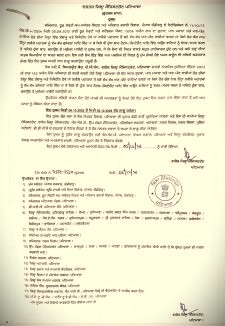
Gutka ban order issued by ADM Patiala under Section 163 BNSS
The Additional District Magistrate (ADM), Patiala, issued a prohibitory order under Section 163 of the Bharatiya Nagarik Suraksha Sanhita (BNSS), banning gutka, pan masala, flavoured chewing tobacco, nicotine products and the operation of hookah bars.
While the objective of curbing harmful substances is undisputed, the manner in which the order was issued, circulated, altered and later “corrected” raises serious questions of governance, legality and accountability.
Verbatim Translation of the Operative Portion of the Order
The following is a verbatim translation of the operative portion of the prohibitory order issued by the Additional District Magistrate, Patiala:
“Whereas Notification No. 11/10/12-H.B.4/2524, dated 05.09.2012, issued by the Commissioner, Food Safety-cum-Secretary, Department of Health and Family Welfare, Punjab, Chandigarh, under the Food Safety and Standards Act, 2006, provides that there is a complete ban on Gutkha, Pan Masala and other food items containing tobacco and nicotine, as well as on various food items made from intoxicants or food items prepared by adding such intoxicants in different flavours, and on selling or serving such items to visitors in any Hookah Bar, Hotel, Restaurant, etc., and on operating such Hookah Bars. And whereas such substances are highly injurious to public health and cause various fatal diseases. Therefore, in the public interest, and keeping in view the health of the general public, it is necessary to strictly enforce the said order in order to maintain the law and order situation.
Accordingly, I, Simerpreet Kaur, P.C.S., Additional District Magistrate, Patiala, in exercise of the powers conferred upon me under Section 163 of the Bharatiya Nagarik Suraksha Sanhita, 2023, hereby impose a complete ban, within the limits of District Patiala, on the sale or serving of Gutkha, Pan Masala, and other food items containing tobacco and nicotine, as well as food items made from intoxicants or prepared by adding such intoxicants in different flavours, to visitors in any Hookah Bar, Hotel or Restaurant, etc., and on operating such Hookah Bars.
Due to the urgency of the matter arising from the above situation, this order is passed ex-parte and is addressed to the general public.
This order shall remain in force from 06 October 2025 to 05 December 2026.“
A 14-Month ‘Emergency’ Order
The duration itself set off alarm bells. Section 163 BNSS—successor to Section 144 of the Criminal Procedure Code—empowers authorities to issue temporary prohibitory orders only in situations of immediate danger requiring urgent preventive action.
Courts have consistently held that such powers are exceptional, short-term and cannot replace regular statutory governance.
Yet in Patiala, an emergency provision was used to impose a nearly 14-month-long prohibition on a long-standing public-health issue. This raises a legitimate concern whether emergency powers were used as an administrative shortcut rather than as a response to any demonstrable imminent threat.
A Public Order That Was Hard to Access

Equally disturbing was the difficulty in obtaining a copy of the order. Punjab Today first sought the order from the ADM office on 15 December 2025. Reminder emails followed on 22 December, 24 December, 30 December and 02 January.
A personal visit on 24 December resulted in refusal, with officials advising that an RTI application be filed. Emails sent to the Additional District Magistrate, Patiala, elicited no response.
Only after another visit on 15 January 2026 did the order surface—and even then, in a form that deepened the confusion.
Three Dates, One Order, Zero Certainty
On the evening of 15 January 2026, Punjab Today was privately sent a copy of the prohibitory order carrying altered operative dates, stating that the ban would remain in force from 06 December 2025 to 05 February 2026.

Order copy shared with altered dates.
When this discrepancy and the post-circulation alteration of the operative dates was questioned, officials described it as a “clerical mistake” that had been corrected after obtaining the ADM’s approval.
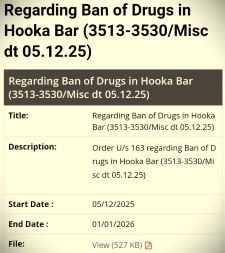
Official website metadata displaying a conflicting validity period
That explanation does not withstand scrutiny. By that stage, the original order had already been reported by sections of the media on 07 December 2025, uploaded on the Patiala district website on 08 December 2025, and officially circulated—along with a press note—to nearly 100 government functionaries, ranging from the Chief Secretary, Punjab, to senior secretaries, departmental heads, district-level officers and Sub-Divisional Magistrates.
Adding to the confusion, the official website metadata for the same order reflected yet another timeline, showing the start date as 05 December 2025 and the end date as 01 January 2026.

Signed order reflecting a 14-month duration.
As a result, three contradictory timelines co-existed simultaneously in the public domain: the signed order showing validity from 06 October 2025 to 05 December 2026; the website listing showing 05 December 2025 to 01 January 2026; and the altered copy privately shared, showing 06 December 2025 to 05 February 2026.
Within less than an hour of these discrepancies being pointed out, a corrigendum was uploaded on the official website. Notably, the corrigendum was confined solely to correcting the dates and did not revisit the order’s legal basis, statutory authority or internal consistency.
The Question That Will Not Go Away
The order was circulated to nearly 100 senior officials, yet glaring inconsistencies in dates, duration and legal footing appear to have gone unexamined.
Did no senior officer scrutinise the order before it was enforced with penal consequences, or has scrutiny become optional when emergency powers are invoked?
This is not about individual fault; it points to a systemic failure.
Gutka Ban Exists—Under a Different Law
Punjab already enforces bans on gutka, pan masala and flavoured chewing tobacco under the Food Safety & Standards Act, 2006, through notifications issued by the State Food Safety Commissioner.
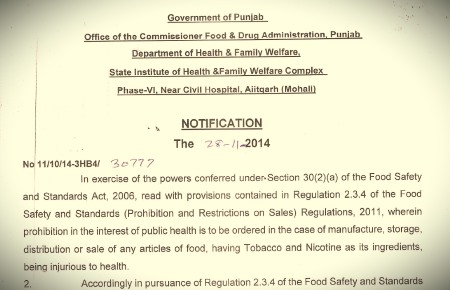
Food Safety Department notification dated 28 November 2014.
Notifications such as the one dated 28 November 2014 clearly prohibit gutka, pan masala and any food product containing tobacco or nicotine. These notifications are time-bound, usually valid for one year and renewed periodically.
The ADM’s order, however, relies solely on a 2012 notification, without clarifying whether it remains valid, without citing renewals, and without acknowledging later statutory developments.
This raises a fundamental legal question: how can an ADM in 2025 rely on a time-bound 2012 notification without establishing its continuity, while bypassing the current statutory framework?
Punjab Already Has a Permanent Ban on Hookah Bars
The legal foundation weakens further when it comes to hookah bars. In 2018, Punjab amended its tobacco control law to impose a permanent statutory ban on hookah bars. (Punjab Act No. 18 of 2018)
The amendment introduced Section 4-A, which imposes a complete ban; Section 21-A, which prescribes imprisonment of up to three years with a minimum fine of ₹20,000; and Section 27-A, which makes the offence cognisable.
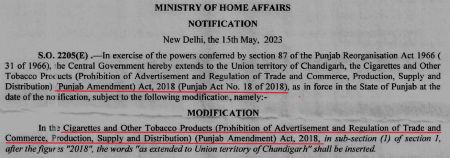
Punjab amendment making hookah bars permanently illegal
Hookah bars are already illegal, and police authorities already possess enforcement powers. No emergency order was required to prohibit an activity that the legislature has permanently outlawed.
Invoking Section 163 BNSS to “re-ban” what is already banned raises serious questions of application of mind.
Outdated Notifications, Wrong Authority
The order relies on a Health Department notification dated 05 September 2012—over 13 years old—which did not even mention hookah bars and was issued for a period of one year.
It was later superseded by a notification dated 04 September 2013 and by Notification No. 11/10/14-3HB4/30777 dated 28 November 2014, both again issued for one year. It is reasonable to presume that subsequent renewals or fresh notifications exist.
The reliance on a 2012 notification in a 2025 order suggests mechanical copying from old records rather than verification of current legal validity.
Bypassing the Correct Statutory Route

Gutka, pan masala and nicotine-containing products fall squarely within the Food Safety & Standards Act. Prohibitory powers vest with the State Food Safety Commissioner, with district authorities acting only through explicit statutory delegation.
The ADM does not possess independent authority to impose such bans outside this framework.
If the order was truly based on an emergency, the obvious question remains unanswered: what sudden, extraordinary situation arose in late 2025 to justify bypassing the Food Safety Act altogether, and how did it translate into a law-and-order problem within Patiala district?
Section 163: Was It Even Studied?
Section 163 of the Bharatiya Nagarik Suraksha Sanhita, like its predecessor Section 144 of the Criminal Procedure Code, is designed for immediate and short-term preventive action, not for imposing long-duration regulatory bans.
 Courts have repeatedly and consistently held that such powers are exceptional in nature and must be exercised only when there is an imminent threat, must remain temporary, proportionate and reasoned, and cannot be invoked where ordinary statutory law is sufficient to address the situation.
Punjab Today has previously examined this settled judicial position in detail in its earlier report on the misuse of Section 163-type powers by the Patiala administration (Read the report here: https://www.punjabtodaynews.com/patiala-adm-section-163-hc/).
Viewed against this clear legal backdrop, the said Patiala order raises a reasonable and unavoidable concern whether emergency powers were invoked as an administrative shortcut rather than as a response to any demonstrable or extraordinary imminent danger.
Confusing Language, Risky Enforcement
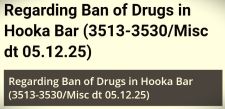
Even the language of the order creates uncertainty. The website describes it as a “Ban of Drugs in Hooka Bar”, though gutka and pan masala are regulated as food products, not drugs.
While hotels, restaurants and hookah bars are mentioned, stalls, kiosks and shops are left undefined, opening the door to selective enforcement rather than uniform compliance.
Not About Gutka—About Governance

No one disputes the need to curb harmful tobacco products. But good intentions cannot cure bad governance. If emergency powers can be exercised for 14 months, altered after circulation, and corrected only after scrutiny begins, what safeguards remain against arbitrary governance?
Punjab Today’s analysis is based on official orders, corrigenda, website records, and written and oral communications accessed during reporting. The district administration was approached repeatedly for clarification. Any response received will be published in full.
Public health deserves strong action.
But the rule of law deserves stronger respect. 
__________
Also Read:
Patiala ADM Defies High Court Guidance, Issues Blanket Section 163 BNSS Orders

Team PT
punjabtodaynews@gmail.com
Disclaimer : PunjabTodayNews.com and other platforms of the Punjab Today group strive to include views and opinions from across the entire spectrum, but by no means do we agree with everything we publish. Our efforts and editorial choices consistently underscore our authors’ right to the freedom of speech. However, it should be clear to all readers that individual authors are responsible for the information, ideas or opinions in their articles, and very often, these do not reflect the views of PunjabTodayNews.com or other platforms of the group. Punjab Today does not assume any responsibility or liability for the views of authors whose work appears here.
Punjab Today believes in serious, engaging, narrative journalism at a time when mainstream media houses seem to have given up on long-form writing and news television has blurred or altogether erased the lines between news and slapstick entertainment. We at Punjab Today believe that readers such as yourself appreciate cerebral journalism, and would like you to hold us against the best international industry standards. Brickbats are welcome even more than bouquets, though an occasional pat on the back is always encouraging. Good journalism can be a lifeline in these uncertain times worldwide. You can support us in myriad ways. To begin with, by spreading word about us and forwarding this reportage. Stay engaged.
— Team PT