


A leaked group-call allegedly featuring SSP Patiala discussing election strategy has shaken Punjab. With the Advocate General raising procedural objections and the High Court issuing notices, the government’s silence signals it has no defence on the core issues.

Punjab Police Logo
THE PATIALA POLICE audio leak is no longer a social media ripple; it has become a constitutional moment. In the alleged recording, a senior IPS officer appears to discuss how local body elections might be influenced.
Whether the clip is authentic, stitched, edited or artificially generated is for forensic experts to determine, but its content alone points to a disturbing normalisation of political interference within policing.
The clip was first made public by the Shiromani Akali Dal leadership, which released an 18-minute recording on social media.
Soon after it surfaced, Akali Dal leaders held a press briefing accusing the AAP government of “weaponising the police” to influence grassroots democratic processes. The party demanded immediate suspension of the officers heard on the call and urged the Governor to seek central intervention.
The provenance and authenticity of the clip remain under forensic evaluation, but its political and institutional implications have already escalated.
 The AAP government’s response has only heightened public suspicion. A government that celebrates every minor achievement is suddenly mute when confronted with allegations that strike at the foundation of electoral integrity. Even the Chief Minister, usually quick to react online, has offered no meaningful comment.
Punjab Police’s official stand has come in the form of an FIR registered under the Information Technology Act, asserting that the viral audio may be an AI-generated clip circulated to create unrest.
But the million-dollar question is: what does the State government itself believe? If the Punjab government’s position is also that the audio is fake, nothing should stop it from welcoming a neutral forensic examination.
And if the State is genuinely serious about establishing the truth, the first step should be to seize the phones of the police officials who participated in the original group call — the very call that Patiala Police now claims has been altered — so that the devices can undergo independent forensic analysis.
A Leak That Strikes at the Heart of Democracy
The worry is not merely about whether the audio is genuine; it is about why such a conversation sounds plausible in the first place. Punjab Police, by design, must stand outside electoral politics. Yet the alleged conversation suggests officers discussing strategy, ground reports and potential advantages — roles no police official is authorised to play.
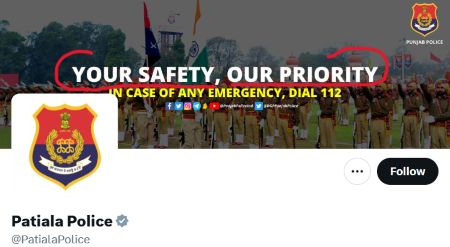
Punjab Police’s motto meets the harsh reality exposed by the alleged Patiala audio leak.
Election-time bullying and manipulation have existed under past regimes — from SAD-BJP to Congress — but the Patiala audio leak crosses a line never breached before. It points to an alleged, deeply immoral, unconstitutional and illegal act not by political workers, but by those who wear the uniform. That is what makes this moment unprecedented.
The alleged content resonates with a long-festering concern: that policing in Punjab has become increasingly politicised, and that this erosion of neutrality is now surfacing in the most critical arena of all — elections.
The High Court Becomes the Only Credible Referee
With executive silence and administrative ambiguity creating a vacuum, the Punjab & Haryana High Court has emerged as the only functioning referee. In its first hearing, the Court took the alleged audio on record and issued notices to the State government and the State Election Commission.

Punjab & Haryana High Court is now the central referee in the alleged Patiala Police audio leak case.
The Court has also asked the State to preserve all electronic records — including call data, tower locations and device dumps — until forensic examination is complete. Legal experts note that such preservation orders indicate the Court’s intent to examine institutional accountability, not just the clip’s authenticity.
Petitioners have requested a court-monitored investigation and even a CBI probe, along with interim administrative measures such as suspension of the Patiala SSP.
The matter is now listed for the next hearing on Monday, 8 December, where the government is expected to file its response.
The High Court’s intervention is no longer optional; it is essential for restoring public trust.
A Government Shielding Itself Behind Technicalities
During the hearing, the Advocate General objected to the petition being treated as a PIL. This may carry procedural validity, but substantively it offers nothing. The High Court, unimpressed, issued notices anyway.
The AG’s stance reveals what the government hopes to avoid: answering the real questions.
Why does such an audio exist? Why does it sound disturbingly believable? Why is the government hesitant to permit an independent forensic analysis?
When a government leans on procedural fencing rather than transparent explanation, it exposes fear, not strength. Punjab deserved clarity. It received evasion.
Punjab Police’s Credibility Was Already Shredded
The alleged Patiala incident is not an anomaly but the culmination of years of institutional decay.
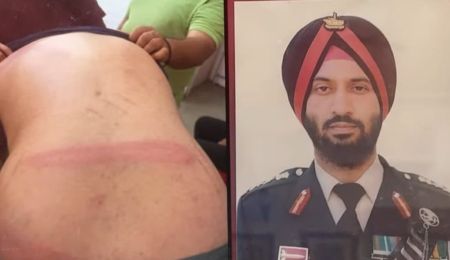
Visuals from the Colonel Bath case, a prior controversy that raised serious questions about Punjab Police conduct.
Punjab has witnessed repeated allegations of fake encounters and custodial excess, many of which have seen judicial scrutiny.
From the Col. Bath assault case — now under CBI investigation — to the Patiala Police audio leak, a deeper crisis of accountability within the force has become unmistakable.
Also Read: PUNJAB KNOWS – “Kitne Ghazi Aaye, Kitne Ghazi Gaye”! YEH BHEE CHALE JAYENGE!
Extrajudicial demolitions carried out under the guise of anti-drug operations — without court orders — have drawn sharp rebuke from the judiciary.
The CBI’s arrest of DIG Harcharan Singh Bhullar in a major corruption and bribery case further exposed cracks in policing leadership.
When a force’s credibility is already fractured, every new scandal reinforces a pattern rather than standing alone.
SIT Cannot Examine Its Own Shadow
The State has constituted a Special Investigation Team to probe the audio leak. But an SIT drawn from the same institutional hierarchy that is under suspicion cannot command public confidence. The alleged clip involves the district’s own senior leadership. How can subordinates impartially investigate their superiors?
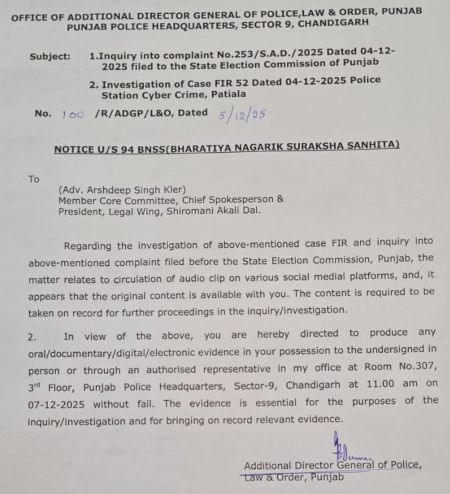
Punjab Police notice to SAD spokesperson Arshdeep Kler requesting submission of the original audio clip for investigation.
Media reports confirm that the SIT has begun taking statements and has summoned key complainants, including SAD spokesperson Arshdeep Kler.
National media has also questioned the SIT’s credibility, pointing out that several officers in the district hierarchy appear to be part of the very chain of command mentioned in the alleged recording.
Editorial commentary in independent outlets notes that an internal probe risks becoming a “self-certifying exercise” unless supervised by an external agency.
If the government insists the audio may be AI-generated, only an independent central forensic laboratory and a CBI investigation can settle the matter credibly. Anything less will be perceived — rightly — as a conflict of interest.
Ground Reality: A Polling Environment Already Under Strain
On the ground, nomination-day disruptions — including alleged incidents of nomination papers being snatched in Ghanaur and reports of selective arrests — have deepened public concern.
These contemporaneous episodes support fears that the alleged audio reflects a larger pattern, not an isolated aberration.
When democratic processes are already under visible strain, even the perception of coordinated interference by law enforcement becomes a constitutional crisis.
This Crisis Did Not Begin With One SSP
Punjab’s political leadership — across governments — has treated the police as a tool of convenience.
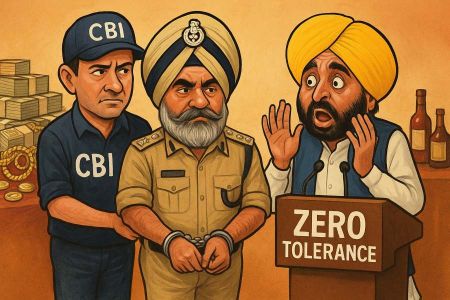
The AAP government came to power promising transparency, neutrality and structural reform.
Today it stands accused of presiding over the same patterns of interference and opacity it once condemned.
The Patiala leak may be the spark, but the oxygen feeding the fire lies in years of erosion, unchecked incentives and institutional complacency. A democracy does not collapse instantly. It collapses when institutions surrender silently and repeatedly.
Punjab Needs Honesty, Accountability and Forensic Truth
The State must stop relying on technical objections and ambiguous statements. It must submit the audio to an independent forensic examination and remove involved officers from active duty until the truth emerges.
 The High Court should continue its firm oversight. Punjab Police must choose whether it wishes to remain a constitutional body or drift further into becoming an electoral instrument.
Punjab has endured insurgency, misgovernance and institutional fragility. It cannot now surrender its democracy to alleged covert calls, manipulated instructions or whispered strategies.
The Patiala audio leak is not merely a scandal. It is a warning.
At stake is not one district, not one election — but the character of Punjab’s democracy itself.
Latest Development: High Court Orders CFSL Probe Into SSP’s Leaked Audio Clip
In a decisive move that validates the seriousness of the allegations, the Bench of the Chief Justice of the Punjab & Haryana High Court today ordered the Chandigarh CFSL to carry out a forensic examination of the leaked audio clip allegedly featuring Patiala SSP Varun Sharma.
This marks the first time the judiciary has formally intervened to verify the authenticity of the clip, signalling that the matter can no longer be brushed aside by procedural evasions or political denials. The Court has sought an expeditious report.
The Punjab Government, meanwhile, has placed SSP Varun Sharma on one-week leave, but only after the High Court’s direction — raising further questions about the State’s reluctance to act without judicial pressure.
The High Court’s step underscores a larger truth:
the integrity of Punjab’s institutions now hinges not on official statements, but on forensic evidence and judicial oversight.
The issue has moved beyond politics.
It is now a test of whether Punjab’s democracy can still defend itself from internal subversion. 
Update: HC Orders CFSL Probe Into Patiala Police Audio Leak; AAP Government Under Pressure
_________
Also Read:
Punjab Police Acting as AAP’s Enforcement Wing, Alleges Akali Dal; Shares ‘Audio Clip’
GANG CANAL ROW — How Modi Govt Retreated at Double Speed After Punjab Today Report

kanwar manjit singh
Kanwar Manjit Singh, Founder Editor of Punjab Today, writes extensively on Punjab’s history, governance, and the evolving landscape of civil liberties in India.
Disclaimer : PunjabTodayNews.com and other platforms of the Punjab Today group strive to include views and opinions from across the entire spectrum, but by no means do we agree with everything we publish. Our efforts and editorial choices consistently underscore our authors’ right to the freedom of speech. However, it should be clear to all readers that individual authors are responsible for the information, ideas or opinions in their articles, and very often, these do not reflect the views of PunjabTodayNews.com or other platforms of the group. Punjab Today does not assume any responsibility or liability for the views of authors whose work appears here.
Punjab Today believes in serious, engaging, narrative journalism at a time when mainstream media houses seem to have given up on long-form writing and news television has blurred or altogether erased the lines between news and slapstick entertainment. We at Punjab Today believe that readers such as yourself appreciate cerebral journalism, and would like you to hold us against the best international industry standards. Brickbats are welcome even more than bouquets, though an occasional pat on the back is always encouraging. Good journalism can be a lifeline in these uncertain times worldwide. You can support us in myriad ways. To begin with, by spreading word about us and forwarding this reportage. Stay engaged.
— Team PT