


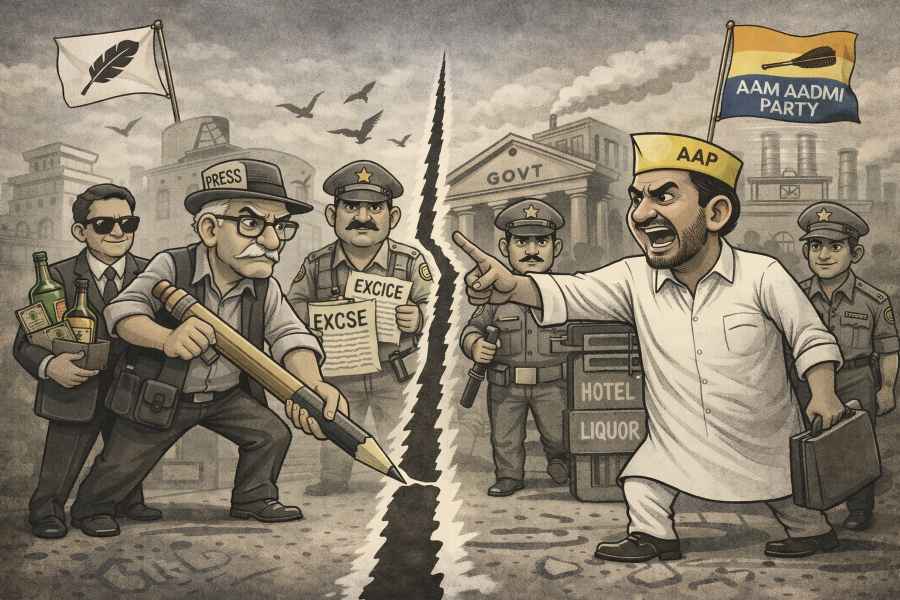
Politics takes sides, but avoids the harder question of where journalism ends and business begins
PUNJAB’S LATEST MEDIA controversy has turned into a political spectacle, with rival parties rushing to take sides while carefully avoiding the core constitutional issue involved.
 The confrontation between the Punjab Kesari Group and the AAP government is being framed either as an “attack on press freedom” or as “routine law enforcement”, depending on political convenience.
Both framings are incomplete. What is missing is a principled examination of where journalism ends and commercial accountability begins, and why that distinction is essential for protecting genuine press freedom.
Punjab Kesari’s Letter: Allegations of Pressure and the Timing Question
In its letter dated 17 January 2026, Punjab Kesari alleges a sustained pattern of pressure following its critical coverage of the AAP government.
The letter refers to obstruction of newspaper distribution, withdrawal of government advertisements, inspections at printing presses, and near-simultaneous action by multiple departments — including Excise, Pollution Control Board, Labour and GST — against establishments linked to the group.
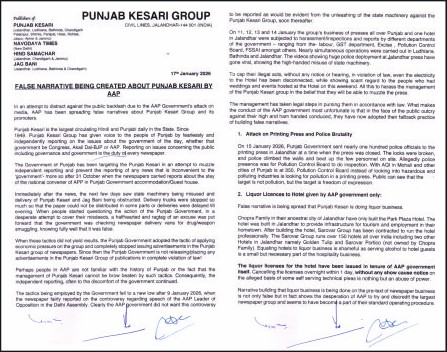
Punjab Kesari Group’s letter outlining allegations of pressure and timing of action.
It further states that electricity supply to a hotel was allegedly disconnected without due notice and that liquor licences were cancelled overnight, despite having been issued during the tenure of the same government.
The thrust of the letter is not merely the existence of alleged violations, but the timing and clustering of state action, which the group suggests indicates retaliation linked to editorial content.
This raises a legitimate public question: were these violations newly discovered, or were they long known and acted upon only after relations turned adversarial?
In press freedom debates, timing is not incidental — selective or unexplained enforcement inevitably invites scrutiny.
Govt Position: Action Based on Recorded Violations, Not Journalism
In an official press release issued on 15 January 2026, the Punjab Government rejected the allegation of a “targeted attack”, asserting that the actions arose from documented violations of law, not journalism, editorial opinion or government advertising.
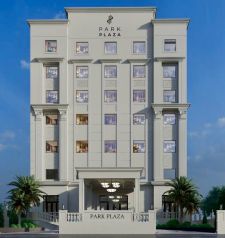
Park Plaza hotel Jalandhar linked to excise and environmental action
According to the government, excise inspections at a hotel linked to the group uncovered unauthorised liquor storage, bottles without mandatory holograms and QR codes, and the sale of expired draught beer, with licence suspension ordered after show-cause notices and hearings.
Pollution Control Board inspections, it said, recorded untreated effluent discharge, non-functional treatment plants, expired environmental consents and violations of waste-management rules, posing risks to groundwater and public health.
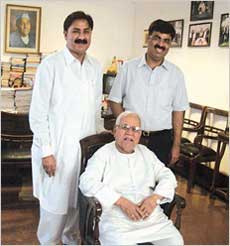
Chopra family associated with Punjab Kesari Group
The government further stated that labour and safety inspections at printing units linked to the same group documented blocked fire exits, unsafe wiring and machinery, expired fire-fighting equipment and failure to maintain statutory labour records, amounting to violations under occupational safety laws.
Simultaneous action by different departments, it argued, reflected delayed enforcement of long-standing violations and did not amount to vendetta.
On government advertisements, the state maintained that public advertising is not an entitlement and cannot insulate any establishment from regulatory scrutiny, reiterating that while editorial independence will be protected, press freedom does not include immunity from excise, environmental or labour laws.
Government Advertisements: Public Money, Not Political Leverage
One of the most sensitive issues raised in the Punjab Kesari letter relates to the alleged withdrawal of government advertisements. This issue must be separated from political rhetoric and examined on legal fundamentals.

Government advertising is not party funding. It is public money, drawn from the state exchequer, meant to disseminate information on welfare schemes, public health advisories, tenders, statutory notices and citizen services.
Allocation or withdrawal of such advertisements cannot lawfully be based on editorial stance, political alignment or tone of reporting.
Any belief — by a political executive or government officer — that advertisements may be withheld to reward favourable coverage or penalise criticism is not legally sustainable.
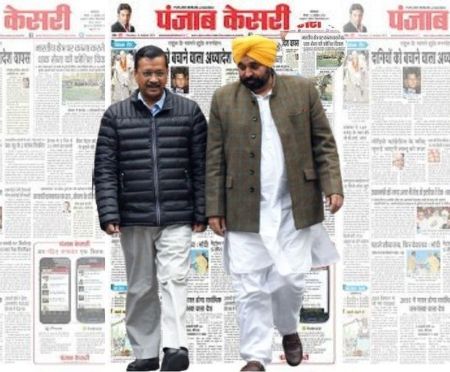
Arvind Kejriwal and Bhagwant Mann with Punjab Kesari newspaper backdrop
State largesse must be distributed in a non-arbitrary, transparent and non-discriminatory manner. Selective denial, if linked to content, would amount to misuse of public funds.
At the same time, allegations of discriminatory ad withdrawal are justiciable matters. If a media house believes government advertising was stopped solely because of its reporting, the appropriate institutional remedy lies in judicial scrutiny.
Public escalation alone cannot substitute legal determination, nor can the ad issue be clubbed with unrelated commercial enforcement without weakening both arguments.
Journalism and Business: A Boundary That Must Hold
This controversy also forces an uncomfortable but necessary introspection within the media fraternity.
Journalists and media owners are free to expand into unrelated commercial fields. But once that choice is made, those businesses operate in a separate legal domain, governed by excise laws, environmental regulations, labour norms and municipal compliance.

Ownership of a media platform does not convert every commercial activity into a constitutionally protected function.
Clubbing regulatory action on hotels, bars or other businesses with professional journalistic activity blurs a boundary that must remain firm.
When press freedom is stretched to shield unrelated business interests, it weakens its moral authority — and makes it easier for governments, tomorrow, to dismiss genuine cases of media suppression as mere business disputes.
A Pattern Punjab Has Seen Before
Punjab has witnessed earlier media–state confrontations, including the widely discussed Barjinder Singh Hamdard episode, where aggressive confrontation eventually gave way to accommodation.
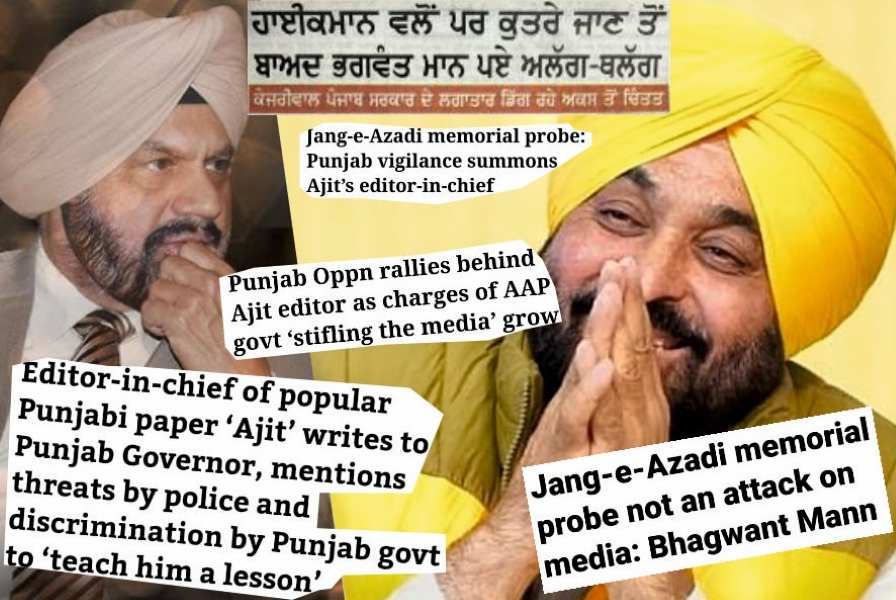
Visual recall of earlier media–government confrontations involving Barjinder Singh Hamdard of the Ajit group.
Those episodes underline why press-freedom debates must be anchored in principles rather than personalities, proximity or political alignment.
They also reinforce a dual responsibility: the state must not weaponise regulation to punish criticism, and the press must not weaponise press freedom to escape accountability.
Politics Takes Sides, Misses the Principle
What has stood out most in this controversy is the way political parties have responded less as guardians of constitutional values and more as tactical players.
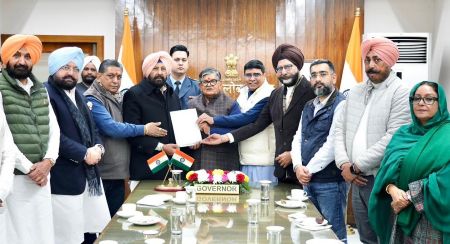
BJP delegation meeting governor over press freedom concerns
The ruling side has sought to collapse the entire issue into a matter of enforcement, while opposition parties have rushed to frame it as an attack on democracy.
Neither approach seriously engages with the harder underlying dilemma — that misuse of state power and misuse of press freedom can coexist, and that highlighting one to conveniently ignore the other weakens both arguments.
Also Read: PLAYING TO GALLERIES – Holy City or Holy Confusion?
In choosing positioning over principle, politics has added noise while sidestepping the real question this episode raises.
Punjab Today’s Stand: Back to Basics
Punjab Today has consistently criticised the AAP government on multiple issues, and that record stands. But criticism of the state cannot mean abandoning first principles when the debate involves the media itself.
 Press freedom exists to protect journalism — reporting, editorial independence, printing and circulation of news. It is a public trust, not a private insurance policy. Expanding it to cover unrelated commercial risk dilutes its meaning and weakens its defence.
The real question political parties are avoiding is simple:
if the same business action were taken against a non-media owner, would it be called an attack on democracy?
If the answer is no, accountability — not censorship — is the issue.
If the answer is yes, the government must explain its timing and consistency.
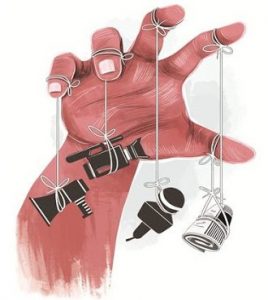 Punjab Today believes democracy is served only when both sides respect boundaries — governments by exercising power transparently and proportionately, and the press by guarding the line between journalism and commerce.
Ignoring these basics may serve short-term convenience, but it ultimately damages the credibility of press freedom itself.
That is the principle this debate must return to. 
_________
Also Read:
SAHITYA AKADEMI AWARDS ROW: Power Comes A-Knocking, or Writers Go Knocking at Power’s Door?
Punjab’s ₹10-Lakh Health Insurance Scheme: Big on Assurance, Still Short on Answers

kanwar manjit singh
Kanwar Manjit Singh, Founder Editor of Punjab Today, writes extensively on Punjab’s history, governance, and the evolving landscape of civil liberties in India.
Disclaimer : PunjabTodayNews.com and other platforms of the Punjab Today group strive to include views and opinions from across the entire spectrum, but by no means do we agree with everything we publish. Our efforts and editorial choices consistently underscore our authors’ right to the freedom of speech. However, it should be clear to all readers that individual authors are responsible for the information, ideas or opinions in their articles, and very often, these do not reflect the views of PunjabTodayNews.com or other platforms of the group. Punjab Today does not assume any responsibility or liability for the views of authors whose work appears here.
Punjab Today believes in serious, engaging, narrative journalism at a time when mainstream media houses seem to have given up on long-form writing and news television has blurred or altogether erased the lines between news and slapstick entertainment. We at Punjab Today believe that readers such as yourself appreciate cerebral journalism, and would like you to hold us against the best international industry standards. Brickbats are welcome even more than bouquets, though an occasional pat on the back is always encouraging. Good journalism can be a lifeline in these uncertain times worldwide. You can support us in myriad ways. To begin with, by spreading word about us and forwarding this reportage. Stay engaged.
— Team PT