


The Mukhyamantri Sehat Yojana (MMSY) enters rollout phase, but funding and execution details remain unclear.
As the Punjab government prepares to formally inaugurate its much-publicised ₹10-lakh universal health insurance scheme on January 15, the promise of “cashless treatment for every family” has begun to dominate public discourse.
The Mukhyamantri Sehat Yojana (MMSY) is being projected as a landmark step towards universal healthcare in Punjab.
On paper, it is among the most expansive state-level health cover schemes in the country. On the ground, however, the scheme enters its launch phase with several critical questions still unanswered.
From Political Announcement to Legal Notification
The trajectory of the ₹10-lakh health insurance scheme has unfolded in clearly identifiable stages.
On July 10, 2025, Chief Minister Bhagwant Singh Mann, sharing the stage with Arvind Kejriwal, announced that all 65 lakh families in Punjab would be entitled to cashless medical treatment up to ₹10 lakh per year, irrespective of income, caste or employment status.
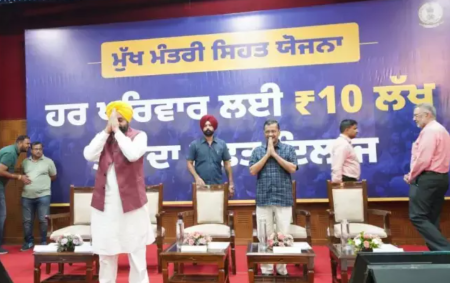
CM Bhagwant Mann and Arvind Kejriwal during the announcement of the Mukhyamantri Sehat Yojana in July 2025.
Four days later, on July 14, 2025, the Department of Health and Family Welfare issued a statutory notification, giving the Mukhyamantri Sehat Yojana legal force.
The notification guarantees universal eligibility, no cap on family size, inclusion of government employees and pensioners, and coverage for secondary and tertiary care through government and empanelled private hospitals.
It also introduces a hybrid funding model, with insurance covering the first ₹1 lakh of treatment and higher claims to be paid directly by the State Health Agency.
Legally, the scheme came into existence in July 2025. Administratively, however, it took several more months to move towards execution.
Insurance Agreement, TPAs and the Execution Gap
By December 2025, documents show that United India Insurance Company had already been allotted responsibility for administering the scheme.
This became evident when the insurer issued tenders inviting Third Party Administrators (TPAs) to manage claims processing, hospital coordination and beneficiary services in Punjab.
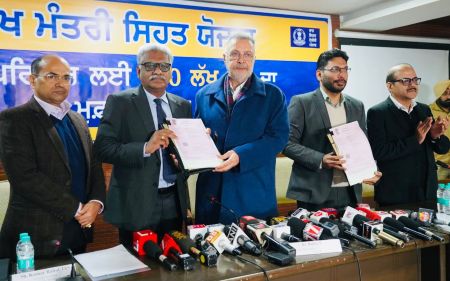
Officials during the signing of the agreement related to Punjab’s ₹10-lakh health insurance scheme.
The government publicly announced the signing of the agreement with United India Insurance on January 2, 2026 — effectively formalising an arrangement that was already operationally underway — paving the way for the official launch scheduled for January 15.
What the July notification does exceptionally well is define entitlement. What it does not explain in sufficient detail is execution.
There is no publicly disclosed information on claim settlement timelines, penalties for delayed reimbursements, or a structured grievance redress mechanism for patients denied cashless treatment.
These omissions are significant because they directly affect whether hospitals will honour the scheme without hesitation.
Budgetary Reality and Fiscal Questions
The financial dimension of the ₹10-lakh health insurance promise remains the least transparent. Covering 65 lakh families up to ₹10 lakh each implies a theoretical exposure running into several lakh crore rupees.

The budgetary challenge of funding large-scale health insurance promises.
Actual expenditure will depend on utilisation rates, but even conservative estimates suggest annual spending of several thousand crore rupees.
Yet, neither the notification nor subsequent official statements have placed on record the annual budgetary allocation, whether a dedicated health insurance corpus exists, or how high-value claims between ₹1 lakh and ₹10 lakh will be managed during periods of heavy demand.
Since the insurer’s liability is capped at ₹1 lakh per family, the bulk of financial risk lies with the state exchequer and the State Health Agency’s payment capacity.
The Shadow of Ayushman Experience
Public caution is also shaped by past experience. Under Ayushman Bharat in Punjab, many beneficiaries reported hospitals refusing high-cost procedures, seeking out-of-pocket payments despite valid cards, or delaying approvals until families were forced to arrange funds on their own.
Past experience under Ayushman Bharat continues to shape public expectations.
These problems stemmed not from lack of eligibility, but from reimbursement delays and weak enforcement.
MMSY significantly raises the coverage ceiling, but unless payment timelines are predictable and strictly enforced, hospitals may remain wary — particularly for expensive treatments — potentially recreating old patterns under a new scheme.
Also Read: Punjab’s Food Safety Crisis
As Punjab moves towards the January 15 launch, the scheme’s success will not be measured by its headline figure of ₹10 lakh, but by its reliability in moments of medical crisis. For ordinary families, the test is simple: will the card work without arguments, advance payments or delays?
The Mukhyamantri Sehat Yojana has the legal foundation and political backing to become a transformative healthcare reform.
Whether it fulfils that promise will depend less on the inauguration ceremony and more on transparent budgeting, timely payments and accountability after the cameras are gone. 
_________
Also Read:
Patiala ADM Defies High Court Guidance, Issues Blanket Section 163 BNSS Orders
Holy City or Holy Confusion? Punjab Notification Collides with Law, Rights and Sikh Doctrine

Ekjot Singh
Special Correspondent covering governance, public policy, and development for Punjab Today.
Disclaimer : PunjabTodayNews.com and other platforms of the Punjab Today group strive to include views and opinions from across the entire spectrum, but by no means do we agree with everything we publish. Our efforts and editorial choices consistently underscore our authors’ right to the freedom of speech. However, it should be clear to all readers that individual authors are responsible for the information, ideas or opinions in their articles, and very often, these do not reflect the views of PunjabTodayNews.com or other platforms of the group. Punjab Today does not assume any responsibility or liability for the views of authors whose work appears here.
Punjab Today believes in serious, engaging, narrative journalism at a time when mainstream media houses seem to have given up on long-form writing and news television has blurred or altogether erased the lines between news and slapstick entertainment. We at Punjab Today believe that readers such as yourself appreciate cerebral journalism, and would like you to hold us against the best international industry standards. Brickbats are welcome even more than bouquets, though an occasional pat on the back is always encouraging. Good journalism can be a lifeline in these uncertain times worldwide. You can support us in myriad ways. To begin with, by spreading word about us and forwarding this reportage. Stay engaged.
— Team PT