


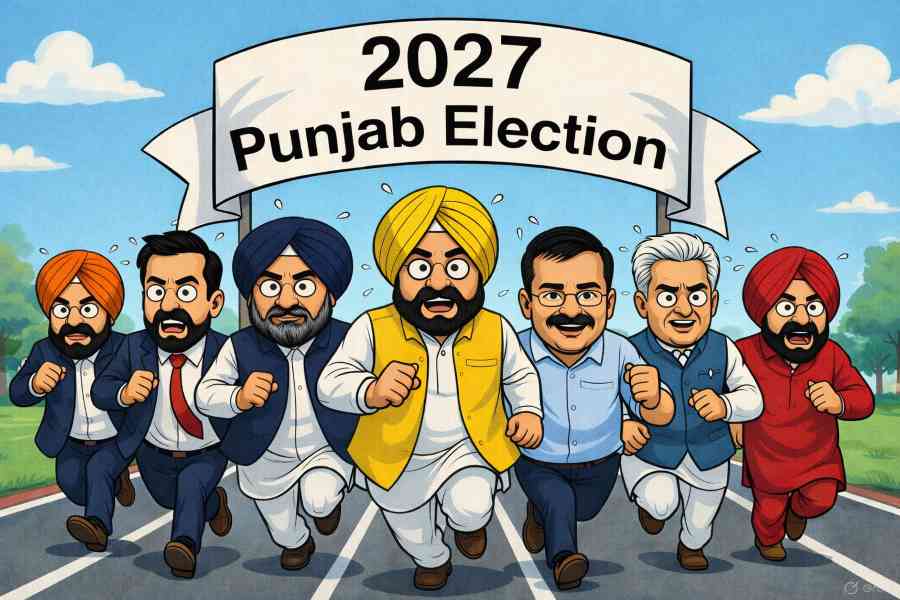
Anti-incumbency is widespread, but Punjab enters 2026 without a unified alternative — leaving arithmetic, not anger, to decide power.
AS PUNJAB ENTERS 2026, with barely a year left before the 2027 Assembly elections, the political kitchen is heating up — yet no one quite knows what will finally be served.

Will it be a confused khichdi of fractured mandates or a clearer à-la-carte verdict? One reality is already evident: anti-incumbency exists, but the absence of a credible alternative is equally real.
Punjab today is exhausted, frustrated, anxious, and economically battered from all sides. It is not angry enough for a revolt, nor hopeful enough for renewal.
This election will be shaped not by passion but by frustration, fear, economic anxiety, identity reflexes, and, ultimately, by hard electoral mathematics — a craft political parties understand far better than voters would like to believe.
Municipal Corporation elections in nine cities and polls in 116 Nagar Councils, expected around February, are already being viewed as a semi-final before 2027.
 The state carries a heavy burden. Public debt is nearing ₹4 lakh crore, hovering around 45–50% of GSDP by official estimates.
The drug crisis continues unabated, now deeply entangled with organised crime and an invisible administrative nexus; year after year, large heroin seizures keep Punjab among the top states in narcotics interception.
Youth unemployment, estimated in high double digits by multiple surveys, fuels sustained out-migration, frustration, and desperation.
Social balance remains fragile in a state where Sikhs form roughly 58%, Scheduled Castes about 32%, and women decisively influence household voting decisions.
With nearly 2.3 crore voters and Assembly turnout historically around 78–80%, the central question is not who people like, but whether scattered discontent can be converted into consolidated votes on the EVM. So far, the answer appears to be no.
Anti-incumbency is real. An alternative is not.
Three Elections, Three Signals
2022 Assembly: A Wave — And a Vacuum
The Aam Aadmi Party swept Punjab in 2022 with about 42% of the vote, converting it into an extraordinary 92 of 117 seats on a turnout slightly above 70%.
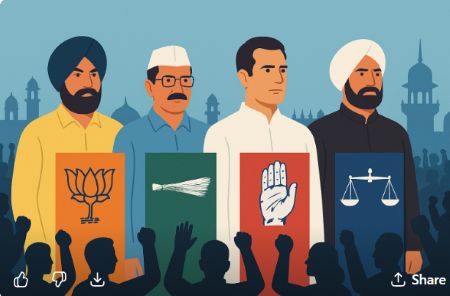
This was not merely an AAP surge; it was the collapse of alternatives. Congress slipped to around 23% with just 18 seats.
The Shiromani Akali Dal fell to roughly 18% and three seats, while the BJP managed about 7% and two seats.
The verdict was driven less by enthusiasm for AAP and more by rejection of traditional parties amid peak farm-law anger and unresolved sacrilege memories.
2024 Lok Sabha: Fragmentation Returns

Two years later, the spell broke. The parliamentary election saw AAP and Congress both hovering in the mid-20% vote range.
The BJP climbed sharply in urban Hindu belts, while SAD slipped further, though retaining a core Sikh vote.
Turnout dropped to the low-60% range, and no single narrative dominated the campaign. The 2022 wave had clearly receded.
December 2025 Rural Polls: A Warning, Not a Verdict

Rural body elections kept AAP ahead but exposed vulnerabilities. While the ruling party won a clear majority of zila parishad and panchayat samiti segments, many victories came by razor-thin margins — a worrying sign for incumbents.
Turnout fell below 50%, signalling disengagement rather than enthusiasm.
Congress remained a consistent second force. SAD showed pockets of recovery in rural Malwa, particularly among Jat Sikhs. The BJP barely registered outside towns. These results reflected political survival, not forward momentum.
Party Positions: A Snapshot
AAP (Incumbent)
AAP’s strength lies in welfare delivery — free power, health services, and an expanded rural organisation — along with continued support among women and Scheduled Castes and a formidable propaganda machinery.
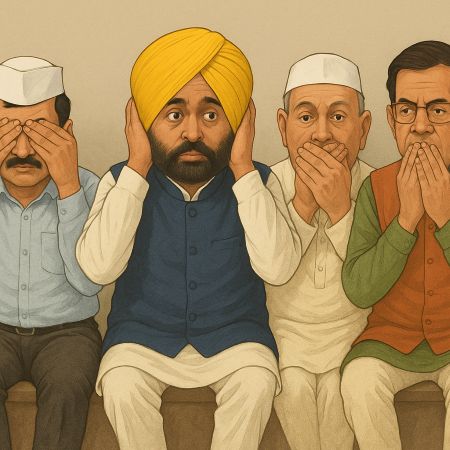
Yet visible anti-incumbency on crime, gangsters, law and order, and drugs has set in. Governance fatigue after four years is palpable, while rising debt limits fiscal space for development.
Fragmented opposition remains its biggest opportunity. Targeted cash support to women could stabilise the base.
The threats are equally clear: delayed promises, youth alienation, falling turnout, and a growing perception of governance failure amplified by hostile social-media ecosystems.
Congress
 Congress retains a stable 20–25% vote base and remains the natural magnet for anti-incumbency, with broad social acceptability across regions, religions, and castes.
Its weakness lies in leadership ambiguity, factionalism, and the absence of a clear 2027 vision. AAP’s welfare outreach has also dented Congress’s traditional SC plank.
The opportunity is arithmetic: in split contests, even modest vote shares can translate into seats. A clear chief ministerial face could sharply improve conversion. The risk is continued indecision, scattering votes and confusing the cadre.
Shiromani Akali Dal (SAD)
SAD still draws strength from residual Panthic identity, a committed cadre, and control over gurdwara institutions.

Sukhbir Singh Badal
There are limited signs of rural revival. However, credibility deficits from the 2015–21 period persist.
While sacrilege fatigue may be setting in, emotive issues such as missing saroops can resurface suddenly. Urban appeal remains weak.
An alliance could restore relevance, but religious issues can also backfire abruptly and brutally, especially in the age of social-media amplification.
BJP
 The BJP has consolidated the urban Hindu vote and made gradual inroads into some SC segments, backed by a strong national leadership image and governance models to showcase. Yet deep trust deficits remain in rural Punjab and among Sikh voters.
Stand-alone reach is limited, and the Ram Mandir narrative has lost salience since 2024. Persistent perceptions of anti-Sikh bias and weak local leadership further constrain growth.
An alliance could improve seat efficiency, while a credible SC chief ministerial face or focused dera outreach may surprise. A solo run, however, sharply caps expansion amid hostile narratives driven by diaspora politics and neighbourhood geopolitics.
The Core Arithmetic: Why Anger Gets Neutralised
Punjab’s high turnout changes everything.
In a four-cornered contest — AAP, Congress, SAD, and BJP — effective voting touches 75–80%, votes split four ways, and the winning threshold drops to around 20–22%. Even strong anti-incumbency gets neutralised.

Recent signals suggest the BJP may fight independently, keeping this scenario alive.
In a three-cornered contest — AAP versus Congress versus a BJP-SAD combine — consolidation raises efficiency and the winning threshold climbs to roughly 26–28%. That narrow 5–6 percentage-point gap could decide who governs Punjab.
₹1,000 a Month: The Trust Test
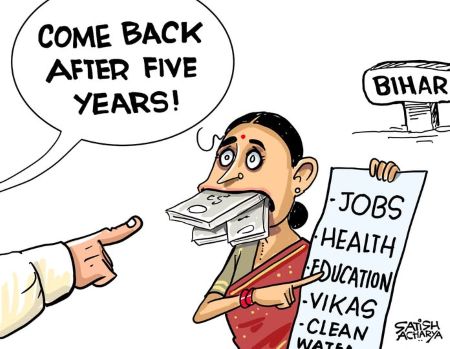
AAP’s proposed monthly support to women is not merely welfare; it is trust arithmetic.
Women influence nearly half of household voting decisions. Welfare credibility directly affects turnout and loyalty.
If delivered, AAP blunts anti-incumbency and remains the largest party. If delayed or diluted, 10–15 seats could slip — largely to Congress. In Punjab, broken promises hurt more than slow delivery. People remember.
The Likely Picture
All indicators point towards AAP remaining the single largest party but falling short of a majority.
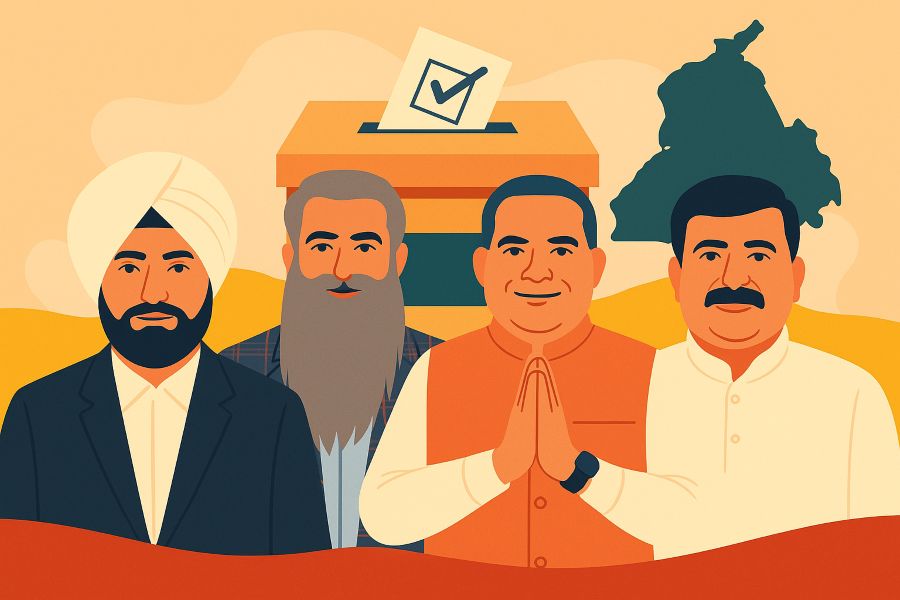 Congress’s prospects depend entirely on leadership clarity and discipline. A BJP–SAD alliance reshapes arithmetic but risks losing 5–6% of the Sikh vote.
Smaller radical formations generate noise rather than waves, yet significantly affect urban psychology and polarisation.
A hung Assembly remains a high-probability outcome.
The Bottom Line
Punjab is not voting for ideology, excitement, or grand speeches. It is voting for control — over drugs, over gangsters, over a system that feels as if it has slipped out of everyone’s hands.
Also Read: CRISIS OF CREDIBILITY
Punjab’s electorate, battered by extortion, gangsters, drugs, debt, migration, and an increasing radicalisation spilling onto the streets, is no longer asking for miracles. It is asking for something far more basic: control and functional governance.
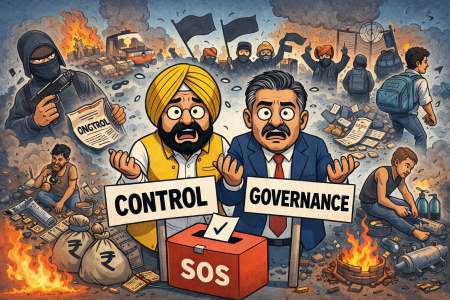
In such a climate, anti-incumbency does not automatically translate into change. It hardens into a mood — widespread, justified, and deeply felt — but not into a decisive movement.
Until a clear and credible alternative emerges, this mood has nowhere to go. Every option before the voter is either divided, distrusted, or undecided.
In that vacuum, voters do not choose; they settle. Power does not change hands because people are convinced — it stays where it is because there is nowhere else to place it.
Also Read: ‘Yudh Nasheyan Virudh’ Just an Ad Campaign?
That is how Punjab 2027 may once again be decided: not by vision or enthusiasm, but by arithmetic default. 
________
Also Read:
Punjab’s ₹10-Lakh Health Insurance Scheme: Big on Assurance, Still Short on Answers
Sekhonwal Gram Sabha Orders Return of Panchayat Land Taken for Mattewara Project
Gurpartap Singh Mann
With prior experience as a Member of the Punjab Public Service Commission, the author brings a nuanced perspective to issues of governance and social change.
Disclaimer : PunjabTodayNews.com and other platforms of the Punjab Today group strive to include views and opinions from across the entire spectrum, but by no means do we agree with everything we publish. Our efforts and editorial choices consistently underscore our authors’ right to the freedom of speech. However, it should be clear to all readers that individual authors are responsible for the information, ideas or opinions in their articles, and very often, these do not reflect the views of PunjabTodayNews.com or other platforms of the group. Punjab Today does not assume any responsibility or liability for the views of authors whose work appears here.
Punjab Today believes in serious, engaging, narrative journalism at a time when mainstream media houses seem to have given up on long-form writing and news television has blurred or altogether erased the lines between news and slapstick entertainment. We at Punjab Today believe that readers such as yourself appreciate cerebral journalism, and would like you to hold us against the best international industry standards. Brickbats are welcome even more than bouquets, though an occasional pat on the back is always encouraging. Good journalism can be a lifeline in these uncertain times worldwide. You can support us in myriad ways. To begin with, by spreading word about us and forwarding this reportage. Stay engaged.
— Team PT