


Punjab’s 3,100 stadium boast, gym math and kit control face tough accountability questions
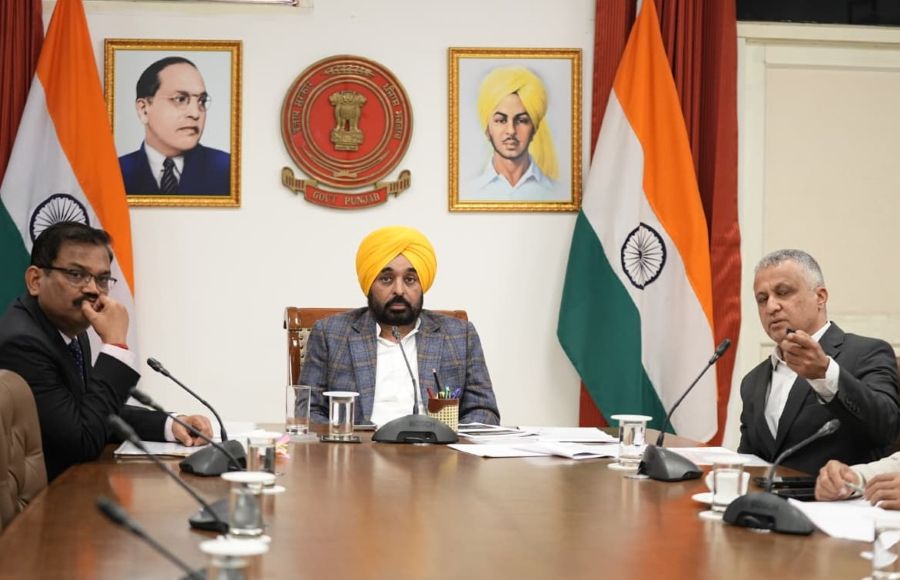
PUNJAB CHIEF MINISTER Bhagwant Singh Mann has declared that 3,100 stadiums will be completed across the state by June 2026, pegging the project cost at ₹1,350 crore.
The assurance comes barely weeks after the same initiative was earlier projected at around ₹1,194 crore, leaving a ₹156-crore question hanging in the air.

Earlier projection: ₹1,194 crore. Why ₹1,350 crore now?
With little publicly known about whether the project scope has changed, additional works have been added or revised components introduced, the escalation has inevitably triggered financial scrutiny.
Equally, there is still no fully transparent public update on how far approvals, tendering or on-ground execution have progressed, which makes the timing and basis of the increased cost particularly significant.
Cost Spike, No Clarity
The earlier figure of around ₹1,194 crore has now climbed to ₹1,350 crore, but the government has not publicly explained what exactly changed. Whether the increase reflects inflationary adjustments, expanded scope, revised technical parameters or administrative recalculations is not known.
In a project of this scale and visibility, such unexplained escalation naturally fuels questions over financial discipline, planning transparency and the seriousness with which the state bureaucracy is treating public expenditure.
Politics Before Governance
There is also the political handling of the announcement itself. The first major declaration about Punjab investing in 3,100 stadiums came not from the state government’s executive machinery but from AAP chief Arvind Kejriwal.

Earlier media report highlighting the ₹1,194 crore stadium announcement
Despite having no constitutional role in Punjab governance, Kejriwal announced expenditure direction and politically owned the narrative.
Now, Chief Minister Bhagwant Singh Mann has revised the cost projection and issued binding instructions to the administration. This layered communication trail has inevitably revived debate over governance propriety, institutional command and political messaging hierarchy around a massive public programme involving taxpayer money.
A Deadline That Shrinks Reality
With June 2026 now officially declared as the completion deadline, the government has locked itself into a fixed, self-imposed clock.

What “stadium construction” currently looks like on the ground
Practically, every stage — administrative approvals, land finalisation, tenders, funding clearances, contractor mobilisation, site development, construction, inspections and handover — must now fall perfectly in line. If many of these processes are still underway, the real construction window shrinks dramatically to just a few active months.
Expecting thousands of fully built, quality-certified and operational stadiums within that compressed timeframe is an enormous administrative challenge — one Punjab has not historically demonstrated at this scale.
This raises a critical question: will Punjab actually build stadiums, or will these turn into modestly fenced grounds projected as major infrastructure achievements?
Gyms: Maths vs Marketing
The government has also announced the installation of “ultra-modern” gyms at 1,000 locations in the first phase at a cost of ₹35 crore, which translates to about ₹3.5 lakh per site. While the announcement sounds energetic, the numbers raise unavoidable doubts.
Even with bulk government procurement, industry estimates typically place a functional medium-level modern community gym — with durable strength equipment, basic cardio machines, rubber flooring, mirrors and safety standards — in the range of ₹8–15 lakh, often higher.

‘Ultra-modern gyms’ are promised — but can Punjab truly build them on this budget?
A recent example from Punjab itself strengthens the concern. Punjab Agricultural University (PAU), Ludhiana, recently inaugurated a modern gym facility costing around ₹1.5 crore, equipped with more than 60 machines and multiple dedicated training stations for students.
That may be an institutional setup, but it clearly indicates what “modern gym infrastructure” actually looks like in terms of cost and capability, even when built efficiently.
Modern gym infrastructure needs durable equipment, quality flooring, trained supervision, routine maintenance and periodic replacement. Whether ₹3.5 lakh can genuinely support that level of infrastructure is something the government has not clarified.
Operational ownership remains equally unclear — who will run these gyms, who will fund upkeep, and who will ensure they do not become locked, symbolic spaces over time rather than genuinely functional youth facilities.
Kits Without a System
The government has further promised the distribution of 17,000 sports kits worth ₹50 crore, primarily covering football, volleyball and cricket equipment.
As per the announcement, each location will receive volleyball and football sets — three balls and two nets each — along with cricket kits comprising two bats, wickets and six tennis balls. The Chief Minister has directed officials to ensure that at least 5,600 of these kits are distributed in villages by March 31, 2026.

The gesture signals intent, but the governance framework remains absent. There is no clarity on who will receive these kits, what eligibility criteria will guide distribution, who will be responsible for their custody and upkeep, and how accountability will be enforced in case of damage, loss, misuse or political diversion.
There is also the question of sporting priorities. Punjab’s sporting legacy is deeply rooted not only in cricket and football, but prominently in hockey, kabaddi, basketball, athletics and wrestling.
The government has yet to explain how these disciplines fit into the sports push, or whether this scheme risks disproportionately favouring select games while leaving traditional strengths under-supported.
Without coaching support, structured sporting programmes, scheduled activity frameworks and clear custodianship, these kits risk becoming one-time distributions photographed for records rather than meaningful enablers of sustained youth participation.
As many sports experts emphasise, equipment alone does not build a sporting culture — systems do.
Punjab’s Youth Deserve Better
The government has framed its massive sports infrastructure plan as a critical intervention to channel youth energy and combat Punjab’s deepening drug crisis. The intent itself carries social value, and increases in sports budgeting and attention to sports medicine must be acknowledged.

Punjab’s youth deserve better
However, the financial escalation, political communication trail, lack of granular execution visibility and the extremely tight deadline together make the initiative subject to legitimate public scrutiny.
Punjab’s youth deserve credible, functioning and sustainable sports infrastructure — not just declarations. For a project of this magnitude, involving thousands of locations, hundreds of crores of public money and a hard deadline, transparency, accountability and clarity are essential.
Also Read: BROOM SWEEPING FUNDS?
Until verified execution details and monitoring frameworks are placed in the public domain, one question will continue to hover over Punjab’s ambitious sports promise: is this truly the beginning of a transformative sports movement, or a political narrative still struggling to prove its administrative footing?
Punjab Today will soon bring a ground-zero reality check. Watch this space. 
__________
Also Read:
Holy City or Holy Confusion? Punjab Notification Collides with Law, Rights and Sikh Doctrine
Sekhonwal Gram Sabha Orders Return of Panchayat Land Taken for Mattewara Project

Ekjot Singh
Special Correspondent covering governance, public policy, and development for Punjab Today.
Disclaimer : PunjabTodayNews.com and other platforms of the Punjab Today group strive to include views and opinions from across the entire spectrum, but by no means do we agree with everything we publish. Our efforts and editorial choices consistently underscore our authors’ right to the freedom of speech. However, it should be clear to all readers that individual authors are responsible for the information, ideas or opinions in their articles, and very often, these do not reflect the views of PunjabTodayNews.com or other platforms of the group. Punjab Today does not assume any responsibility or liability for the views of authors whose work appears here.
Punjab Today believes in serious, engaging, narrative journalism at a time when mainstream media houses seem to have given up on long-form writing and news television has blurred or altogether erased the lines between news and slapstick entertainment. We at Punjab Today believe that readers such as yourself appreciate cerebral journalism, and would like you to hold us against the best international industry standards. Brickbats are welcome even more than bouquets, though an occasional pat on the back is always encouraging. Good journalism can be a lifeline in these uncertain times worldwide. You can support us in myriad ways. To begin with, by spreading word about us and forwarding this reportage. Stay engaged.
— Team PT