


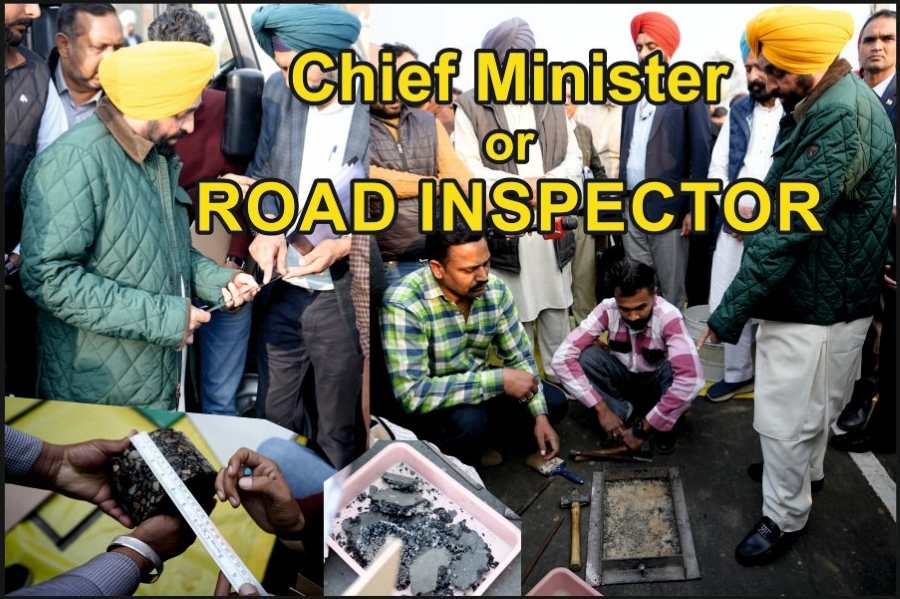
When a Chief Minister becomes the state’s road inspector, the problem is not the roads — it is the governance machinery beneath them.
IN EARLIER TIMES, when a young man wandered aimlessly, elders jokingly called him a ‘Road Inspector’ — someone with plenty of time and nothing important to do.
A Chief Minister, however, is entrusted with steering a state’s destiny, reviving its economy, reforming its institutions, and building a future for millions.
But today, when one sees the Chief Minister of Punjab bending over asphalt, checking road thickness with a metal tray and a core cutter, the old phrase “Road Inspector (RI)” rings uncomfortably true.
And the timing makes it sting even more. Because while the CM is busy checking asphalt, Punjab is burning at its core.
The state’s law-and-order machinery is collapsing in full public view.
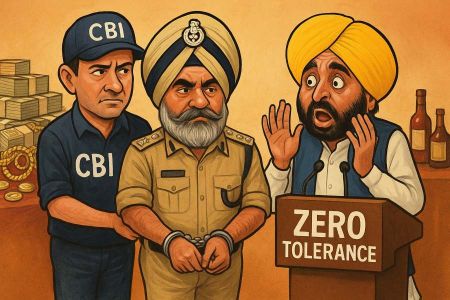
DIG Bhullar corruption scandal: CBI probe and CM Bhagwant Mann’s silence raise troubling questions.
The DIG Bhullar corruption scandal, the CBI investigation, and the Chief Minister’s deafening silence have shaken confidence in policing. Instead of restoring integrity, the government appears paralysed — or worse, complicit.
If that were not enough, the Patiala Police leaked audio scandal — where officers openly discussed illegal actions in blatant violation of the Constitution — has become a national embarrassment.
It is a chilling reminder that the police force is increasingly seen not as protectors of citizens, but as power-driven enforcers operating outside the rulebook.

Patiala Police audio leak — a shocking window into unconstitutional policing practices.
Punjab Police, once respected, is now becoming notorious for conduct that defies the letter and spirit of our democracy.
And the rot is neither hidden nor isolated — it is systemic. And it hits harder because Punjab is nowhere near prosperity.
Punjab is sinking. The state is trapped under a mountain of debt rising like amar-bel, strangling every sector it touches.
Young Punjabis are not chasing dreams abroad — they are fleeing out of compulsion. Families are tearing themselves apart just to escape a future that feels increasingly hopeless.
Law and order now resembles a warning sign, not a guarantee.
The bureaucracy has been reduced to a personal delivery service for a political supremo sitting outside Punjab.
Employment guarantees have evaporated, agriculture is choking, drug addiction continues to hollow out villages, and governance is now indistinguishable from a social-media circus — a spectacle of optics instead of outcomes.
In such a grim backdrop, watching the Chief Minister act as the state’s Road Inspector feels less like a joke and more like a diagnosis — a diagnosis of a government where institutions are so broken that the chief executive is forced to perform the duties of a Junior Engineer.
Flying Squads, Failing Departments — and a CM Playing J.E.
The Punjab Government’s own press note proudly declares that the CM conducted “surprise checks” on three roads, including the Sarhind–Patiala 4-lane project. He halted payments to contractors, ordered show-cause notices, and checked compliance with weight and thickness parameters.
Wonderful.
But this raises a bigger, humiliating truth:
Why did the Chief Minister have to do this himself?
Punjab has a Public Works Department created solely to supervise road quality.
Punjab has engineers — from Chief Engineer down to Junior Engineer.
Punjab has district technical committees.
Punjab has quality-control wings.
Punjab has a CM Flying Squad specifically announced to catch corruption.

CM inspects roads during a surprise check
Yet the system has decayed so badly that violations become visible only when the CM arrives with a videographer.
Punjab’s largest road construction programme — 44,920 km costing ₹16,209 crore, including 19,373 km of rural link roads — is apparently being monitored by the man at the top instead of those hired and paid to do the job.
If the CM must check every road, what are the departments doing?
If the public must report negligence on Twitter, what are the Flying Squads doing?
This is not accountability. This is administrative collapse packaged as heroism.
And yet here we are: the Chief Minister himself kneeling on the road like a Junior Engineer conducting field sampling.
And by the way, a natural question arises — what about the minister concerned? Where is he in this circus? What exactly is his role in the malfunctioning of the department that reports to him?
Ministers Playing Musical Chairs
Punjab has entered a new era of governance where ministers supervise anything except their own departments.
The Health Minister seems busy checking road quality, while dengue and diarrhoea outbreaks flourish like a seasonal crop in his own constituency.

News of water contamination and diarrhoea outbreak.
Roads are being inspected by someone who should be inspecting hospitals instead. Hospitals, one fears, may soon be inspected by someone from the Agriculture Department. And agriculture may be inspected by whoever happens to pass by with a camera crew.
This musical-chairs model of governance is breathtaking in its creativity. In most democracies, ministers are accountable for their own departments.
In Punjab, ministers conduct surprise checks on other departments because checking their own would reveal uncomfortable truths.
So while the CM is doing a Junior Engineer’s job, the minister is doing someone else’s job — and the public is left to wonder if anyone is doing the job they were actually appointed for.
When Toilet Repairs Become Historic Events
And now, thanks to the Sikhya Kranti drive, the government has discovered gold.
Why inaugurate major projects when you can inaugurate repairs?

Sikhya Kranti backlash: toilet inauguration ceremonies spark public ridicule.
Toilets repaired? Inaugurate.
Classroom whitewashed? Inaugurate.
Boundary wall plastered? Inaugurate.
Not in one village, city or district — schools everywhere put up plaques for the repair of washrooms, sometimes multiple plaques for the same toilet.
Teachers were told to arrange ceremonies. Some even paid from their pockets. Photos went viral. Memes exploded. Ridicule poured in.
It became so absurd that the government had to quietly instruct officials:
No more inaugurating toilet repairs with plaques.
A historic order indeed.
New Roads? No. New Ribbons.
But like all comedy sequels, the show continues — now on roads.
Every half-kilometre patch of repair is being inaugurated. Every resurfaced gali is celebrated as if it were the Delhi–Mumbai Expressway. Even pothole repairs have VIP ceremonies.

Road inaugurations continue while core governance issues remain ignored.
Punjab’s MLAs are cutting more ribbons than they have raised questions in the Assembly.
One cannot blame MLAs entirely. No one told them their primary duty is to attend Vidhan Sabha sessions, debate amendments, oversee bills and shape public policy.
How would they know? The Assembly barely functions. Sessions are “sparse-sky” — short, rushed and ornamental. MLAs are required mainly to raise one hand and say “Aaye” to whatever their high command brings from outside the state.
There is no legislative culture, no debate, no dissent, no homework on policy.
So naturally, MLAs focus on areas where they can still be visible:
cutting ribbons, unveiling plaques, posing for photographs.
Governance: The Era of Camera-Driven Administration
The CM’s “surprise check” videos flood social media — except they fail the first requirement of a surprise: surprise.
How can an inspection be called a surprise when:
– media teams are already present,
– cameramen are positioned,
– district officers are lined up to receive the CM,
– equipment is neatly arranged,
– the core cutter is pre-cleaned and ready?

Punjab CM checking road quality — a task meant for engineers, not the head of government.
This is not a surprise inspection. This is a scheduled shoot.
Punjab today is governed more by drone footage and tweets than by institutions. Inspections are choreographed. Governance is performative. Accountability becomes cinematography.
The CM’s appeal — “If any contractor is negligent, inform me immediately” — deputises the public to do what engineers, supervisors and Flying Squads are paid to do.
At this rate, Punjab may soon see a Road Quality Self-Assessment Kit handed to citizens.
Being Governed — or Being Entertained?
What makes this spectacle even more surreal is the CM’s continuing reliance on his old comedian persona.
Government functions become stand-up sets. Serious issues are punctuated by jokes. Crowds are often bussed-in staff or party workers encouraged to laugh on cue.
Punjab, however, is not laughing.

Punjab – a state in crisis.
The state needs jobs, reforms, functioning institutions and competent governance — not punchlines.
Punjab doesn’t need a Road-Inspector Chief Minister. Punjab needs a Chief Minister who rebuilds the system that made him behave like one.
And until that system is rebuilt, every photo-op inspection will keep raising the same painful question:
“Are we being governed — or just filmed?”
Because Punjab deserves a government that works when the cameras turn away — not one that only works when they turn on. 
________
Also Read:
High Court Orders CFSL Probe Into Patiala Police Audio Leak; AAP Government Under Pressure

kanwar manjit singh
Kanwar Manjit Singh, Founder Editor of Punjab Today, writes extensively on Punjab’s history, governance, and the evolving landscape of civil liberties in India.
Disclaimer : PunjabTodayNews.com and other platforms of the Punjab Today group strive to include views and opinions from across the entire spectrum, but by no means do we agree with everything we publish. Our efforts and editorial choices consistently underscore our authors’ right to the freedom of speech. However, it should be clear to all readers that individual authors are responsible for the information, ideas or opinions in their articles, and very often, these do not reflect the views of PunjabTodayNews.com or other platforms of the group. Punjab Today does not assume any responsibility or liability for the views of authors whose work appears here.
Punjab Today believes in serious, engaging, narrative journalism at a time when mainstream media houses seem to have given up on long-form writing and news television has blurred or altogether erased the lines between news and slapstick entertainment. We at Punjab Today believe that readers such as yourself appreciate cerebral journalism, and would like you to hold us against the best international industry standards. Brickbats are welcome even more than bouquets, though an occasional pat on the back is always encouraging. Good journalism can be a lifeline in these uncertain times worldwide. You can support us in myriad ways. To begin with, by spreading word about us and forwarding this reportage. Stay engaged.
— Team PT