


Punjab’s move to notify ‘holy cities’ raises unresolved constitutional questions on legal enforceability and fundamental freedoms
ON NEVEMBER 24, 2025, the Punjab Vidhan Sabha unanimously passed a resolution declaring the Walled City of Amritsar, along with Sri Anandpur Sahib and Talwandi Sabo, as “Holy Cities”.
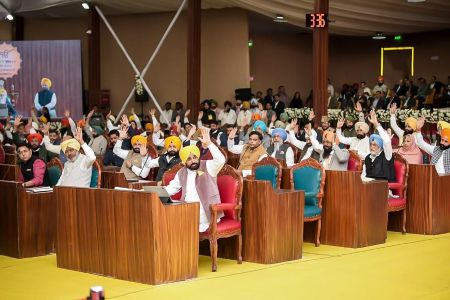
Punjab Vidhan Sabha special session held at Anandpur Sahib.
The resolution, inter alia, provided for a ban on the sale and consumption of meat and liquor in these cities to commemorate the 350th martyrdom anniversary of the Ninth Sikh Guru, Sri Guru Tegh Bahadur Ji.
Pursuant to this resolution, the Department of Home Affairs, Government of Punjab, issued a notification dated December 15, 2025, reiterating its contents.
This article confines itself strictly to an examination of the legal questions arising from the resolution: first, whether such a resolution has any statutory or constitutional force; and second, whether a blanket ban on the sale and consumption of meat and liquor in these cities is permissible under the Constitution of India.
Also Read:
Anandpur Sahib Special Session — A Political Stunt in the Name of Piety
It does not seek to express any view on matters of religious belief or practice, nor does it question the sanctity of the religious sentiments involved.
Do Legislative Resolutions Have Binding Legal Force?
The answer to the first question lies in the constitutional character of legislative resolutions.
Justice P. B. Mukherjee, in his research article published in the Journal of the Indian Law Institute (July–September 1963), titled “Resolutions of Parliament and Legislatures: A Study of Their Constitutional Character”, classified legislative resolutions into three categories: first, those having legal effect, where binding consequences flow from the Constitution or a statute; second, those having quasi-legal effect, governing the internal functioning of the House; and third, those that are merely expressions of opinion carrying political or symbolic significance.

Notification ambiguity raises questions on enforceability.
Viewed in light of this framework, the resolution passed by the Punjab Vidhan Sabha falls squarely within the third category. In other words, it primarily carries symbolic significance.
This is further evident from the existing statutory framework governing excise and municipal regulation. Clause 9A of Rule 37 of the Punjab Excise Rules, 1965, already prohibits the sale of liquor in Sri Anandpur Sahib and the Walled City of Amritsar. Any extension of this prohibition to Talwandi Sabo would require an amendment to the prevailing Excise Rules.
Similarly, the Punjab Municipal Corporation Act, 1976, empowers Municipal Commissioners to regulate slaughterhouses and allied trades, including butcher shops, fish markets, and eating establishments, through licensing conditions. The resolution, therefore, does not introduce any new prohibition but merely reiterates the existing legal position in a symbolic form.
Liquor Prohibition and the State’s Regulatory Power
Turning to the second issue—namely, whether a complete ban on the sale and consumption of liquor and meat is permissible under the constitutional scheme—the two must be analysed separately, as they rest on distinct constitutional footings.
Insofar as liquor is concerned, the Supreme Court has consistently upheld the power of the State to impose restrictions and, in appropriate cases, even complete prohibition on its sale. In Khoday Distilleries Ltd. v. State of Karnataka (1995) 1 SCC 574, the Court held that there is no fundamental right to trade in liquor and that the State may impose total prohibition.

When resolutions lack statutory force.
Similarly, in Kerala Bar Hotels Association v. State of Kerala (2015) 16 SCC 421, the Court upheld restrictions on liquor licences, noting that Article 47 of the Constitution casts a duty upon the State to progressively prohibit the consumption and sale of intoxicating drinks.
A similar approach was adopted by the Bombay High Court in Rajendrakumar v. State of Maharashtra, 2016 SCC OnLine Bom 201, where the notification declaring Chandrapur district as a dry district was upheld, with the Court observing that such measures warrant a liberal and purposive interpretation.
At the same time, it is important to note that while the sale of liquor is already prohibited under the Excise Rules in the Walled City of Amritsar and Sri Anandpur Sahib, there is presently no specific statutory provision prohibiting the consumption of liquor in any of the three cities.
While a person may be prosecuted under Section 355 of the Bharatiya Nyaya Sanhita for consumption of liquor in a public place, a blanket prohibition on consumption would require a legislative amendment to the Punjab Excise Act.
Meat Ban, Food Choice, and Constitutional Limits
The constitutional position with respect to a complete ban on meat is more sensitive. While the resolution clarifies that the proposed ban applies only to the Walled City of Amritsar, the position remains unclear with respect to Sri Anandpur Sahib and Talwandi Sabo.
In Mohd. Faruk v. State of M.P. (1969) 1 SCC 853, a Constitution Bench of the Supreme Court struck down a notification imposing a total ban on the slaughter of bulls and bullocks on the ground that it violated the petitioner’s fundamental right under Article 19(1)(g) to practise any profession or to carry on any occupation, trade, or business.

Punjab Government Holy City notification circular forwarded to departments directing consideration of restrictions
In contrast, in Om Prakash v. State of U.P. (2004) 3 SCC 402, the Supreme Court upheld a ban on the sale of eggs, meat, and fish in Rishikesh, observing that only a small section of persons were engaged in such trade, while a large majority of the population practised vegetarianism as part of their religious beliefs.
However, the relevance of this reasoning must be examined in light of subsequent judgments of the Supreme Court.
In Navtej Singh Johar v. Union of India (2018) 10 SCC 1, the Court held that fundamental rights cannot be curtailed merely because their exercise runs contrary to prevailing social morality or the views of the majority.
This principle was further reinforced in K.S. Puttaswamy (Aadhaar–5J.) v. Union of India (2019) 1 SCC 1, where privacy was recognised as a fundamental right under Article 21, protecting individual autonomy and personal choices, including choices relating to food habits.
Consequently, food choices are protected under the right to life and personal liberty guaranteed by Article 21 of the Constitution.
Also Read: Hollowness of Punjab ‘Holy City’ Gazette Notification
A complete ban on meat consumption in Sri Anandpur Sahib or Talwandi Sabo would therefore have to pass constitutional scrutiny under Articles 21 and 19(1)(g). Limiting such restrictions to a defined radius around gurdwaras, as in the Walled City of Amritsar, may balance religious sensitivities with fundamental rights.
Symbolism Cannot Override Constitutional Discipline
In conclusion, while the resolution may be appreciated from a religious and political perspective, its enforcement must necessarily align with the constitutional framework and Sikh values of inclusivity and accommodation.
Also Read: Holy City or Holy Confusion?
The law laid down by the Supreme Court recognises the wide regulatory power of the State with respect to the sale and consumption of liquor.
However, the same reasoning cannot justify a blanket ban on the sale or consumption of meat. A calibrated and geographically limited regulatory approach would protect religious sentiments without infringing upon individual food choices. 
_________
Also Read:
Holy City or Holy Confusion? Punjab Notification Collides with Law, Rights and Sikh Doctrine
Punjab’s ₹10-Lakh Health Insurance Scheme: Big on Assurance, Still Short on Answers

Amarpal Singh Dua
The author is an Advocate practising before the Supreme Court of India.
Disclaimer : PunjabTodayNews.com and other platforms of the Punjab Today group strive to include views and opinions from across the entire spectrum, but by no means do we agree with everything we publish. Our efforts and editorial choices consistently underscore our authors’ right to the freedom of speech. However, it should be clear to all readers that individual authors are responsible for the information, ideas or opinions in their articles, and very often, these do not reflect the views of PunjabTodayNews.com or other platforms of the group. Punjab Today does not assume any responsibility or liability for the views of authors whose work appears here.
Punjab Today believes in serious, engaging, narrative journalism at a time when mainstream media houses seem to have given up on long-form writing and news television has blurred or altogether erased the lines between news and slapstick entertainment. We at Punjab Today believe that readers such as yourself appreciate cerebral journalism, and would like you to hold us against the best international industry standards. Brickbats are welcome even more than bouquets, though an occasional pat on the back is always encouraging. Good journalism can be a lifeline in these uncertain times worldwide. You can support us in myriad ways. To begin with, by spreading word about us and forwarding this reportage. Stay engaged.
— Team PT