


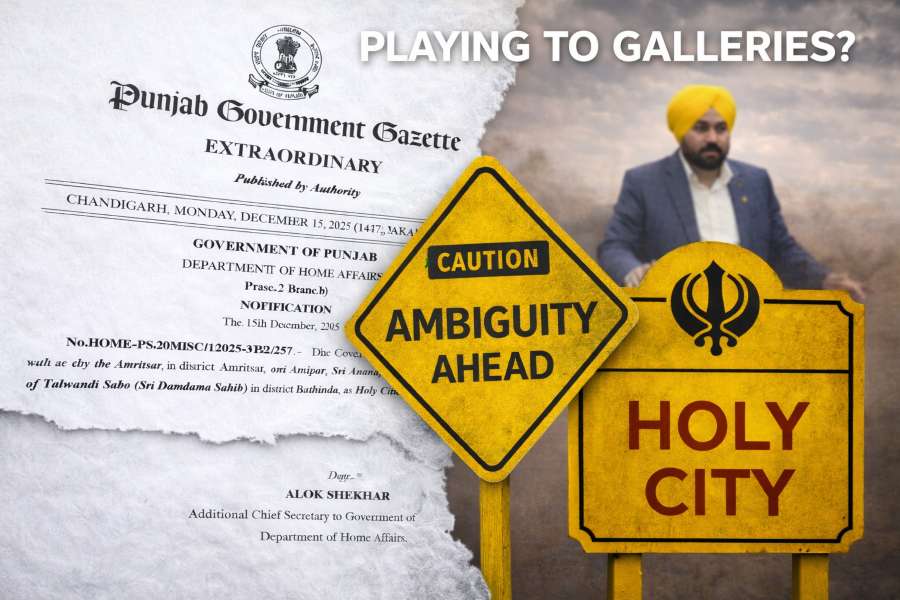
Holy City Without Rules: Legal Ambiguity, Dietary Policing and the Questions Punjab Must Answer
THE PUNJAB Government’s decision to declare parts of Amritsar, Sri Anandpur Sahib and Talwandi Sabo as “Holy Cities” has already been exposed as legally hollow at the level of the Gazette notification.

Punjab Holy City Gazette Notification
What raises deeper concern now is the administrative circular issued alongside it—an executive communication that opens a far more serious debate about constitutional limits, legal ambiguity and doctrinal misrepresentation.
If Part One examined how the Gazette notification conferred a title without defining its meaning, Part Two turns to the consequences of executive ambiguity—how a seemingly innocuous circular can quietly expand discretion, blur rights, and invite informal enforcement in the name of sanctity.
A circular is not law — but ambiguity can still harm
At the outset, a clear legal distinction must be made.

Punjab Government Holy City notification circular forwarded to departments directing consideration of restrictions
The document directing the Excise, Health, Animal Husbandry and district administrations to take “necessary action” is not part of the Gazette notification.
It is a departmental forwarding circular, issued by an Under Secretary, carrying no independent statutory force.
In strict legal terms, such a circular cannot create offences, impose prohibitions or prescribe penalties. Yet its language carries weight because it signals expectation without authority—nudging departments to act as if restrictions are imminent, while offering no statutory foundation for those actions.
This creates a governance paradox: nothing is prohibited in law, yet administrative behaviour is encouraged as if prohibition already exists.
In constitutional administration, ambiguity of this kind is not neutral. It widens discretion without accountability, leaving citizens uncertain and officials exposed.
When food is grouped with intoxicants, the law must ask why
The most contentious element of the circular is its treatment of meat—placing it alongside liquor and tobacco, and asking the Animal Husbandry Department to consider prohibitory measures on its “sale and use” within the declared areas.
This raises foundational legal questions that the circular does not even attempt to answer.
Food is not an intoxicant.
Personal diet is not a regulated vice.
And meat, per se, is not prohibited under any general law in Punjab.
So under what statute is meat suddenly placed in the same regulatory category as alcohol and tobacco? On what authority does an executive circular equate dietary choice with intoxication? And who has decided that meat consumption violates the sanctity of a so-called “Holy City”?
Also Read:
Hollowness of Punjab ‘Holy City’ Gazette Notification: Leaves More Questions Than Answers
The circular offers no legal reasoning, no statutory reference and no doctrinal justification—only assumption. In a rule-of-law system, assumption is not governance.
Meat, Sikhism and the danger of doctrinal misrepresentation
This issue cannot be examined purely through an administrative lens. It directly engages religious doctrine, an area where the State must act with the highest restraint.
Sikhism does not prohibit meat consumption. The Sikh Rehat Maryada—the authoritative code approved by the Shiromani Gurdwara Parbandhak Committee (SGPC)—explicitly rejects dietary taboos as a measure of spirituality.

Historical newspaper clipping on Sikh doctrinal concerns
It prohibits kutha (Halal or Kosher meat), not meat itself, and permits jhatka. The vegetarian nature of langar exists to ensure inclusivity across faiths, not because Sikh doctrine mandates vegetarianism. Confusing the two is a theological error with political consequences.
By grouping meat alongside intoxicants, the State risks importing non-Sikh ritual morality into Sikh religious space—something Sikh institutions have historically resisted. This is not merely a present-day objection; it is part of an older institutional consciousness.
SGPC executive member and former General Secretary Kiranjot Kaur recently shared an archival Punjabi newspaper clipping recalling how Sikh leadership has, in the past as well, opposed attempts to impose ritual-purity driven dietary morality upon Sikh spaces—arguing that such impositions misrepresent the essence of Sikh doctrine.
Kiranjot Kaur has sharply criticised the present move as an attempt at the “Brahminisation of Sikhs.”
She points out that while tobacco and kutha are categorised as bajjar kurehits—grave religious transgressions—jhatka meat is neither prohibited nor doctrinally condemned, and has historically been defended as a Sikh right.
She recalls that the Shiromani Akali Dal organised a Jhatka Conference as early as 1935 to assert this principle, citing historical accounts of Sikh Gurus and Sikhs engaging in hunting, including the well-known sakhi of Guru Nanak Dev Ji cooking deer meat at Kurukshetra to challenge ritualistic notions of purity.
The implication is serious: when the State misrepresents doctrine, it does not protect faith—it distorts it.
Private life, public ambiguity
Beyond doctrine lies an even more fundamental issue: constitutional liberty.
What citizens eat inside their homes is protected under Article 21 as part of privacy, dignity and personal autonomy. No executive circular—especially one unsupported by legislation—can intrude into private kitchens.

Yet the absence of official clarification creates uncertainty. Can residents bring food from outside municipal limits? Can they cook at home? Can they order food online?
When law is silent but symbolism is loud, rumours fill the gap. And when religion intersects with food, such rumours carry social risk.
This is not theoretical. Across India, dietary ambiguity has often enabled moral policing and vigilantism. Punjab has largely avoided that path—but ambiguity is how such trajectories begin.
The State’s duty does not end with issuing declarations. It includes preventing misuse, misinterpretation and informal enforcement. Silence, in such cases, is not neutrality—it is abdication.
Governance already exists — why invoke “holiness”?
Ironically, the route chosen by the government was unnecessary.
District administrations already possess ample powers under existing laws to regulate public health, licensing, and nuisance. The recent district-wide prohibition order in Patiala illustrates this clearly.

On 7 December, the Additional District Magistrate, Patiala, Mrs. Simarpreet Kaur (PCS), issued a comprehensive order under Section 163 of the Bharatiya Nagarik Suraksha Sanhita, 2023, imposing a blanket ban across the district on the sale and serving of gutka, pan masala, nicotine-laced food products, intoxicating flavours, and the operation of hookah bars in hotels and restaurants.
The order was clear, time-bound, legally grounded, and fully enforceable. It explicitly stated the authority invoked, the duration of applicability, and the territorial scope of the restriction — and it remains in force until 5 December 2026. Punjab Today is attempting to obtain further details and clarifications from the ADM, Patiala, and will update readers as soon as they are available.
This single example exposes the central contradiction of the “Holy City” approach: administrative discipline, public health protection, and civic order do not require symbolic, religiously coloured declarations. The legal framework already exists — and when applied properly, it works.
Also Read:
Anandpur Sahib Special Session — A Political Stunt in the Name of Piety
When the administration already has the legal authority to regulate public health, civic order, and commercial conduct, why invoke a symbolic, Governor-notified religious label that neither defines standards nor prescribes rules, and merely invites confusion, arbitrariness, and political misuse?
What CM Bhagwant Mann Says
Amid rising public debate, Chief Minister Bhagwant Singh Mann issued a detailed statement describing the move as a “historic decision” inspired by faith, gratitude and responsibility.
He said the notification seeks to honour Punjab’s unique status as home to three of the five Sikh Takhts, formally recognising Amritsar, Sri Anandpur Sahib and Talwandi Sabo as “centres of faith and holy cities.”

CM Bhagwant Mann
The Chief Minister announced that the state will provide enhanced facilities for devotees, including improved transport arrangements, and declared that “strict regulations will now apply”—explicitly stating that the sale of meat, alcohol, tobacco and intoxicants will be completely prohibited within these areas.
He framed the declaration as both spiritually significant and culturally protective, emphasising that such recognition “should have been implemented long ago” and asserting that the decision has “now come into effect” with the notification.
This makes the government’s intent clear: it is projecting the decision as sanctity-driven, enforceable and already operational, even as questions continue regarding its legal foundation, practical implementation and doctrinal alignment.
Who defines “holy” in a constitutional democracy?
At the heart of the controversy lies an unresolved question.

Is “holiness” a legal category?
A religious sentiment?
Or a political symbol?
If it is legal, it must be defined in law.
If it is religious, the State must respect Articles 25 to 28.
If it is symbolic, it cannot be enforced through executive direction.
The present circular straddles all three—and satisfies none.
Between intent and implication
Taken together, the Holy City declaration and its accompanying circular risk turning governance into symbolism and law into suggestion. In a constitutional democracy, such ambiguity is not harmless—it is dangerous.
 The Punjab Government must now clarify what exactly changes on the ground, what does not, who enforces what, under which law, and how citizens’ rights will be protected against excess.
Until then, the Holy City designation remains suspended between intent and implication—its greatest impact not in law, but in uncertainty.
Punjab Today raises these issues in public interest—not to oppose sanctity, but to insist that faith-based declarations in a constitutional state must be governed by clarity, legality and restraint, not by ambiguity that invites misuse. We will revisit the subject once implementing orders are formally issued. 
__________
Also Read:
Hollowness of Punjab ‘Holy City’ Gazette Notification: Leaves More Questions Than Answers
Anandpur Sahib Special Session — A Political Stunt in the Name of Piety

kanwar manjit singh
Kanwar Manjit Singh, Founder Editor of Punjab Today, writes extensively on Punjab’s history, governance, and the evolving landscape of civil liberties in India.
Disclaimer : PunjabTodayNews.com and other platforms of the Punjab Today group strive to include views and opinions from across the entire spectrum, but by no means do we agree with everything we publish. Our efforts and editorial choices consistently underscore our authors’ right to the freedom of speech. However, it should be clear to all readers that individual authors are responsible for the information, ideas or opinions in their articles, and very often, these do not reflect the views of PunjabTodayNews.com or other platforms of the group. Punjab Today does not assume any responsibility or liability for the views of authors whose work appears here.
Punjab Today believes in serious, engaging, narrative journalism at a time when mainstream media houses seem to have given up on long-form writing and news television has blurred or altogether erased the lines between news and slapstick entertainment. We at Punjab Today believe that readers such as yourself appreciate cerebral journalism, and would like you to hold us against the best international industry standards. Brickbats are welcome even more than bouquets, though an occasional pat on the back is always encouraging. Good journalism can be a lifeline in these uncertain times worldwide. You can support us in myriad ways. To begin with, by spreading word about us and forwarding this reportage. Stay engaged.
— Team PT