


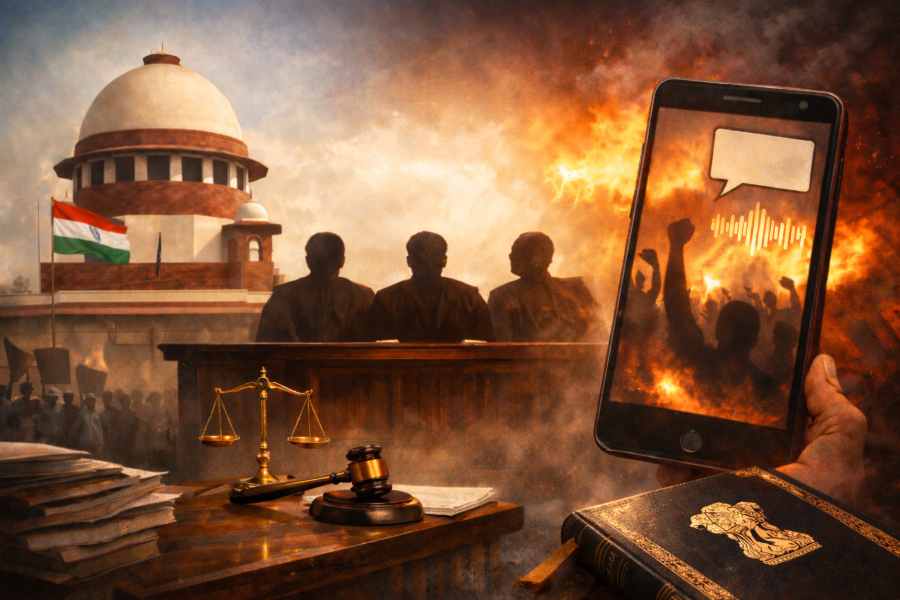
Supreme Court Declines to Hear Petition on Assam Hate Video Featuring Hemanta Biswa Sarma
THE SUPREME COURT has refused to entertain a petition against a hate video featuring the Assam Chief Minister, Hemanta Biswa Sarma, holding a gun and shooting at two members of the Muslim community. It instead asked the petitioners to follow the routine procedure and approach the Assam High Court.
The short video clip carried the words “Point blank shot” and “No mercy” as titles and could have easily qualified as one of the most blatantly communal posts celebrating violence by any standards. It was not posted by a common citizen but by the Chief Minister of the state.
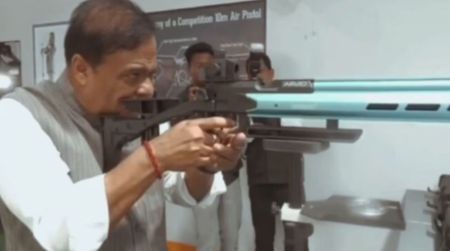
A still from a controversial video shared on X by BJP’s Assam unit.
To be fair, the video clip, put out on social media by the state BJP’s official Twitter handle, was taken down after widespread condemnation. However, the Chief Minister showed no qualms about what the video projected.
He was expected to outrightly condemn the contents of the video and take strict action against the person who had made and uploaded it. Instead, he maintained complete silence, making it clear that he did not believe the video deserved condemnation.
Communal Politics and Election Context in Assam
Sarma, who will soon be facing Assembly elections in Assam, has emerged as perhaps the most communal-minded Chief Minister, next only to Uttar Pradesh’s Yogi Adityanath. His anxiety to retain power is understandable, but the high cost that society is paying for such communal poison will have long-term consequences.
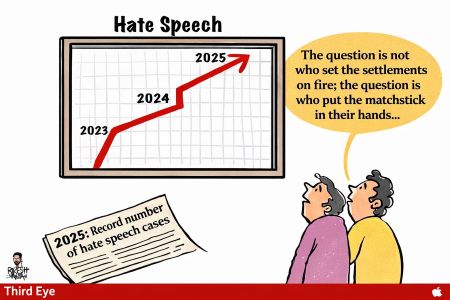
Many would have expected the highest court to take suo motu notice of what critics describe as a hate campaign linked to the Assam Chief Minister. Instead, the court declined to hear a plea filed by a group of eminent citizens and asked them to approach the state’s High Court first.
Ignoring the gravity of the issue, the top court, led by Chief Justice of India Surya Kant, observed that whenever elections are on the radar, “this court becomes a political battleground”.
This comment was seen as unfortunate, as the matter concerned not an ordinary citizen but the head of a state government.
Debate Over Article 32 and Supreme Court Jurisdiction
“The entire effort is to undermine and demoralise the High Courts, which is not acceptable to us. There is a very calculated move to undermine the authority of the High Courts. They are constitutional courts and have more power than us,” the CJI said.
 However, this was not the first time petitioners had directly approached the Supreme Court. Senior Advocate A. M. Singhvi referred to 17 instances where the Supreme Court had directly entertained petitions under Article 32 of the Constitution.
“The High Court’s power is not in doubt. But why was Article 32 created? It was created for mega cases,” Singhvi argued.
Article 32 grants individuals the right to move the Supreme Court for the enforcement of their fundamental rights.
Singhvi further stated that while the Chief Justice spoke of demoralising High Courts, “here is a person demoralising the constitutional ethos of the country.”
Public Office, Hate Speech and Constitutional Morality
While declining to hear the petition, the court did not consider the difficulty of a High Court taking up a petition against a sitting Chief Minister. Any probe ordered by the High Court would require assistance from the state machinery, including the police, which reports to the Chief Minister through the Home Minister. It appeared to be a fit case for the Supreme Court to intervene expeditiously.

In another case, however, the apex court emphasised that political leaders must foster fraternity and that high public officers must live up to constitutional ideals.
The court was hearing a petition highlighting instances of Chief Ministers, senior bureaucrats and police officers making public statements that stigmatise entire communities, legitimise discriminatory governance and erode public confidence in equal citizenship.
It underscored that holders of public office who engage in a pattern of derogatory speech are not ordinary speakers.
Also Read: COMMUNALISM VS. COURAGE
The court suggested framing a mandatory code of conduct for public figures similar to the one applicable to public servants.
“We would like to impress upon all political parties the importance of constitutional morality, values and mutual respect. These principles must be applied uniformly across the board. When it comes to public figures and public servants, the position is different. For public servants, there is a wealth of laws and rules that govern conduct. Some similar code of conduct should be for public figures,” said CJI Surya Kant.
That would be the right step. However, the Supreme Court should have taken cognisance of the Assam hate video, considering that it warranted immediate intervention. Such action would have sent a clear signal to hate mongers. 
___________
Also Read:
Normalisation of Hate, Violence and Communalism in India’s Public Discourse

Vipin Pubby
The author, a freelance journalist, is a former Resident Editor of Indian Express, Chandigarh, and reported on the political developments in Jammu and Kashmir, North-Eastern India, Gujarat, Himachal Pradesh, Haryana and Punjab in his long, illustrious career.
Disclaimer : PunjabTodayNews.com and other platforms of the Punjab Today group strive to include views and opinions from across the entire spectrum, but by no means do we agree with everything we publish. Our efforts and editorial choices consistently underscore our authors’ right to the freedom of speech. However, it should be clear to all readers that individual authors are responsible for the information, ideas or opinions in their articles, and very often, these do not reflect the views of PunjabTodayNews.com or other platforms of the group. Punjab Today does not assume any responsibility or liability for the views of authors whose work appears here.
Punjab Today believes in serious, engaging, narrative journalism at a time when mainstream media houses seem to have given up on long-form writing and news television has blurred or altogether erased the lines between news and slapstick entertainment. We at Punjab Today believe that readers such as yourself appreciate cerebral journalism, and would like you to hold us against the best international industry standards. Brickbats are welcome even more than bouquets, though an occasional pat on the back is always encouraging. Good journalism can be a lifeline in these uncertain times worldwide. You can support us in myriad ways. To begin with, by spreading word about us and forwarding this reportage. Stay engaged.
— Team PT