



What millions of pages on Jeffrey Epstein reveal, not a crime dossier, but a ledger of how power protects itself.
There are scandals that shock because they are hidden, and scandals that disturb because they are not. The Jeffrey Epstein files belong firmly to the latter. They do not expose a secret world operating in darkness; they expose a familiar world operating in daylight — one where wealth dulls moral reflexes, proximity to power replaces scrutiny, and institutions hesitate until outrage becomes unavoidable.
For informed readers, this is not a story about sex crimes alone. It is about how modern power behaves when it assumes immunity.

Epstein in court
Jeffrey Epstein was arrested in 2019 on federal charges of sex trafficking minors. He died before trial, officially ruled a suicide. That death closed a criminal case, but it did not close the record.
Over nearly two decades, investigators had amassed an extraordinary archive: emails, messages, financial documents, travel logs, photographs, videos, and internal notes.
When millions of pages from this archive entered the public domain, they did not radically alter what was already known about Epstein’s crimes. What they did was far more unsettling, they revealed how acceptable he remained.
Epstein was not sustained by secrecy. He was sustained by normalisation.
What the Files Reveal: Not a Conspiracy, but a Culture
Read carefully, the Epstein files do not resemble a cinematic conspiracy. They resemble a social ledger. Page after page records introductions, invitations, flights taken, dinners hosted, and messages exchanged, long after Epstein was a convicted and registered sex offender. There is no moment of collective recoil, only quiet continuity.

This is the core revelation of the files: abuse did not persist because it was unknown, but because it was inconvenient to confront.
The young women who appear in the background of this world were overwhelmingly from marginal circumstances, financially insecure, emotionally vulnerable, and already failed by the institutions meant to protect them.
In elite correspondence, they are barely acknowledged. Their presence is noted, if at all, without alarm. They were not seen as victims-in-waiting; they were seen as fixtures. Disposable lives in a disposable moral economy.
This is not an American problem. It is a class problem that travels well.
Politics and the Illusion of Transparency
The Epstein story inevitably collided with politics, particularly in the United States. Donald Trump entered the public frame not through new criminal evidence, but through expectations he himself cultivated.

Public pressure mounts as transparency remains contested.
Trump’s past social association with Epstein was known years before his presidency. In another era, it might have remained an uncomfortable footnote.
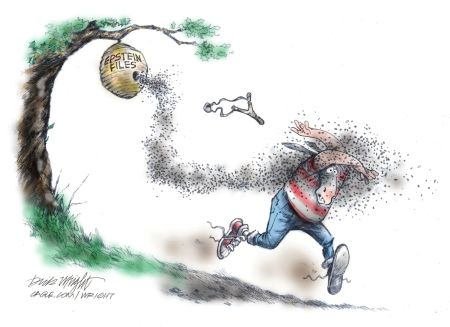
Instead, Trump promised sweeping transparency, hinting at dramatic disclosures and a definitive “client list.” What followed were staggered releases, redactions, and material that was often already in the public domain.
The result was not clarity but distrust. In public life, perception can be as corrosive as proof, and the sense that information was being curated rather than confronted deepened suspicion.
Yet it would be analytically dishonest to reduce the Epstein saga to Trump alone. The files cut across ideologies, parties, and nations. British royalty appears through Prince Andrew. European and Middle Eastern political figures surface in correspondence. Financiers, academics, and cultural elites drift in and out of the record with little consequence.
This was not a partisan failure. It was a systemic one.
The Indian Context: Few Mentions, Familiar Patterns
India appears only at the margins of the Epstein files, but those margins triggered outsized attention. A small number of references involve correspondence linked to Anil Ambani, reflecting attempts between 2017 and 2019 to seek introductions and access to U.S. political figures, and exchanges associated with Hardeep Puri, described as diplomatic or industry outreach, including advocacy around initiatives such as Digital India.
Occasional mentions of Narendra Modi or India’s diplomatic calendar appear largely in passing, often as part of Epstein’s own expansive claims of relevance. India’s Ministry of External Affairs dismissed these references firmly, characterising them as speculative and unworthy of credence. No criminal case or formal investigation in India has arisen solely from these disclosures.
For serious readers, this distinction matters. Mention is not misconduct. Correspondence is not conspiracy.
But the Indian relevance lies elsewhere. The files illuminate how global elites operate through informal access, reputational shielding, and institutional hesitation. These dynamics are not foreign to India. Whether in corporate lobbying, bureaucratic discretion, or political proximity, the same moral hazards emerge wherever power concentrates without accountability.
The Moral Reckoning This Story Demands
At its core, the Epstein archive asks a question that polite societies prefer not to answer: how much wrongdoing are we willing to tolerate when it is committed by the useful, the wealthy, and the well-connected?
The files show that institutions often act not when harm is evident, but when silence becomes reputationally costly. Victims are heard not when they suffer, but when ignoring them becomes untenable. This is not a failure of law alone; it is a failure of ethical courage.
Why This Scandal Will Not End
Jeffrey Epstein is dead. But the ecosystem that enabled him, the culture of access, the transactional morality, and the institutional reluctance to confront power, remains intact. The files ensure that this reality cannot be dismissed as rumour or hindsight.

For Punjab Today’s readership, administrators, jurists, diplomats, academics, and policy thinkers, the Epstein files are not scandal literature. They are a diagnostic archive. They show what happens when transparency is promised but managed, when outrage is selective, and when justice is delayed until it becomes unavoidable.
The lesson is not about names. It is about systems.
Until societies, whether in Washington, London, or New Delhi, are willing to confront how power actually behaves when it believes itself untouchable, this story will remain unfinished.
That is why the Epstein files are not merely disturbing.
They are instructive. 
___________
Also Read:
Gurinder Dhillon, Bikram Majithia and Bhagwant Mann: When Faith, Power and Justice Collide in Punjab

Punjab Today
Punjab Today is an independent media platform committed to rigorous journalism, critical analysis, and perspective-led reporting on politics, society, and public affairs.
Disclaimer : PunjabTodayNews.com and other platforms of the Punjab Today group strive to include views and opinions from across the entire spectrum, but by no means do we agree with everything we publish. Our efforts and editorial choices consistently underscore our authors’ right to the freedom of speech. However, it should be clear to all readers that individual authors are responsible for the information, ideas or opinions in their articles, and very often, these do not reflect the views of PunjabTodayNews.com or other platforms of the group. Punjab Today does not assume any responsibility or liability for the views of authors whose work appears here.
Punjab Today believes in serious, engaging, narrative journalism at a time when mainstream media houses seem to have given up on long-form writing and news television has blurred or altogether erased the lines between news and slapstick entertainment. We at Punjab Today believe that readers such as yourself appreciate cerebral journalism, and would like you to hold us against the best international industry standards. Brickbats are welcome even more than bouquets, though an occasional pat on the back is always encouraging. Good journalism can be a lifeline in these uncertain times worldwide. You can support us in myriad ways. To begin with, by spreading word about us and forwarding this reportage. Stay engaged.
— Team PT