


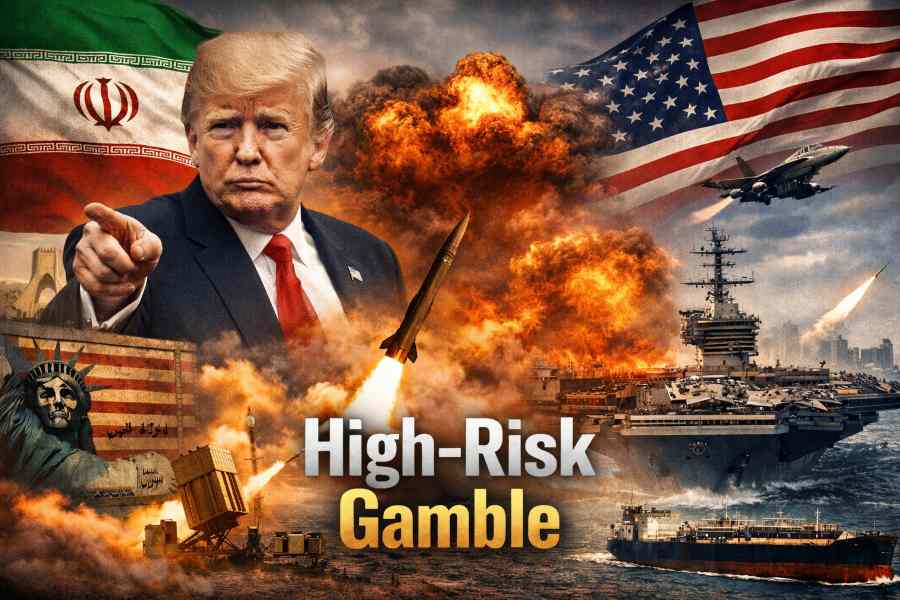
Applying a Latin American playbook to West Asia ignores Iran’s regional power and capacity to escalate.
THE RETURN OF blunt military signalling to U.S. foreign policy has once again put West Asia on edge. By invoking Venezuela while warning Iran of possible military action, Donald Trump has revived a familiar coercive playbook — one that relies on intimidation, rapid force projection and psychological pressure.
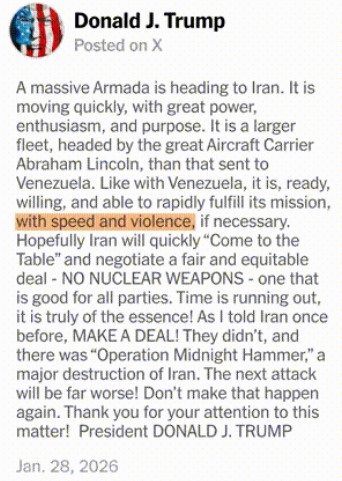
But while the language may sound decisive, the comparison itself is deeply flawed. Iran is not Venezuela, and treating it as such risks transforming political posturing into a strategic miscalculation with global consequences.
Trump’s demands on Iran are sweeping: dismantle its nuclear programme, stop producing long-range missiles, and abandon all regional allies and proxy groups. In effect, Tehran is being asked to surrender the very instruments it believes ensure its survival. History suggests that such ultimatums rarely succeed — especially against states that define themselves through resistance.
Why the Venezuela Analogy Breaks Down
The temptation to compare Iran with Venezuela lies in surface similarities. Both countries have faced years of U.S. sanctions, both are governed by authoritarian systems, and both have framed Washington as an external adversary. Venezuela, however, lacked the strategic depth, military reach and regional entanglements that Iran has built over decades.

The Venezuela precedent that shapes Washington’s coercive thinking.
Caracas was diplomatically isolated, economically hollowed out and militarily brittle. Iran, by contrast, is embedded across the Middle East through political influence, security partnerships and aligned militias. Its state ideology, shaped by revolution and war, has normalised confrontation as a permanent condition rather than a crisis to be avoided.
This difference matters. Pressure that worked — or appeared to work — in Latin America cannot simply be transplanted into West Asia without altering the strategic balance in unpredictable ways.
A Region Where Escalation Travels Fast
Iran’s leverage does not lie in conventional military dominance but in layered deterrence. Its ballistic missile programme places much of the Middle East within range. Its network of allies and aligned forces stretches from Iraq and Syria to Lebanon and Yemen. These are not symbolic relationships; they provide Tehran with multiple pressure points should conflict erupt.
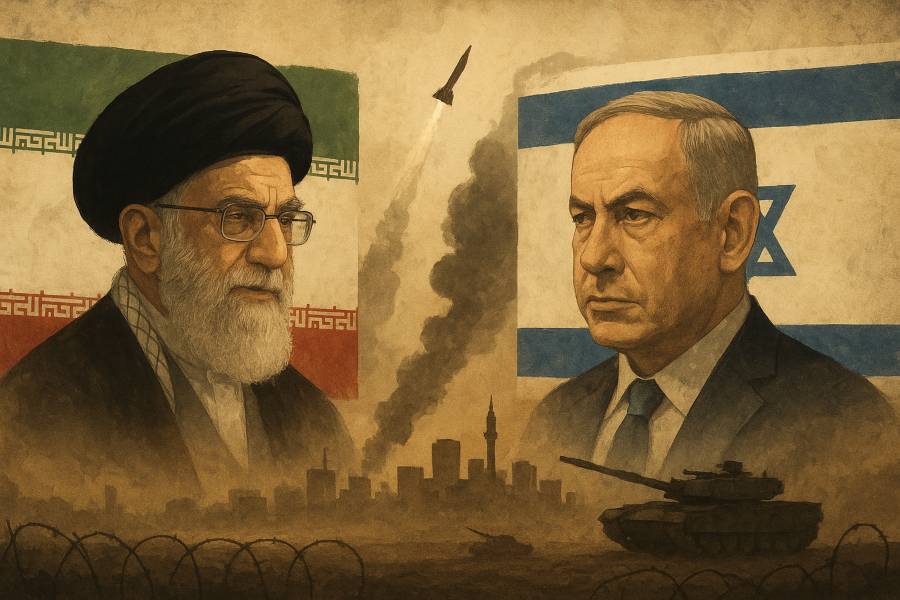
Iran–Israel tensions form the most immediate flashpoint of escalation.
Any direct confrontation would almost certainly draw in Israel, which Iran has explicitly identified as a primary target in the event of U.S. or Israeli strikes.
While Israel’s air-defence systems have proved effective, they are not inexhaustible. Prolonged or concentrated missile barrages could overwhelm defences, particularly after years of sustained regional conflict.
Beyond Israel, the risks extend to global trade. The Strait of Hormuz — through which a significant portion of the world’s oil supply passes — remains a critical vulnerability. Even limited disruption would ripple through energy markets, with immediate consequences for fuel prices and inflation worldwide.
Perceived Weakness, Real Danger
Paradoxically, Iran’s current vulnerabilities may increase the danger rather than reduce it. The weakening of its regional partners, damage to elements of its missile and nuclear infrastructure, and internal economic strain have narrowed Tehran’s room for manoeuvre.
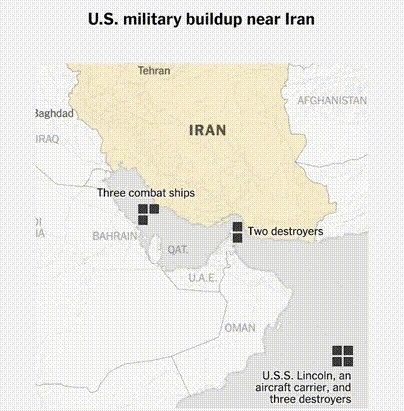
US forces positioned around Iran.
Iranian leaders increasingly frame the present moment as existential — a test of regime survival rather than a policy dispute.
States that perceive themselves as cornered are more likely to escalate. This dynamic has played out repeatedly in modern conflicts, where deterrence gives way to pre-emptive or retaliatory action driven by fear of irreversible loss. Iran’s leadership has signalled that if attacked, it would seek to expand the conflict rather than contain it.
That calculus makes any assumption of a quick, decisive outcome dangerously optimistic.
Unclear Objectives, High Stakes
Perhaps the most troubling aspect of the current U.S. posture is the absence of a clearly articulated endgame. Is Washington seeking regime change? A permanent rollback of Iran’s missile capabilities? Or a new nuclear agreement under tougher terms? Each objective demands a different strategy — and carries sharply different risks.
Military action may damage facilities or degrade capabilities, but it cannot easily dismantle Iran’s political structure, which rests on religious authority, elite security forces, and a deeply ingrained narrative of resistance to foreign interference.
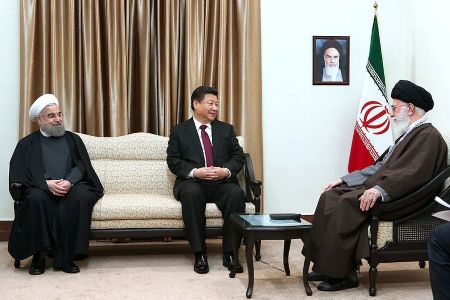
China’s engagement blunts the impact of Western pressure on Iran.
Unlike Venezuela, where leadership change was projected as an achievable outcome, Iran’s system is built to absorb shocks and endure prolonged pressure.
Complicating this calculus is the fact that Iran is not operating in isolation. Its deepening economic and strategic engagement with China — alongside coordination with Russia — blunts the effectiveness of pressure tactics designed for a different geopolitical era.
Any strategy that assumes Tehran can be boxed in or quickly coerced underestimates how alternative power centres now shape both Iran’s resilience and America’s constraints.
Without clear priorities, coercion risks becoming an end in itself — a posture that may satisfy domestic political signalling but leaves allies uncertain and adversaries unconvinced.
Why This Matters Beyond the Middle East
For countries like India, the implications are immediate. Energy security, shipping routes, regional diplomacy and diaspora interests are all tied to stability in the Gulf. A wider conflict involving Iran would complicate New Delhi’s carefully balanced relationships with Israel, Iran and Arab states, while also impacting global markets.
 The lesson here is not that Iran is invulnerable, but that it is structurally different from Venezuela in ways that make coercive shortcuts ineffective. Power in West Asia is diffuse, escalation is contagious, and military force rarely produces clean outcomes.
A Dangerous Simplification
Comparing Iran to Venezuela may serve a rhetorical purpose, but it obscures more than it reveals. Iran is a regional power with the capacity to retaliate, destabilise and endure. Treating it as a weaker analogue risks underestimating both its resilience and its willingness to escalate.
History is replete with conflicts born from false equivalence. In this case, the cost of misjudgement would not be confined to Tehran or Washington — it would be paid across the Middle East and far beyond. 
_________
Also Read:
Canada’s Pivot Away from the U.S. and the End of Comfortable Certainties
Gandhi Beyond Rituals: Why His Warnings Matter More Than His Statues

Punjab Today
Punjab Today is an independent media platform committed to rigorous journalism, critical analysis, and perspective-led reporting on politics, society, and public affairs.
Disclaimer : PunjabTodayNews.com and other platforms of the Punjab Today group strive to include views and opinions from across the entire spectrum, but by no means do we agree with everything we publish. Our efforts and editorial choices consistently underscore our authors’ right to the freedom of speech. However, it should be clear to all readers that individual authors are responsible for the information, ideas or opinions in their articles, and very often, these do not reflect the views of PunjabTodayNews.com or other platforms of the group. Punjab Today does not assume any responsibility or liability for the views of authors whose work appears here.
Punjab Today believes in serious, engaging, narrative journalism at a time when mainstream media houses seem to have given up on long-form writing and news television has blurred or altogether erased the lines between news and slapstick entertainment. We at Punjab Today believe that readers such as yourself appreciate cerebral journalism, and would like you to hold us against the best international industry standards. Brickbats are welcome even more than bouquets, though an occasional pat on the back is always encouraging. Good journalism can be a lifeline in these uncertain times worldwide. You can support us in myriad ways. To begin with, by spreading word about us and forwarding this reportage. Stay engaged.
— Team PT