


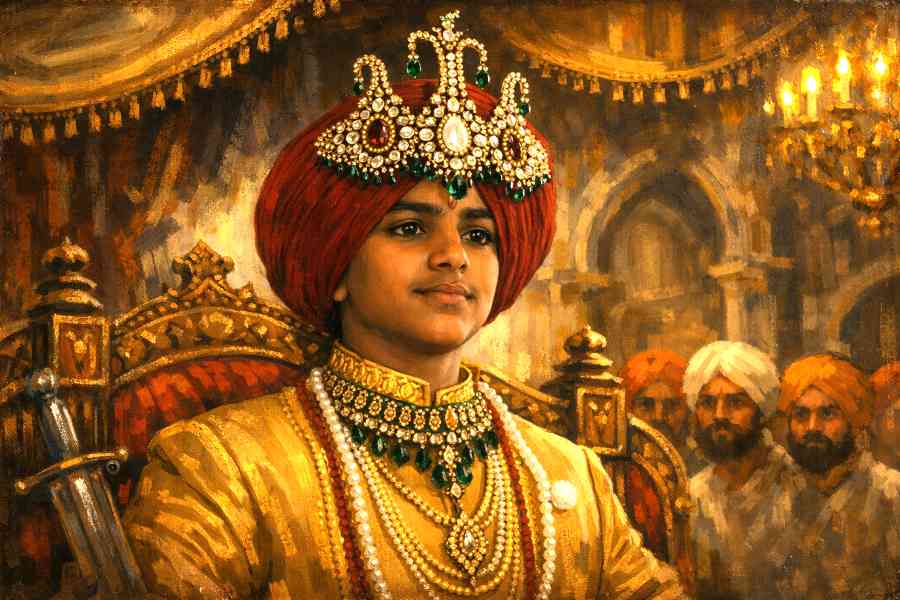
A religious ceremony transformed into royal spectacle with state endorsement
PUNJAB HAS DEVELOPED a peculiar new mode of cultural storytelling. Take a religious ceremony rooted in Sikh dignity. Place it inside a palace. Add royal vocabulary like “Kunwar” and “Maharaja.”
Decorate a child with a kalgi that visually mimics a crown. Invite ministers, Speakers, bureaucrats, and religious figures. Let social media amplify it as a “heritage revival.” Then present the spectacle as if history is being restored rather than hierarchy rebranded.
That is exactly what unfolded at Hira Mahal and Sheesh Mahal in Nabha, where a dastar-bandi ceremony involving Abhyuday Pratap Singh, a minor descendant of the erstwhile Nabha royal family, was turned into a public event framed as the revival of royal tradition.
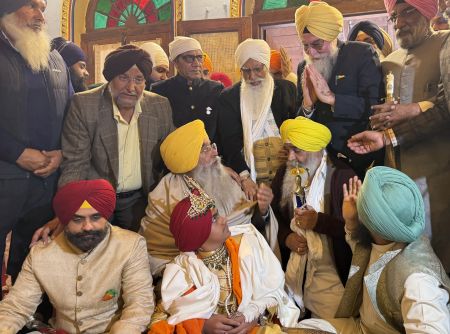
Punjab Assembly Speaker Kultar Singh Sandhwan and Agriculture Minister Gurmeet Singh Khuddian at the Nabha ceremony.
The gathering was attended by Punjab Assembly Speaker Kultar Singh Sandhwan, Agriculture Minister Gurmeet Singh Khuddian, and Tourism and Culture Minister Tarunpreet Singh Sond, alongside religious leaders, administrators, artists, and political figures. A religious ceremony transformed into royal spectacle with state endorsement.
At first glance, some may insist this was simply a religious occasion. But the optics tell a different story. The photographs circulating widely do not convey the humility of a Sikh rite of passage. They convey the staging of a princely court.
The child is seated in a throne like arrangement, dressed in royal costume and heavy jewellery, and crowned with an ornate kalgi that functions visually as a crown substitute.
A turban does not belong to royal families. It does not belong to palaces.
The setting is not a simple gurdwara environment. It is the architecture of monarchy, carefully curated to revive the aura of inherited power.
This was not merely a family celebration. It was a narrative project. It was the repackaging of feudal identity as cultural pride. And in a democratic republic, that should concern anyone who understands what Sikh tradition and constitutional equality actually mean.
A Dastar-bandi Is Not a Coronation
A dastar-bandi in Sikh tradition is not a coronation. It is not a ritual of dynastic succession. It is not a ceremony meant to elevate a bloodline above ordinary citizens. It is a personal and spiritual milestone, a moment when an individual embraces the responsibility, discipline, and identity that the Sikh turban represents. The dastar is not worn for decoration. It is worn as a moral commitment.
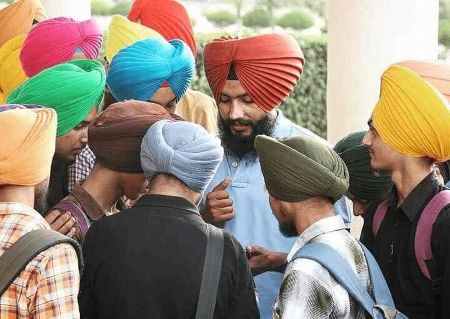
The Sikh turban as a symbol of dignity and equality.
The Sikh turban carries historical weight precisely because it challenged social hierarchy. In many eras of South Asian history, the turban functioned as a marker of rank, tied to privilege, class, and aristocracy. Sikhism took that symbol and radically transformed its meaning.
The Sikh Gurus did not preserve the turban as a sign of elite status. They democratised it. They placed dignity on the head of the common person and declared that honour is not reserved for kings.
That was the revolutionary core of Sikh identity. Every Sikh could wear the turban. Every Sikh could stand tall. Every Sikh could live with sovereignty of conscience.
When a dastar-bandi is staged with palace optics and royal language, it ceases to be a harmless cultural flourish. It becomes a distortion of Sikh philosophy. It attempts to convert a symbol of equality back into a symbol of hierarchy.
The Kalgi and the Manufacture of Royal Optics
The most revealing detail of the Nabha spectacle was not merely the dastaar, but the kalgi placed upon it, designed unmistakably in the visual language of royalty. This was not a subtle accessory. It was oversized, ornate, gem studded, and positioned as the centrepiece of the visual narrative. Combined with royal attire, heavy necklaces, and throne like seating, the message became impossible to ignore.
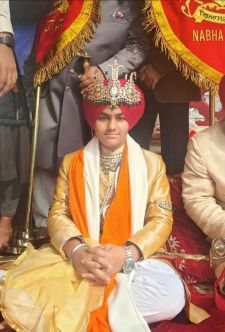
Abhyuday Pratap Singh
This was no longer simply a Sikh rite. It was the construction of a coronation aesthetic.
In Punjab’s cultural memory, the kalgi has historically been associated with princely courts, elite status, and ceremonial authority. When placed on a turban in a palace setting, it does not read as spiritual symbolism.
It reads as inherited prestige. It signals that this is not merely a boy adopting the Sikh turban, but an heir being projected as royalty.
No elected office has the right to sanctify bloodlines.
This is why the defence that it was “just a religious ceremony” collapses under its own optics. A religious ceremony does not require a royal crown substitute. A spiritual milestone does not need the visual grammar of monarchy.
The kalgi transforms the turban into a prop for feudal branding, and that is where the ideological danger begins.
Religion, Royalty, and the Betrayal of Sikh Ethos
A turban does not belong to royal families. It does not belong to palaces. It does not belong to bloodlines. The turban belongs to Sikh ethos, an ethos that historically resisted tyranny, resisted unjust rulers, and rejected the idea that birth determines worth.
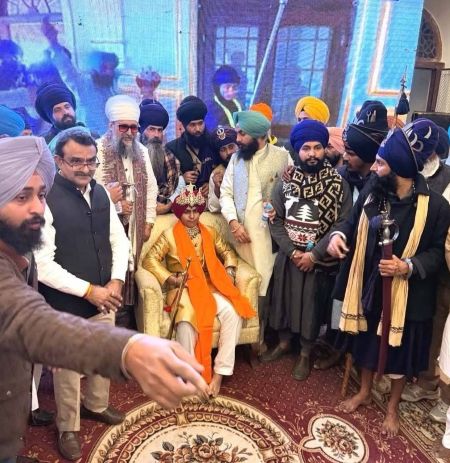
Abhyuday Pratap Singh during the dastaarbandi ceremony in Nabha.
Sikh history is not a celebration of monarchy. It is a record of resistance against power structures that reduced human beings to subjects rather than equals.
Sikh tradition emerged as a challenge to systems where dignity was monopolised by elites. It empowered ordinary individuals to live with courage, responsibility, and moral sovereignty.
That is why the turban is not merely a piece of cloth. It is a declaration that the wearer refuses to live bowed.
The Dastar was given to destroy hierarchy, not to decorate it.
To claim that a dastar is a “royal legacy” is to convert Sikh dignity into aristocratic property. It is like treating the Constitution as a family inheritance document. It is the appropriation of a collective moral symbol into a private dynastic narrative.
The insult here is not only political. It is spiritual. Sikh tradition did not emerge to bless royal lineages. It emerged to dismantle them.
A Democracy Cannot Be Half Feudal
India is a democratic republic. This is not a decorative label. It is the foundational principle of our political existence. The abolition of princely states was not symbolic theatre. It was a decisive historical break from feudal authority.
We did not replace kings with elected representatives so that elected representatives could later behave like courtiers in palaces.
Democracy rests on a simple idea. No citizen is born greater than another.
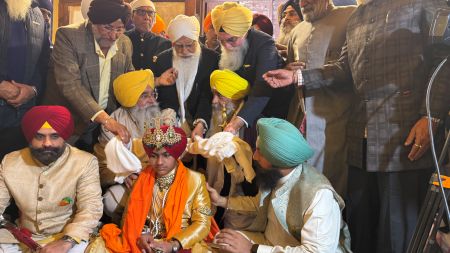
Ministers and attendees present during the Nabha event.
When politicians attend royal themed events and publicly frame them as “heritage revival,” they are not merely congratulating a family. They are legitimising the idea that inherited lineage still carries cultural authority. They are endorsing the belief that ancestry deserves reverence and that bloodline merits public applause.
This is not harmless nostalgia. It is ideological regression. It is the subtle re entry of feudal thinking into democratic public life.
A democracy cannot be half feudal. The moment it applauds dynastic privilege, it begins to betray its own foundation.
When ministers sit in darbar, democracy stands outside.
The presence of ministers and state leaders at such spectacles fundamentally alters their meaning. Families are free to conduct ceremonies as they wish. The problem begins when the state enters the frame and confers legitimacy through attendance and praise.
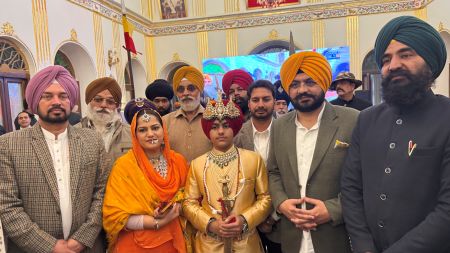
Minister Tarunpreet Sond and MLA Nabha Gurdev Mann at the Nabha ceremony.
Punjab’s political class has increasingly substituted governance with performance. In a state grappling with unemployment, drug addiction, collapsing public education, farmer distress, and mass migration, leaders appear remarkably available for palace optics and royal nostalgia.
The reason is simple. Heritage sells. Royalty sells. Nostalgia sells. A palace offers glamour that a government school does not. A kalgi offers spectacle that a public hospital does not. The performance generates emotional pride without requiring structural progress.
Political power today thrives on theatre. Leaders do not merely govern. They perform. Royal imagery feeds that hunger perfectly.
Hira Mahal, Heritage, and the Shadow of Dispute
The Nabha event carries additional discomfort because Hira Mahal itself has long been associated with controversy over ownership and control.
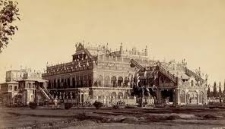
Historic photograph of Hira Mahal in Nabha
Past reports have pointed to disputes involving attempted transfers, sale, and legal proceedings reportedly reaching the Punjab and Haryana High Court. While full legal clarity may not be settled in the public mind, the palace remains surrounded by unresolved questions.
Against this backdrop, the ceremony begins to resemble symbolic succession building rather than a purely religious occasion.
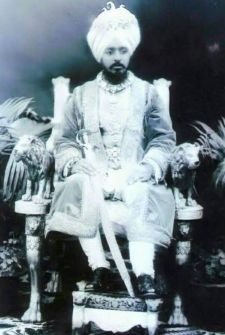
Maharaja Ripudaman Singh
Social media discourse has already alleged that the event was designed to project Abhyuday Pratap Singh as a new Maharaja of Nabha through deliberate royal imagery. Some posts suggest that rival family branches could be marginalised through such public image construction.
Many of these claims remain unverified. But their very existence is revealing. In Punjab, heritage sites frequently become arenas for property disputes, legacy battles, and political influence. When ministers publicly attend and endorse such spectacles, they risk lending legitimacy to private contests over land, control, and dynastic authority.
Even if intentions were innocent, the optics are not.
The Bottom Line
Punjab already lives with a feudal hangover. Caste hierarchies, landholding dominance, and family name politics continue to shape social and political power.
When society repeatedly witnesses certain bloodlines receiving grand ceremonies and ministerial reverence, the idea that inherited status is natural quietly re enters public consciousness.
Feudalism does not return with a proclamation. It returns with applause.
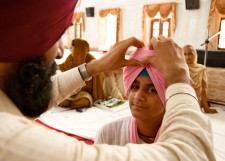
Dastar-bandi is a personal and spiritual Sikh rite.
A dastar-bandi should remain what it is meant to be. A personal spiritual milestone grounded in Sikh values of equality, dignity, and responsibility. When it is staged with royal kalgis, palace settings, throne like seating, and dynastic vocabulary, it becomes something else entirely. A political performance and branding exercise.
When ministers glorify such spectacles as heritage revival, they are not merely witnessing culture. They are endorsing a feudal narrative that democracy was meant to bury.
Democracy dies first in ceremony, not in court.
In a democracy, no one deserves public reverence simply for being born into a lineage. Respect must be earned through service, contribution, and accountability. Not inherited through dynasty.
If Punjab truly wishes to revive heritage, let it revive the heritage of resistance, equality, and dignity. Not the heritage of palaces and princes.
Because the dastar is not a crown of royalty.
It is the crown of equality.
And a democracy should never bow to anything less. 
Editor’s Note
This piece critiques public optics and political symbolism. It does not question personal faith or private religious practice. Main image used is representational in nature.
__________
Also Read:
Gurinder Dhillon, Bikram Majithia and Bhagwant Mann: When Faith, Power and Justice Collide in Punjab
When Hate Came to Kotdwar, ‘Mohammad’ Deepak Stood His Ground

kanwar manjit singh
Kanwar Manjit Singh, Founder Editor of Punjab Today, writes extensively on Punjab’s history, governance, and the evolving landscape of civil liberties in India.
Disclaimer : PunjabTodayNews.com and other platforms of the Punjab Today group strive to include views and opinions from across the entire spectrum, but by no means do we agree with everything we publish. Our efforts and editorial choices consistently underscore our authors’ right to the freedom of speech. However, it should be clear to all readers that individual authors are responsible for the information, ideas or opinions in their articles, and very often, these do not reflect the views of PunjabTodayNews.com or other platforms of the group. Punjab Today does not assume any responsibility or liability for the views of authors whose work appears here.
Punjab Today believes in serious, engaging, narrative journalism at a time when mainstream media houses seem to have given up on long-form writing and news television has blurred or altogether erased the lines between news and slapstick entertainment. We at Punjab Today believe that readers such as yourself appreciate cerebral journalism, and would like you to hold us against the best international industry standards. Brickbats are welcome even more than bouquets, though an occasional pat on the back is always encouraging. Good journalism can be a lifeline in these uncertain times worldwide. You can support us in myriad ways. To begin with, by spreading word about us and forwarding this reportage. Stay engaged.
— Team PT