


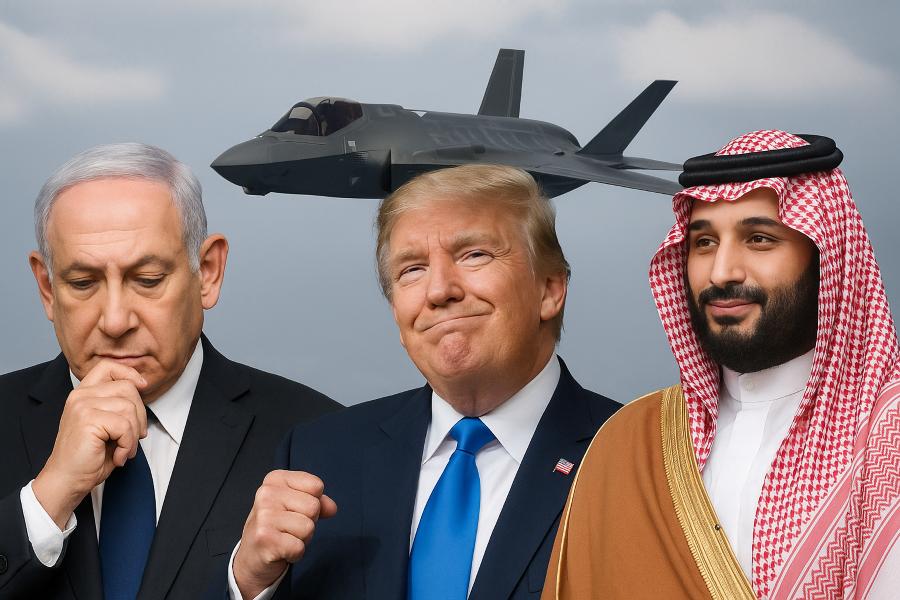
Proposed sale tests US commitments to Israel’s qualitative military edge and raises concerns over technology security.
US PRESIDENT Donald Trump has said he is considering Saudi Arabia’s request to buy F-35 fighter jets, even as intelligence officials warn that China could gain access to the aircraft’s latest American technology. The sale has also raised Israeli concerns, as it would bring Saudi fighters closer to Israel.

F-35 stealth fighter jet — at centre of proposed US sale to Saudi Arabia
Trump said last Friday (November 14) that he is considering a deal to supply Saudi Arabia with F-35 stealth fighter jets manufactured by Lockheed Martin.
The potential sale comes ahead of Saudi Crown Prince Mohammed bin Salman’s meeting with Trump at the White House this week, during which the two sides are expected to sign economic and defence agreements.
When asked about the talks, Trump told reporters that it was “more than a meeting; we’re honouring” Saudi Arabia. He reiterated that he hoped the kingdom would soon join the Abraham Accords, which have normalised relations between Israel and several Muslim-majority Middle Eastern nations.

Donald Trump with Saudi Crown Prince Mohammed bin Salman
Riyadh, however, has resisted such a step in the absence of a roadmap to Palestinian statehood.
The potential sale has raised concerns on two fronts. First, both the Israeli government and opposition warn that it could alter the military balance in the region and undermine Israel’s qualitative military edge (QME). Moreover, Israel believes it may not receive any immediate diplomatic benefit from the deal.
There are also concerns about possible leakage of American technology to China — and even Türkiye. A Pentagon intelligence assessment, cited by the New York Times, warns that China could gain access to the aircraft’s technology if the sale goes ahead.
Israel’s Stance
Israel does not oppose the sale of F-35s to Saudi Arabia outright, but wants it conditioned on the kingdom normalising relations with the Jewish state. Some Israeli officials say it would be “a mistake and counterproductive” for the US to supply the jets without securing diplomatic concessions.
Maintaining Israel’s QME has long been a bipartisan commitment in Washington. Congress formally codified the US obligation to uphold Israel’s QME in 2008.
As part of the Abraham Accords in 2020, Israel agreed to the US supplying F-35s to the United Arab Emirates (UAE), subject to security guarantees. The deal ultimately stalled after the Biden administration sought to restrict how the jets could be used.

Israeli opposition leader Yair Lapid, who criticised possible US–Saudi F-35 deal
Opposition leader Yair Lapid criticised the Israeli government’s “weakness” following reports that Israel did not object to the potential US-Saudi deal. “An F-35 deal was never part of a normalisation agreement, because it was clear that Israel’s security requires maintaining its qualitative military edge,” he said, according to the Times of Israel.
Israel’s security concerns stem partly from geography: an F-35 taking off from a Saudi base on the Red Sea could strike without penetrating Israel’s air-defence arrays. The jets could launch precision-guided bombs and US air-to-surface missiles with ranges exceeding 100 km.
Moreover, the F-35’s advanced radar and autonomous systems turn it into a flying platform for intelligence gathering, early warning, command and control, and interception. This would allow Saudi Arabia to monitor Israeli aircraft, UAVs, and cruise missiles, not only over the Red Sea but also north and northeast of Israel.
 Such capabilities would reduce Israel’s ability to gather intelligence and conduct surprise strikes in regions such as Iran, the Red Sea, and the Indian Ocean.
Nonetheless, the F-35s the US would sell to Saudi Arabia would differ significantly from Israel’s Adir variant. Even if Riyadh receives the latest Block 4 model, it would not include Israeli-developed improvements in avionics, electronics, or weapons systems.
For instance, the Adir reportedly carries unique long-range precision munitions developed by Israeli defence industries. It is also believed to have conformal fuel tanks enabling a 30 % increase in range (depending on payload), allowing Israeli jets to reach targets in Iran without aerial refuelling.
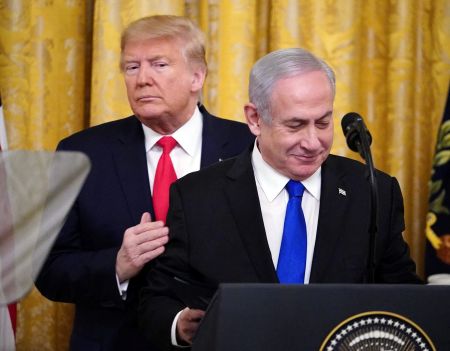
Donald Trump with Israeli Prime Minister Benjamin Netanyahu — file photo
Israel has also integrated customised electronic-warfare suites, intelligence-gathering tools, and encrypted communications with other aircraft and UAVs — some of which are absent even from American export models.
Israel’s greatest advantage, however, lies in its operational familiarity with the aircraft’s radar profile and vulnerabilities, tested extensively during wartime. Israel is the only country that maintains its F-35 fleet comprehensively, even under fire.
And if Saudi Arabia were ever to become hostile, Israel would retain the capability to destroy the aircraft on the ground — assuming it remains vigilant and avoids complacency.
Concerns About China
A US Defence Intelligence Agency (DIA) report warns that the deal could allow China — and possibly Türkiye — to access sensitive F-35 technology, the New York Times reported.
Saudi Arabia is a long-standing defence partner of China, which has assisted the kingdom in building its ballistic missile arsenal.

Saudi Arabia’s expanding defence cooperation with China raising US technology-transfer concerns
The DIA assessment cautions that China could obtain classified F-35 information through its defence ties with Riyadh. Beijing has a history of acquiring US defence and civilian technology through espionage or reverse-engineering.
US officials are also discussing whether to impose additional safeguards on the aircraft’s classified components, according to the report.
Overall, given Trump’s track record, he may choose to ignore these concerns. He appears more focused on securing Saudi investment to bolster the American economy and on restoring US influence in a region where it has recently waned. 
________
Also Read:
Complaint Against Lawyers? Pay ₹6,500 First, Says Bar Council of Punjab & Haryana
Asad Mirza
The author is a New Delhi-based senior commentator on national and international affairs, defence and strategic issues, and environmental concerns. He is also an interfaith practitioner and a media consultant. Previously, he was associated with the BBC Urdu Service and the Khaleej Times in Dubai.
Disclaimer : PunjabTodayNews.com and other platforms of the Punjab Today group strive to include views and opinions from across the entire spectrum, but by no means do we agree with everything we publish. Our efforts and editorial choices consistently underscore our authors’ right to the freedom of speech. However, it should be clear to all readers that individual authors are responsible for the information, ideas or opinions in their articles, and very often, these do not reflect the views of PunjabTodayNews.com or other platforms of the group. Punjab Today does not assume any responsibility or liability for the views of authors whose work appears here.
Punjab Today believes in serious, engaging, narrative journalism at a time when mainstream media houses seem to have given up on long-form writing and news television has blurred or altogether erased the lines between news and slapstick entertainment. We at Punjab Today believe that readers such as yourself appreciate cerebral journalism, and would like you to hold us against the best international industry standards. Brickbats are welcome even more than bouquets, though an occasional pat on the back is always encouraging. Good journalism can be a lifeline in these uncertain times worldwide. You can support us in myriad ways. To begin with, by spreading word about us and forwarding this reportage. Stay engaged.
— Team PT