


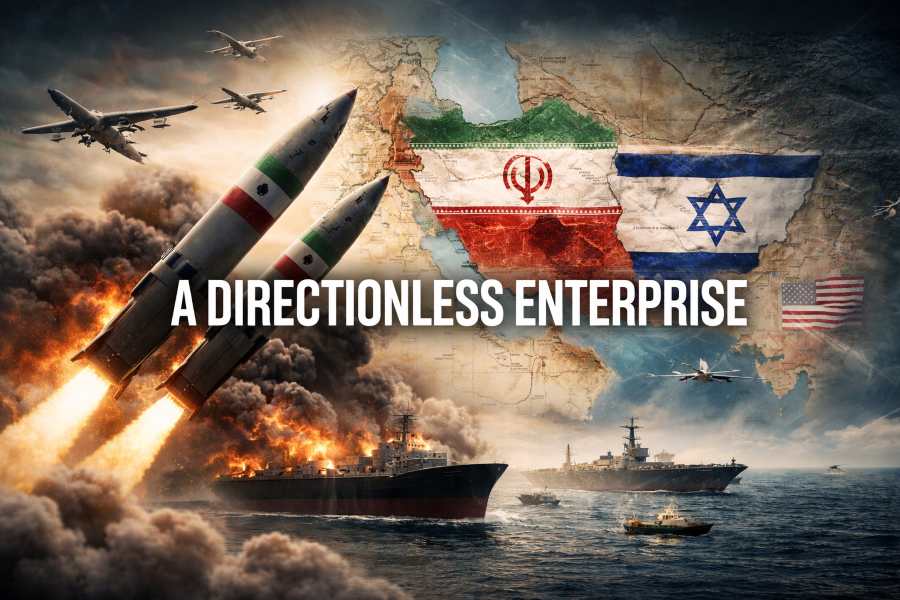
Logistics, energy shocks, military sustainability and the geopolitical limits of modern warfare
Introduction: A War Without Strategic Direction
I have to make some observations about the ongoing US–Israel–Iran war as follows:
1. That the IRGC is more a religio-terror police force than a professional military/paramilitary force is apparent from the meeting of the top four leaders of Iran in a venue used for meetings in normal times.
Military Reality vs Perception
2. An ammunition deficit will plague the US & Israel if this battle lasts more than a week. NATO will not transfer ammo from their strategic reserves, nor will China or Russia. There is speculation on SM that Iran may have only 3000 ballistic missiles ex-stock, not having been able to fully restore its depleted stock after the last conflagration. Yet, there is no remotely accurate reliable figure.
There are reports of China having supplied chemicals and other materials to Iran to replenish its missile stock. Then there are hypersonic missiles and lakhs of drones of dizzying varieties. Put together, Iran may be having 5000–8000 missiles. *Defence Security Asia* (Feb 2, 2026) reports that Iran has 80,000 Shahed drones with daily normal production capacity of 400 (24×7 war-time production may exceed 800/day). In contrast, Lockheed Martin is licensed to manufacture just 2,000 units per annum.
3. The immediate fallout is to exhaust air-defence systems rather than achieve immediate battlefield breakthroughs. Such numerical depth would enable Iran to conduct prolonged saturation campaigns across multiple theatres simultaneously, maintaining operational pressure over days or weeks without depleting higher-value ballistic or cruise missile stockpiles.
The Shahed-136, forming the backbone of this alleged arsenal, is engineered specifically for this role, combining extended range exceeding 2,000 kilometres with a warhead mass of 40–50 kilograms sufficient to disrupt hardened yet economically critical infrastructure. Chances of a hijacked Shahed are rare since it is guided by inertial navigation systems.
4. The estimated unit costs range from USD 20,000 to USD 193,000. In contrast, Patriot PAC-3 MSE interceptors cost about USD 4 million per shot. *The Guardian* (July 8, 2025) reported that the US only had about 25% of the Patriot missile interceptors it needs for all of the Pentagon’s military plans after burning through stockpiles in the Middle East in recent months, an alarming depletion that led to the Trump administration freezing the latest transfer of munitions to Ukraine.
Logistics and Industrial Capacity
5. The same holds true of Raytheon’s cruise missiles. Ukdj.com (Feb 9, 2026) reported that Raytheon has signed five major framework agreements with the U.S. Department of Defense aimed at significantly expanding production capacity for key missile systems, including Tomahawk cruise missiles, AMRAAM air-to-air missiles, and multiple variants of the Standard Missile family.
The agreements, lasting up to seven years, are intended to increase annual production and accelerate deliveries of Tomahawk Land Attack and Maritime Strike variants, AMRAAM missiles, SM-3 Block IB interceptors, SM-3 Block IIA interceptors, and the SM-6 missile.
Raytheon said the agreements will allow it to raise Tomahawk production to “more than 1,000” per year, AMRAAM production to “at least 1,900” annually, and SM-6 production to “more than 500” annually. The company also plans to increase SM-3 Block IIA output and accelerate SM-3 Block IB production. According to the company, “many of these munitions will grow two to four times their existing production rates” as global demand continues to rise.
RTX Chief Executive Chris Calio said the agreements would reshape how government and industry cooperate on weapons production. These agreements will not enable supplies to start before a few months at least. Till then, the US will have to ration supplies to its own forces and Israel. Therefore, the supply chain’s integrity is not as hunky-dory as Mr. Trump would have the world believe.
6. Iran is fighting from its home base unlike the US that is reliant on the Ben Gurion civilian airport and its flotilla in the Red Sea–Gulf of Oman. Direct rail links with China and Russia too are fully operational. The Houthis have already damaged a Palau-registered tanker yesterday while there are reports of a KSA-registered one, a US flotilla combat support oiler in the Gulf of Oman in flames.
Given the severe limits on transferring local provisions by road, sea or air in contested environments, the USN flotilla has no more than what it has onboard, to eat or fight with. Iran, on the other hand, does not need such provisioning. Its homegrown missile industry is capable of producing missiles and drones of all shapes and sizes on an industrial scale, unlike Western ammo plants, as stated above.
7. With all its West Asian bases now gone, with the exception of KSA and Israel, and the Fifth Fleet now homeless, USN ships and aircraft on board are vulnerable to major mechanical/electrical failures since they are on global patrol duty year-round, with little or no major dry dock maintenance. With year-round duties, their crews too would be exhausted and homesick.
There are opinions on SM that attribute 95% of choked toilets on board the USS *Gerald Ford* to deliberate sabotage by its crew — a distinct probability. If Iran were to hit a few more oilers, the flotilla would grind to a standstill and become sitting ducks for Iran.
Beyond a week of 24×7 military action, what would be the physical condition of these equipment is debatable. On the other hand, much of Iran’s inventory is like freshly baked cakes — fresh and ready to go. They also require nominal HR to operate them.
Energy Shock and Global Economic Fallout
8. A week of 24×7 high-intensity military action spread over a wide geography is akin to eternity. Aside from machines, Western allies, divorced from Russian energy sources, are wholly dependent on West Asia; US crude is way more expensive even with volumetric discounts. Light US shale crude also does not fully meet the needs of any country. Winter is still in full force across the West and North and demand for energy is much higher.
Nor is any country possessed of giant storage facilities, unlike the US (714 mn barrels) or China (> one billion barrels). Therefore, the shoe will pinch NATO allies the earliest. Given the uncertainty of the duration and intensity of the war with Iran and provision Israel, the US would be loath to part with any of its strategic reserve to its other allies. Within a week, NATO and other allies (like Japan & Australasia) may pressure Mr. Trump to return to the negotiating table.
9. The oil crunch will also affect the rest of Asia, including India, that has reserves of just about 10–12 days. Now that the Gulf of Hormuz has been declared closed by Iran, waiting loaded ships would have to take the Cape of Good Hope route, if they can at all get away from the war zone — meaning an additional three weeks’ sailing time. Naturally, freight and insurance costs will spiral. As the landed cost increases, it will cause substantial inflation in recipient countries.
Global production will decline and affect the US the most, which has the largest trade deficit in the world, and its allies. Aside from this, stranded passengers, ships, freighter planes, medical stores, manufacturing intermediates and finished produce, and agro-horticultural produce will substantially suffer. Employment too could be affected by lay-offs and economies could go into a tailspin. For how long will Mr. Trump be able to resist these economic pressures?
Political Consequences and Strategic Limits
10. If this war continues for over a week, and appreciable American lives and naval assets are lost, Mr. Trump would find himself in diplomatic quicksand. For one, Iran would be at liberty to renege on the progress made in Geneva and Vienna and lay down stricter conditions. For Mr.
Trump, negotiations may devastate his chances of winning the midterms next November, particularly as his personal rating is already down to 38%, his MAGA base is financially disadvantaged, and sections of the armed forces appear disillusioned. Buoyed by bringing the US back to the negotiating table, Iran will certainly speak the language of a victor. Of course, Iran has very competent diplomatic negotiators, far more than two businessmen on the US side with no idea of geostrategy or diplomacy.
11. Mr. Trump’s Venezuela sortie only proved his willingness to deal with regimes no less vile and corrupt than Mr. Maduro, a far cry from regime change. Forty-seven years of intolerant cleric rule has finished whatever remained of the Iranian opposition. The Shah’s son is no more than an imbecile dreaming of ascending the Peacock Throne again. Then, with whom does Mr. Trump decide he is most comfortable? He has dealings with the corrupt, money launderers, pedophiles, goondas, et al. So what regime change is he talking of?
12. Regime change from the air is a distant dream, never mind digital warfare and the like. With no boots on the ground, how will the US take control of nuclear plants, munition factories, oil and gas fields, mines, etc.? Is he willing to engage in mountain guerrilla warfare with vengeful Iranians and then escape overnight as Biden did from Afghanistan? If the latter were to happen, Democrats can be safely assured of the US Presidency for the next six terms (with new candidates).
13. Last, Iran is not Venezuela. The assassination of the Iranian Head of State in full public view did not happen even with one Herr Heidler eight decades ago; this was no different from the savagery of Barbary pirates. Shias have long believed in shahadat and the obligation to extract revenge. They have sleeper cells across the world and are represented globally in positions of eminence.
Travel for Americans and Israelis has already become more hazardous. Their embassies, consulates, banks, airlines, railways, corporate HQs and branches, offshore entities, intelligence communities and many more may come to grief once these cells are activated. Iran will never be short of discretionary cash so long as its oil and gas reserves remain active.
Above all, the insult to their nationhood by the assassination of their Supreme Leader is something Iranians will neither forget nor forgive, never mind that many suffered and died. 
_____________
Also Read:

Shantanu Basu
The writer is a retired senior civil servant, public policy analyst, author and commentator.
Disclaimer : PunjabTodayNews.com and other platforms of the Punjab Today group strive to include views and opinions from across the entire spectrum, but by no means do we agree with everything we publish. Our efforts and editorial choices consistently underscore our authors’ right to the freedom of speech. However, it should be clear to all readers that individual authors are responsible for the information, ideas or opinions in their articles, and very often, these do not reflect the views of PunjabTodayNews.com or other platforms of the group. Punjab Today does not assume any responsibility or liability for the views of authors whose work appears here.
Punjab Today believes in serious, engaging, narrative journalism at a time when mainstream media houses seem to have given up on long-form writing and news television has blurred or altogether erased the lines between news and slapstick entertainment. We at Punjab Today believe that readers such as yourself appreciate cerebral journalism, and would like you to hold us against the best international industry standards. Brickbats are welcome even more than bouquets, though an occasional pat on the back is always encouraging. Good journalism can be a lifeline in these uncertain times worldwide. You can support us in myriad ways. To begin with, by spreading word about us and forwarding this reportage. Stay engaged.
— Team PT