


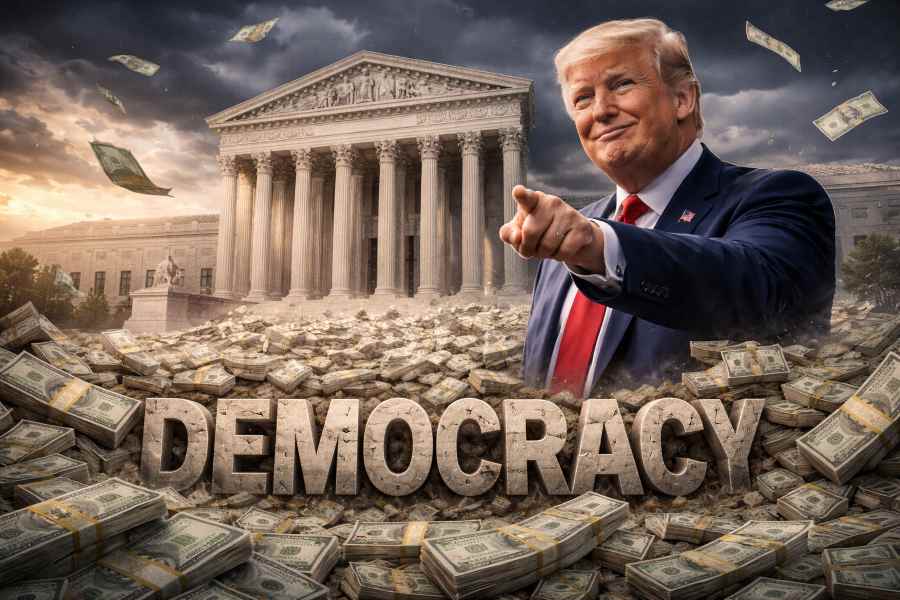
How a Supreme Court ruling rewired democracy by letting big money flood politics.
IF BIG MONEY corrupts democracy, then this is when the disease was really sanctified. And once the leader of the free world shows a path, puny leaders in flawed democracies are bound to follow.
When the robed reactionaries of the U.S. Supreme Court decided Citizens United v. Federal Election Commission, a landmark case holding that corporations and unions have the same First Amendment speech rights as individuals, striking down federal restrictions on independent political spending (including election campaign) from their general treasuries, they effectively allowed unlimited cash flow into American politics. Though direct campaign contributions remained banned, the ruling ushered an era of increased corporate money in politics.
Most pundits, and even common people, think a key reason we have a corrupted and highly flawed democracy is the unrestricted money injection in our elections. India’s election expenditure is widely believed to have surpassed Rs 1,00,000 crores for Lok Sabha polls, compared to approximately $16 billion (around ₹1,36,000 crores) spent in U.S. presidential and Congressional elections in November 2024.

The Constituent Assembly debates (1946-1950) have no reference to the issue of election funding and the first significant laws on the subject were the Representation of the People Act, 1950, and the Representation of the People Act, 1951, that did not impose limits on expenditure for political party leaders while making it obligatory for candidates to maintain accounts of their election expenditures.
Political parties in India are not even required to maintain such accounts for promoting official programs, though they must disclose contributions of over Rs 20,000 to income tax authorities and cannot accept donations from government companies or foreign sources.

In the United States, the January 21, 2010 judgement of SCOTUS ruled that the government cannot suppress political speech based on the speaker’s corporate identity, affirming that corporations have First Amendment rights.
It struck down restrictions in the Bipartisan Campaign Reform Act (BCRA) that banned corporations and unions from using general treasury funds for “electioneering communications” or ads that expressly advocate for or against a candidate close to an election.
The fateful ruling overturned previous decisions, like Austin v. Michigan State Chamber of Commerce, that had allowed such bans. However, the ban on direct contributions from corporate or union treasuries to candidates and political parties remained intact.
Its impact was along expected lines. The face of elections changed and it became an even bigger game of money. Corporations and Unions could now spend potentially unlimited amounts of money in politics, significantly altering campaign finance by enabling large-scale political advertising.

Dark money has become a defining force in modern electoral politics.
It led to the creation of Super PACs and significantly increased “dark money” in politics, allowing corporations and unions to spend freely to influence elections.
In India, the election expenditure limit for candidates is Rs 95 lakh per Lok Sabha constituency in larger States and Rs 75 lakh in smaller States, while it is Rs 40 lakh and Rs 28 lakh for Assembly seat poll in larger and smaller States, respectively.
But just like the United States, there are no limits on the expenditure of political parties during elections. This Political Party Spending remains the “Elephant in the Room” and the system directly favours wealthy candidates and wealthy parties.
Apart from this, there is an unholy nexus between the elected representatives and donors in democracies across the world, and the system also helps keep out anyone without deep pockets, thus keeping intact an entry barrier into electoral politics for many well-meaning citizens.
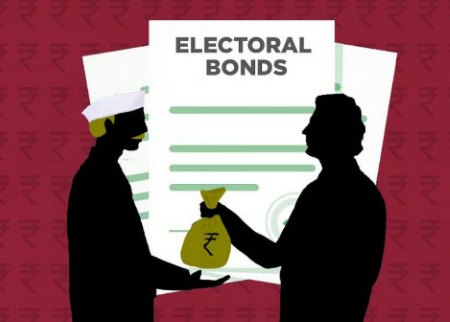
India’s now-scrapped Electoral Bonds scheme institutionalised anonymous funding.
In India, the Indrajit Gupta Committee (1998) and the Law Commission report (1999) proposed state funding of elections, suggested that the government should partially cover the election expenses of candidates nominated by recognized political parties, but no headway has been made.
The Indian Supreme Court judgment on the shameful Electoral Bonds notwithstanding, regulating big money induction into politics is on no one’s agenda.
But still, it is worthwhile to recall the shameful precedent set by the Supreme Court of the United States, otherwise forever weakening the First Amendment but in this case, weaponising the First Amendment in favour of billionaires against the common man in politics. 
__________
Also Read:
Freedom of Speech in India: Why Criticism of the Government Is Not Sedition

Punjab Today Legal Bureau
Disclaimer : PunjabTodayNews.com and other platforms of the Punjab Today group strive to include views and opinions from across the entire spectrum, but by no means do we agree with everything we publish. Our efforts and editorial choices consistently underscore our authors’ right to the freedom of speech. However, it should be clear to all readers that individual authors are responsible for the information, ideas or opinions in their articles, and very often, these do not reflect the views of PunjabTodayNews.com or other platforms of the group. Punjab Today does not assume any responsibility or liability for the views of authors whose work appears here.
Punjab Today believes in serious, engaging, narrative journalism at a time when mainstream media houses seem to have given up on long-form writing and news television has blurred or altogether erased the lines between news and slapstick entertainment. We at Punjab Today believe that readers such as yourself appreciate cerebral journalism, and would like you to hold us against the best international industry standards. Brickbats are welcome even more than bouquets, though an occasional pat on the back is always encouraging. Good journalism can be a lifeline in these uncertain times worldwide. You can support us in myriad ways. To begin with, by spreading word about us and forwarding this reportage. Stay engaged.
— Team PT