


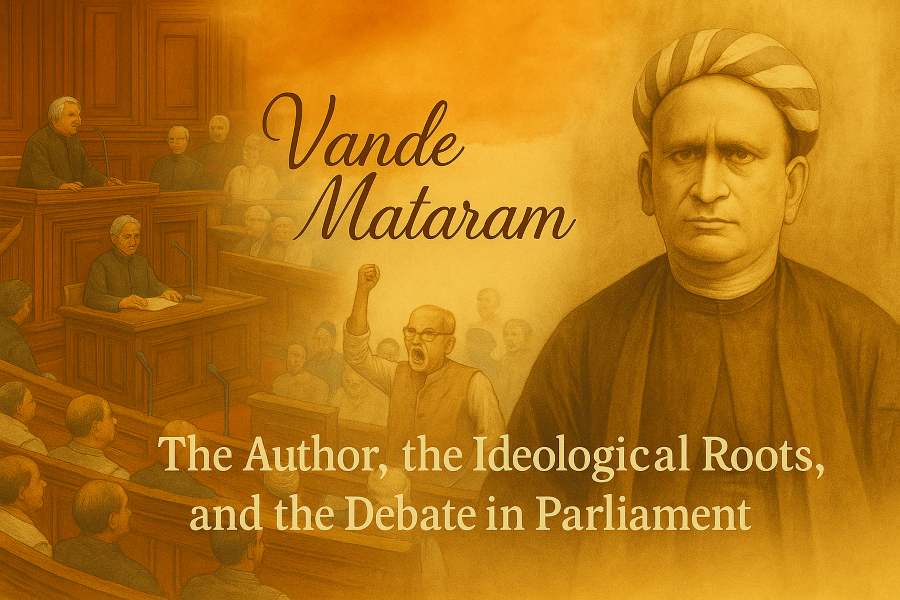
Vande Mataram and the Current Parliamentary Debate
The slogan “Vande Mataram” has once again become the subject of heated debate in Parliament, with sharp reactions both inside and outside the House.

In recent sittings, its invocation has raised fundamental questions—not merely about patriotism, but about history, inclusiveness, and the ideological origins of national symbols.
When a literary work or slogan is repeatedly asserted in Parliament as a test of nationalism, it becomes necessary to examine its historical and ideological foundations, rather than treating it as beyond scrutiny.

Kapil Sibal speaking in the Rajya Sabha during the Vande Mataram debate
In this context, my good friend Kapil Sibal, MP, former Union Minister, and Senior Advocate of the Supreme Court of India, has also recently delivered a speech in the Rajya Sabha (the Upper House of the Indian Parliament) touching upon this issue.
I am therefore setting out my response by examining the text and ideology behind Vande Mataram, particularly its source, the novel Anand Math, so that the present controversy is understood in its correct historical perspective.
Anand Math and the Ideological Roots of Vande Mataram
The novel Anand Math (in which the poem Vande Mataram occurs) was written by the Bengali writer Bankim Chandra Chattopadhyay.

Bankim Chandra
Bankim Chandra is acclaimed as a great Bengali novelist. The fact, however, is that a great writer can also become communal. Literary brilliance does not automatically ensure ideological consistency or moral clarity.
The Urdu poet Iqbal, for instance, was secular and nationalist in his early years—when he wrote “Saare jahaan se achcha Hindustan hamaara”—but later became highly communal, advocating pan-Islamic ideas (as in his poem “Shikwa”) and supporting Jinnah’s two-nation theory.
Similarly, a writer who at one stage opposed oppression may later begin to advocate turning the other cheek—that is, not resisting injustice—as happened with the Russian writer Dostoevsky.
Also Read: ECHOES OF THE PAST
Bankim Chandra, like Iqbal, had great literary talent. But unlike Sharad Chandra or Premchand, he was highly communal, and disliked Muslims, often calling them “yavanas.”

A cover illustration of Anand Math, the novel in which Vande Mataram first appeared.
Here is a dialogue in his well-known novel Anand Math. This dialogue, in the last chapter, describes a divine force persuading the leader of the Sanyasis, Satyananda, to stop fighting the British.
The dialogue is as follows (“He” implies the divine force and “S” implies Satyananda):
He: Your task is accomplished. The Muslim power is destroyed. There is nothing else for you to do. No good can come of needless slaughter.
S: The Muslim power has indeed been destroyed, but the dominion of the Hindu has not yet been established. The British still hold Calcutta.
He: Hindu dominion will not be established now. If you remain at your work, men will be killed to no purpose. Therefore come.
S: (greatly pained) My lord, if Hindu dominion is not going to be established, who will rule? Will the Muslim kings return?
He: No. The English will rule.
Satyananda protests, but is persuaded to lay down the sword.
He: Your vow is fulfilled. You have brought fortune to your Mother. You have set up a British government. Give up your fighting. Let the people take to their ploughs. Let the earth be rich with harvest and the people rich with wealth.
S: (weeping hot tears) I will make my Mother rich with harvest in the blood of her foes.
He: Who is the foe? There are no foes now. The English are friends as well as rulers. And no one can defeat them in battle.
Vande Mataram, British Rule, and the Question of Nationalism

Bankim Chandra in his early age
While earlier Bankim Chandra had written that the Bengali intellect shone under the rule of Pathans (Afghans), he later took a somersault and started criticising Muslims, thus furthering the British policy of divide and rule.
In the fifth edition of Anand Math, Bankim says:
“The British have been forced to rule in India in order that Hinduism might regain its pristine power. I tell you what the wise know. True religion is not to be found in the worship of 33 crores of gods.
True Hinduism consists in knowledge, and they (the British) are good teachers. Therefore we must accept the English rule. The English power will remain unbroken. Under the English our people will be happy: and there will be no impediment to our teaching our faith. So, wise one, stop fighting against the English and follow me.”
Is this not rank chamchagiri (sycophancy) of the British?
This was the brand of Hindu “nationalism” propagated by Bankim Chandra. According to him, the English were the saviours of Hinduism.

When Vande Mataram is invoked in Parliament without reference to this background, it creates an incomplete—and misleading—picture.
The novel does not preach resistance to colonial oppression; rather, it preaches surrender and collaboration with British rule, coupled with hostility towards Muslims. These aspects cannot be wished away merely by emotional appeals or repeated slogan-chanting.
Also Read: Urdu, Hindustani, and Language Politics in UP
A mature democracy must be willing to examine its symbols honestly, especially when they are deployed in the country’s highest legislative forum. 
_________
Also Read:
Chief Minister or Road Inspector? Crisis Worsens in Punjab Governance

Markandey Katju
Justice Markandey Katju is former Judge, Supreme Court of India and former Chairman, Press Council of India.
Disclaimer : PunjabTodayNews.com and other platforms of the Punjab Today group strive to include views and opinions from across the entire spectrum, but by no means do we agree with everything we publish. Our efforts and editorial choices consistently underscore our authors’ right to the freedom of speech. However, it should be clear to all readers that individual authors are responsible for the information, ideas or opinions in their articles, and very often, these do not reflect the views of PunjabTodayNews.com or other platforms of the group. Punjab Today does not assume any responsibility or liability for the views of authors whose work appears here.
Punjab Today believes in serious, engaging, narrative journalism at a time when mainstream media houses seem to have given up on long-form writing and news television has blurred or altogether erased the lines between news and slapstick entertainment. We at Punjab Today believe that readers such as yourself appreciate cerebral journalism, and would like you to hold us against the best international industry standards. Brickbats are welcome even more than bouquets, though an occasional pat on the back is always encouraging. Good journalism can be a lifeline in these uncertain times worldwide. You can support us in myriad ways. To begin with, by spreading word about us and forwarding this reportage. Stay engaged.
— Team PT