


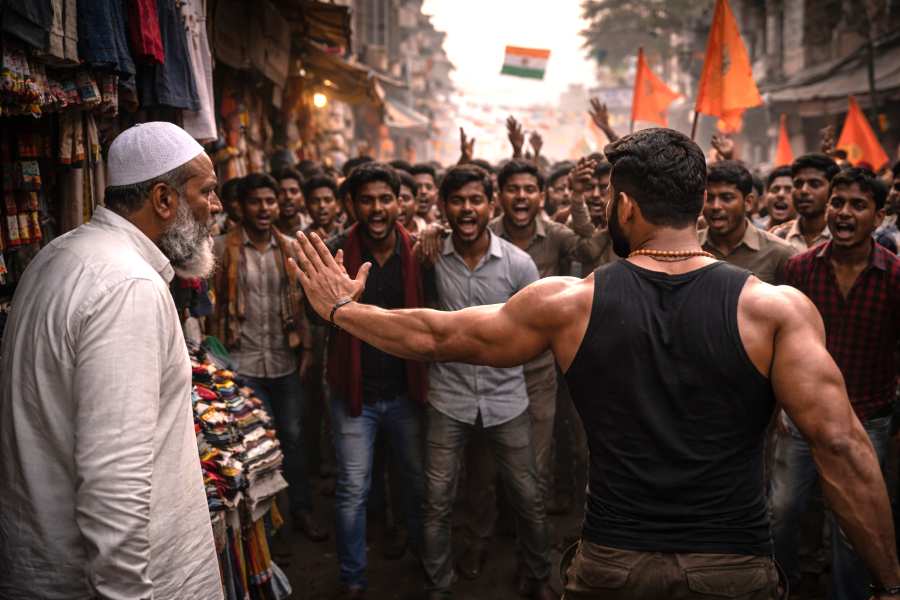
An inspiring incident in which a Muslim shopkeeper was targeted for using the word ‘Baba’, and how a Hindu stood up to communal intimidation.
On January 26, when the country was celebrating Republic Day with a display of cultural diversity and military might in the national capital, a shameful incident was unfolding in Kotdwar, a small town in Uttarakhand. It reflected the growing communalism and the further poisoning of society.
If you are a television news viewer, there is little chance that you would have come to know what happened in Kotdwar that day. If you are a newspaper reader, you might have noticed a report about the incident tucked away on an inside page. But if you follow social media, you would certainly know about it, with crores of responses to the incident.
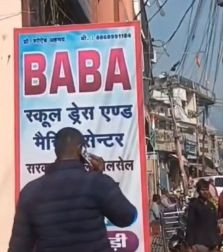
That day, a group of young men, claiming to be from the Bajrang Dal, descended on a garment shop and accosted its owner—a septuagenarian Muslim—demanding that he change the name of his shop. The shop was called *Baba School Dress and Matching Centre*. They had no objection to the English words in the name.
Their grievance was with the use of the word “baba”. They claimed that “baba” was associated with Bhagwan Shankar and that a Muslim shop owner could not use it, even though the name of the Muslim proprietor was also mentioned on the same signboard. They rejected the shopkeeper’s argument that the word “baba” is also associated with fakirs and pirs.
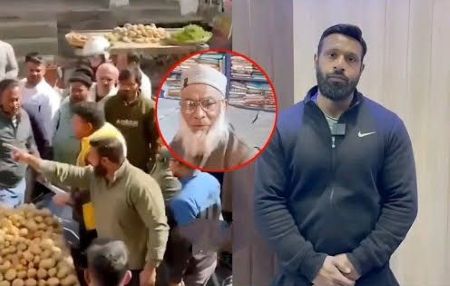
Video still from the Kotdwar incident showing the shopkeeper at the centre of the confrontation and ‘Mohammad’ Deepak
At that moment, a young man stepped forward and questioned the Bajrang Dal workers. When asked his name, he immediately said that his name was “Mohammad” Deepak, evidently to show solidarity with his Muslim brethren. He was a gym owner and bodybuilder whose nearby gym displayed a large poster of Bajrang Bali to bless and motivate his customers.
He stood like a wall between the group and the shopkeeper and asked them to leave. His argument with the group was video-recorded by someone and soon went viral on social media. With little choice left, the group retreated.
However, the Bajrang Dal workers sought reinforcements from Dehradun, from where a mob of 100 to 150 supporters entered Kotdwar, raising slogans against the Muslim shopkeeper and threatening Deepak.
They hurled derogatory slurs at him, commonly used against Muslims, and dared him to stop them. By then, a sizeable police presence had reached the spot, and the protesters were dispersed despite grave provocation.
The widespread condemnation of the incident on social media and the support for Deepak reflect growing resentment over the protection and encouragement extended to so-called protectors of Hinduism.
Ironically, even as millions celebrated the courage displayed by Deepak and condemned the actions of the Bajrang Dal workers, the police went on to file an FIR—against Deepak. He was charged with endangering public order and creating a nuisance.
To be fair, the local police also registered an FIR against a group of protesters, but it was filed against “unknown persons”, despite the fact that at least five leaders of the group were clearly identified, with their photographs widely circulating on social media platforms.
This is the same Uttarakhand police that had earlier done its best to provide cover to a VIP who allegedly sought sexual favours from Ankita, a hotel receptionist who was later murdered in cold blood in Rishikesh.
And this is the same state where, recently, a boy from Tripura was bludgeoned to death by a group of youths simply because he had “Chinese features”.
There have been several reports of tensions and conflicts between different communities in the state. Incidents of violence and economic boycotts have also been reported, particularly affecting Muslims.
Uttarakhand, incidentally, is the first state in the country to enact a Uniform Civil Code (UCC), and its Chief Minister, Pushkar Singh Dhami, makes little effort to conceal his biases. In fact, after Gujarat, Uttarakhand has increasingly become a laboratory of Hindutva.
Unfortunately, this virus of communalism and discrimination based on caste and religion shows no signs of abating. On the contrary, it appears to be worsening. Take the case of Assam Chief Minister Himanta Biswa Sarma. His tirades against minorities in the state are well known.
While concerns over illegal immigration from Bangladesh may be justified, his recent advice urging people to boycott Muslim workers is appalling. He reportedly asked people to pay only ₹4 if a Muslim rickshaw puller demands ₹5 for a ride.
Predictably, videos have surfaced on social media showing college students doing exactly that—denying a rupee to poor rickshaw pullers.
One can only hope that good sense prevails among our political leaders. 
Note: The main image is an AI-generated, representational image.
__________
Also Read:
Gurinder Dhillon, Bikram Majithia and Bhagwant Mann: When Faith, Power and Justice Collide in Punjab
Why TV News in India Is Losing Viewers, Credibility and Trust

Vipin Pubby
The author, a freelance journalist, is a former Resident Editor of Indian Express, Chandigarh, and reported on the political developments in Jammu and Kashmir, North-Eastern India, Gujarat, Himachal Pradesh, Haryana and Punjab in his long, illustrious career.
Disclaimer : PunjabTodayNews.com and other platforms of the Punjab Today group strive to include views and opinions from across the entire spectrum, but by no means do we agree with everything we publish. Our efforts and editorial choices consistently underscore our authors’ right to the freedom of speech. However, it should be clear to all readers that individual authors are responsible for the information, ideas or opinions in their articles, and very often, these do not reflect the views of PunjabTodayNews.com or other platforms of the group. Punjab Today does not assume any responsibility or liability for the views of authors whose work appears here.
Punjab Today believes in serious, engaging, narrative journalism at a time when mainstream media houses seem to have given up on long-form writing and news television has blurred or altogether erased the lines between news and slapstick entertainment. We at Punjab Today believe that readers such as yourself appreciate cerebral journalism, and would like you to hold us against the best international industry standards. Brickbats are welcome even more than bouquets, though an occasional pat on the back is always encouraging. Good journalism can be a lifeline in these uncertain times worldwide. You can support us in myriad ways. To begin with, by spreading word about us and forwarding this reportage. Stay engaged.
— Team PT