


Annual Fatehgarh Sahib congregation managed by district administration for decades is suddenly projected as a Chief Minister-led governance exercise
FOR THE FIRST time, a Punjab Chief Minister has held an exclusive press conference to announce arrangements for the Shaheedi Sabha at Fatehgarh Sahib—an annual religious congregation whose logistics have traditionally been handled by the district administration in coordination with various state government departments and neighbouring districts.
The move has raised a fundamental question: why did the Punjab Government feel the need this year for the Chief Minister himself to formally “brief” the public on what is essentially a routine administrative exercise?
An annual congregation, decentralised by design
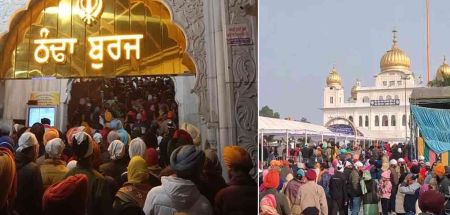
Devotees arrive at Fatehgarh Sahib to commemorate the martyrdom of the younger Sahibzadas and Mata Gujri Ji. (File photo)
Shaheedi Sabha, commemorating the martyrdom of the younger Sahibzadas and Mata Gujri Ji, draws lakhs of devotees every year.
Health facilities, traffic regulation, parking, sanitation, transport and security arrangements have long been executed through district-level coordination, supported by police, health, transport, municipal bodies and adjoining districts.
Yet on Tuesday, Chief Minister Bhagwant Singh Mann personally detailed these arrangements from Chandigarh—speaking of medical camps, shuttle buses, Google-assisted traffic management, CCTV surveillance, drones, police deployment, mobile towers, ambulances and cleanliness drives.
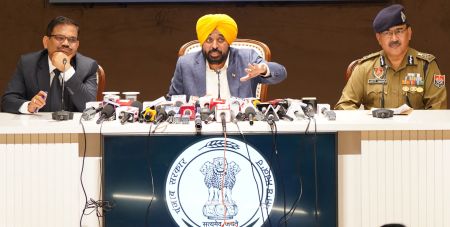
Punjab CM Bhagwant Mann with Chief Secretary and Special DGP during briefing on Shaheedi Sabha arrangements
Officials estimate that around 50 lakh devotees are expected, with more than 3,200 police personnel, 200 shuttle buses, 100 e-rickshaws, multiple parking zones and an Integrated Control Centre being put in place.
What stands out is not the scale of preparations—but the centralisation of messaging and credit, traditionally the domain of local administration.
From ‘surprise inspections’ to spotlight governance
The press conference also fits into a larger pattern. In recent weeks, the Chief Minister has been seen conducting “surprise” road inspections, projecting hands-on governance—despite road maintenance being a routine responsibility of line departments and district officials.
Also Read: Chief Minister or Road Inspector? Crisis Worsens in Punjab Governance
Critics argue that this shift—from institutional processes to personality-driven visibility—suggests an attempt to replace administrative accountability with optics. When routine governance is repeatedly elevated into headline events, it invites scrutiny over whether systems are functioning as intended.
Faith, politics and messaging blur
While briefing on Shaheedi Sabha arrangements, the Chief Minister also reiterated the government’s recent “Holy Cities” notification for Amritsar (walled city), Talwandi Sabo and Anandpur Sahib, and ventured into political commentary on Delhi pollution and BJP-led renaming exercises.
Also Read: DIVINITY VS. DRAMA
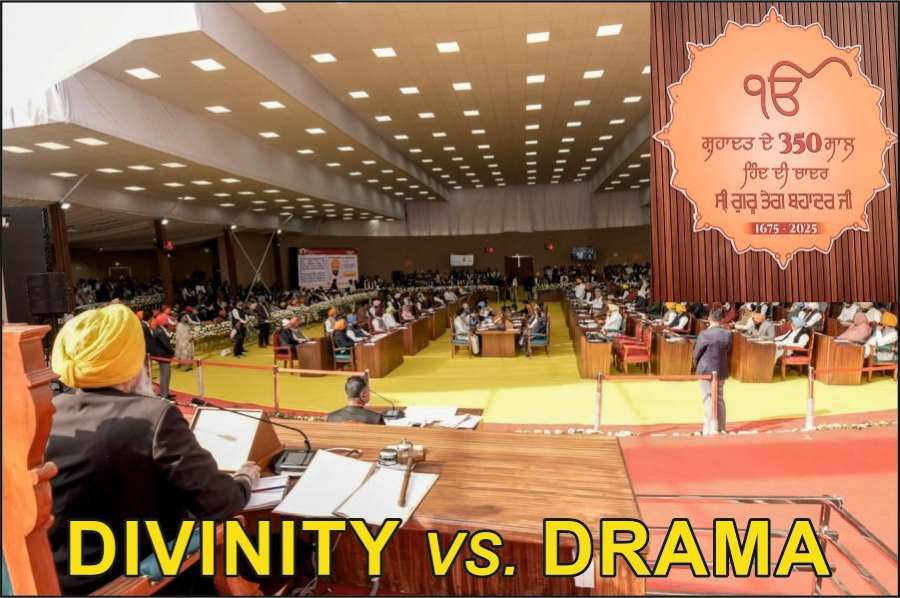
A view from a special session of the Punjab Assembly amid debates on governance, symbolism and religious messaging.
The blending of religious sentiment, administrative logistics and political messaging in a single forum further blurred the purpose of the briefing.
No one disputes the need for efficient arrangements for devotees. The question is whether a Chief Minister–level press conference was necessary for an annual event managed smoothly for decades through district coordination.
As devotees converge on Fatehgarh Sahib, outcomes on the ground—not press briefings—will be the real measure. The rest, many feel, is symbolism packaged as governance. 
_________
Also Read:
Hollowness of Punjab ‘Holy City’ Gazette Notification: Leaves More Questions Than Answers
Sekhonwal Gram Sabha Orders Return of Panchayat Land Taken for Mattewara Project

Ekjot Singh
Special Correspondent covering governance, public policy, and development for Punjab Today.
Disclaimer : PunjabTodayNews.com and other platforms of the Punjab Today group strive to include views and opinions from across the entire spectrum, but by no means do we agree with everything we publish. Our efforts and editorial choices consistently underscore our authors’ right to the freedom of speech. However, it should be clear to all readers that individual authors are responsible for the information, ideas or opinions in their articles, and very often, these do not reflect the views of PunjabTodayNews.com or other platforms of the group. Punjab Today does not assume any responsibility or liability for the views of authors whose work appears here.
Punjab Today believes in serious, engaging, narrative journalism at a time when mainstream media houses seem to have given up on long-form writing and news television has blurred or altogether erased the lines between news and slapstick entertainment. We at Punjab Today believe that readers such as yourself appreciate cerebral journalism, and would like you to hold us against the best international industry standards. Brickbats are welcome even more than bouquets, though an occasional pat on the back is always encouraging. Good journalism can be a lifeline in these uncertain times worldwide. You can support us in myriad ways. To begin with, by spreading word about us and forwarding this reportage. Stay engaged.
— Team PT